



Diverse American Stories, Told by Those Who Lived Them
Despite some points of friction, NewsBank’s Life in America Collection is an impressive digital archive documenting lived experience, cultural identity, and social change.
Despite some points of friction, NewsBank’s Life in America Collection is an impressive digital archive documenting lived experience, cultural identity, and social change.

NewsBank’s Life in America Collection is a suite of fully searchable digital archives exploring the American experience through diverse cultural and historical lenses. It includes six thematic subsets—Black Life in America, Hispanic Life in America, Indigenous Life in America, Asian Life in America, Immigrant Life in America, and LGBTQ+ Life in America—each built around thousands of news sources documenting lived experience, cultural identity, and social change.
The collection supports research and teaching across the humanities and social sciences, particularly in diversity, equity, and inclusion- (DEI-) centered curricula. The platform’s effective search and guided discovery tools offer a stable user experience, though visual content presents some accessibility limitations. Licensing terms are standard, though they restrict text and data mining and provide limited pricing transparency. Where Life in America really shines is its content: a broad array of resources that provide in-depth coverage of underrepresented communities in the United States, including an impressive selection sourced from those communities themselves.
Life in America centers on US history but incorporates international coverage where relevant. Its design directly supports DEI goals by highlighting materials from within the communities represented, such as Black-owned newspapers or Spanish-language publications. Intended primarily for academic libraries, Life in America supports coursework and research in history, sociology, ethnic and cultural studies, political science, and journalism.
Each individual collection within the Life in America suite is divided into three series. The first two are archival databases, while the third covers contemporary history. For example, Asian Life: Series 1, covers 1704 to 1941 (“Early 18th century to US entry in WWII”); Series 2 covers 1942 to 2017 (“WWII to the 21st century”); and Series 3 covers 2018 to the present (“Asian Americans in the twenty-first century”).
The archival series are available to purchase as standalone collections from Readex, NewsBank’s archival database provider, and include perpetual access to millions of documents. Series 1 primarily contains historical newspapers; Series 2 and 3 include newspapers alongside videos, blogs, newsletters, journals, magazines, transcripts from news programs, and other sources. The collections are sprawling: for example, Asian Life provides access to over 35 million primary source documents in 41 languages (Asian Life in America, n.d.).
Series 3 interfaces serve, essentially, as specialized discovery layers, pulling relevant content from NewsBank’s massive Access World News Research Collection, where content is updated daily. Series 3 content is only available to Access World News subscribers, who have the option to purchase Series 1 and/or 2 content, increasing the depth of the archive.
Life in America’s “Suggested Searches” are a distinctive (and prominently marketed) feature. While technically these operate as pre-constructed Boolean queries, they are more than canned searches. Curated by editors rather than being generated automatically, the Suggested Searches embed historically appropriate terminology, variant descriptors, and date parameters aligned with major events and social movements. This design mitigates a persistent challenge in historical newspaper research: the problem of language that shifts across time, including outdated, community-specific, or now-obsolete terms that novice researchers may not anticipate. In this way, the feature functions as both research scaffold and instructional model, demonstrating effective search construction while lowering the barrier to entry for undergraduates.
The collections are hosted on the NewsBank platform (discussed in a 2021 Charleston Adviser review of the Access to World News Research Collection) and require no special software beyond a web browser.
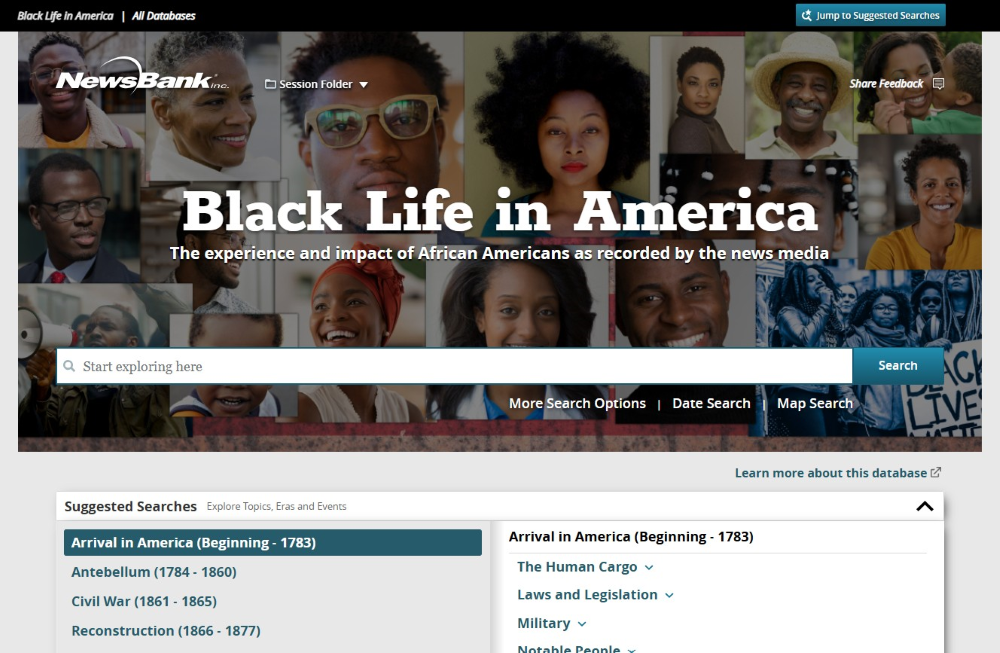
The landing page for each collection features a prominent search box, underneath which are links to “more search options” “date search,” which allows users to limit by date or date range, and “map search,” which pulls up a map the user can click to see resources from a particular region (Figure 1). Below that are the Suggested Searches.
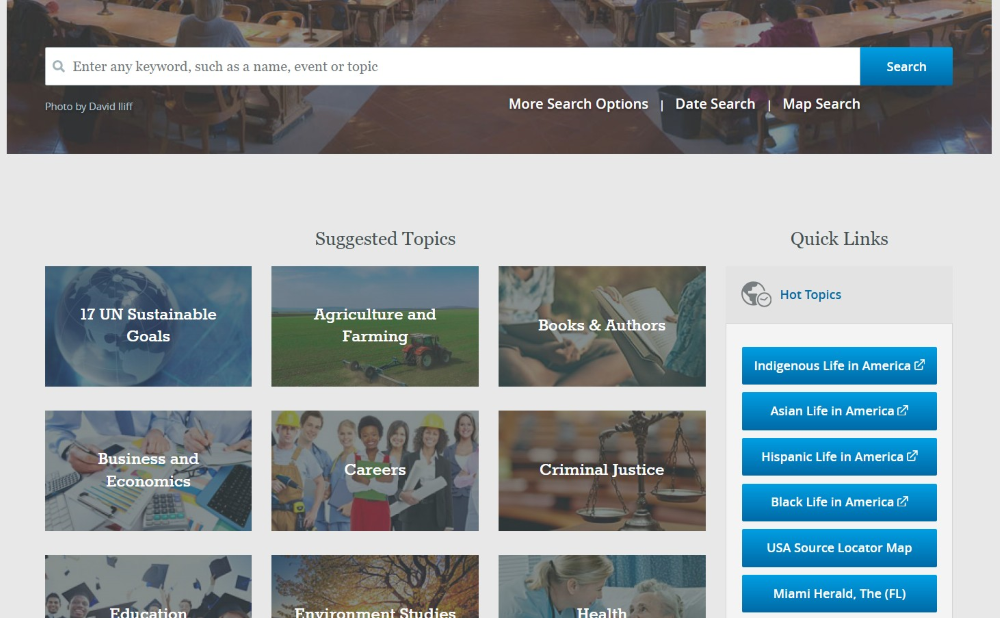
The NewsBank platform that hosts Life in America was assessed in a 2021 Charleston Advisor review of Access World News (Ismail, 2021). When current NewsBank subscribers add any of the Life in America collections, a link to the collection is added to the right side of the NewsBank homepage (Figure 2).
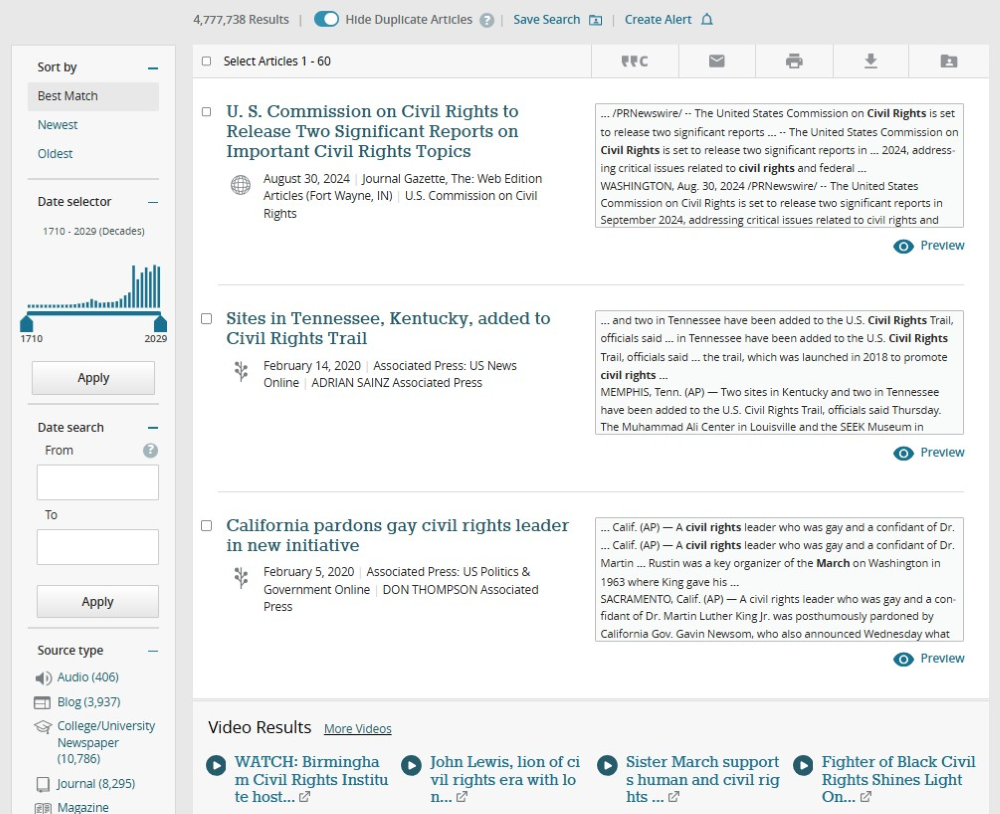
I searched for “civil rights march” in series 1, 2, and 3 of the Black Life in America collection. In the search results, each article appeared with metadata including headline, source publication, date, page number when applicable, and a snippet of the article with keywords highlighted. On the left, a panel of useful limiters included “sort by” (best match, newest, oldest), date, source type, etc.
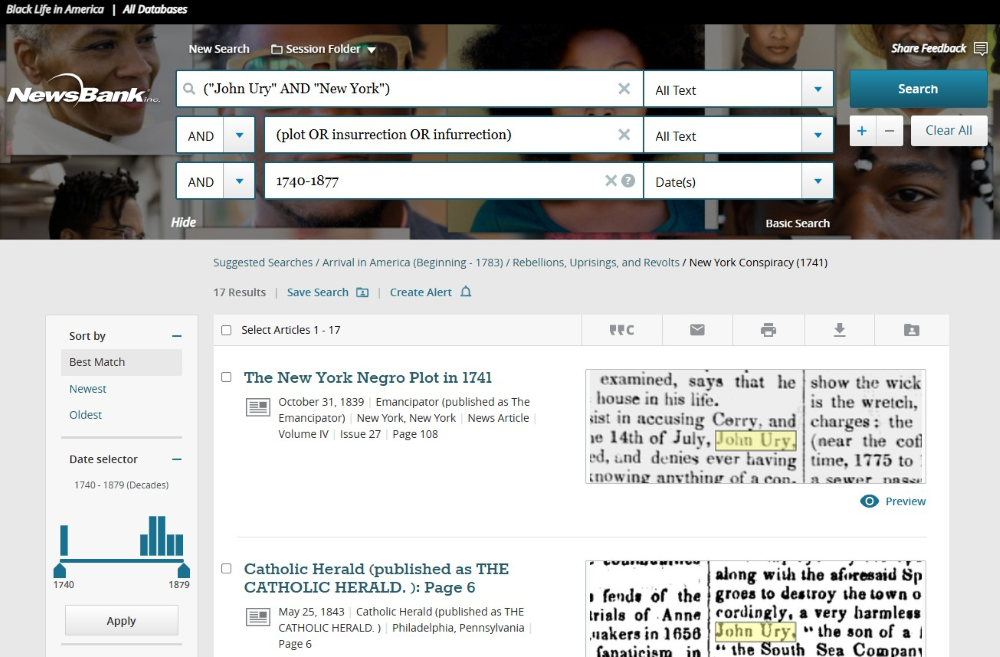
The default search in NewsBank is set to “newest,” but I often found myself often switching to “best match” for the most relevant results (Figure 3). Clicking on “Advanced Search” opened a second search box set to search by date, with additional filters available (e.g., author, source, headline, caption, word count). To create a very precise query, I could click on “+” to add additional search boxes.
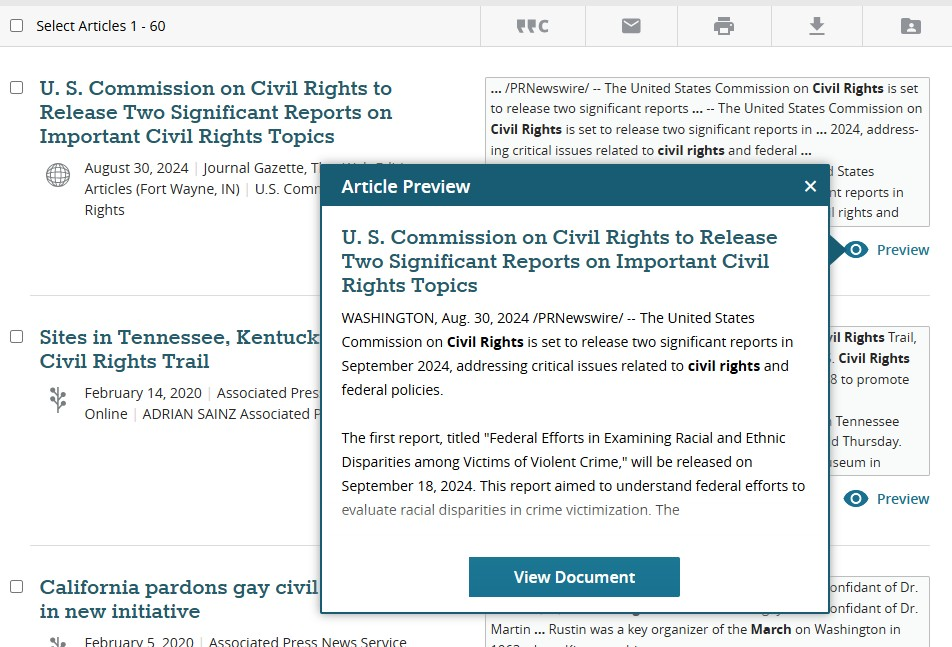
I clicked on the first search result; an html text version of an article from the Journal Gazette opened in the same window with my keywords highlighted. Articles from a full-image source open in the same window within an embedded viewer. Users can also preview an article from the result list, opening a small pop-up window with the first few paragraphs displayed (Figure 4).
For full-image articles displayed in the embedded viewer, I could zoom in/out and scroll page by page. Both the html text and full-image options allow users to adjust text size, cite, email, print, download, save, or copy the permalink. A “Back-to Results” button quickly returns the user to the result list, with their search filters intact.
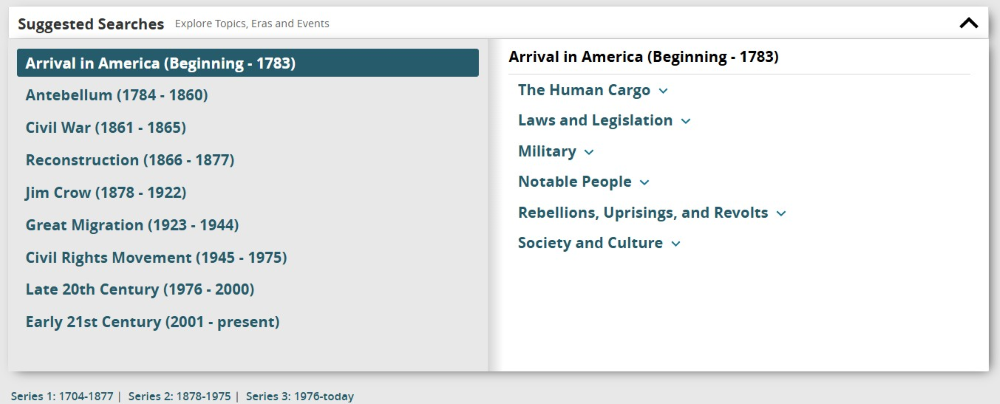
In the “Suggested Searches” section, I tried “Arrival in America (Beginning–1783)” further limiting to “Rebellions, Uprisings, and Revolts/New York Conspiracy (1741) Early 21st Century” (Figure 5). The results showed the preset advanced search boxes and limiters, allowing me to make adjustments to the search strategy (Figure 6). I also appreciated that the Suggested Searches default to the “Best Match” rather than the “Newest” sort.
For students and novice researchers in particular, this feature provides a pathway into the material without requiring advanced search expertise. It also models how multiple terms and concepts can be combined to retrieve meaningful results. As users explore the resulting documents, they can refine or expand the query further. The Suggested Searches also reduce the trial-and-error phase of keyword selection and help users quickly locate historically contextualized primary sources within the database.
The Suggested Searches cover a broad range of topics. For example, in Black Life in America Series 3, topics include Activist Groups, Court Decisions, Education, Government, Laws, Literature and the Arts, Notable People, Religion, Technology, and more. The Eras and Suggested Searches covered in Series 1 and 2 are, of course, much broader and include historical sources, with topics dating back to 1704.
Overall, navigation within each collection is intuitive: tabs or links enable quick switching between full-text search, filtering options, result sorting (by date, relevance, publication) and facets (topic, era, publication). NewsBank does not, however, support searching across collections; each Life in America collection stands alone. The interface is mobile-responsive.
In an accessibility statement on its website, NewsBank indicates that it aims to conform with the WCAG 2.2 Level AA standard and with US ADA/Section 508 compliance (NewsBank, n.d.). Additionally, a January 2025 Voluntary Product Accessibility Template (VPAT) for NewsBank Inc. published on the Library of Virginia website shows that the platform supports many success-criteria of WCAG 2.0-2.2 at Levels A and AA, although some image-scans lack text-equivalents (NewsBank Inc. Accessibility Conformance Report WCAG Edition, 2025).
Keyboard navigation is supported; when I tabbed through the interface, focus order was logical. In the default theme, color contrast was acceptable. For users who rely on screen-readers, the underlying HTML portions are accessible, but full-page image scans present a challenge: as indicated on the VPAT, unless OCR text was embedded, a screen reader may not obtain the content of the scan.
I did not locate a dedicated accessibility roadmap for upcoming features specific to the NewsBank interface, although NewsBank’s “Accessibility” page invites feedback and indicates the use of third-party audits (NewsBank, n.d.).
For libraries serving users of assistive technologies, this product provides a reasonable level of accessibility support. But libraries may wish to proactively assess whether individual scanned-image documents (with limited embedded text) meet their users' needs and be prepared to provide assistance or alternate access.
For both subscriptions and perpetual purchases, NewsBank grants a non-exclusive, non-assignable license for non-commercial academic, educational, and research purposes. For public libraries, authorized users are defined as staff, residents of the geographic area, and on-site walk-in patrons. For academic institutions, they include students, faculty, staff, visiting scholars, and on-site walk-in patrons.
Content cannot be provided to non-authorized users, used to create derivative works, or shared via interlibrary loan. Data and text mining are also prohibited without prior written approval. Remote access, where authorized, must be for personal use only.
NewsBank and its third-party providers retain all rights to the content, software, and compilations. Users cannot remove or alter copyright notices within the product.
With the purchase of a perpetual license, the user retains access even after the subscription ends. If NewsBank ceases to provide online access, they will provide an archival copy of the data in a mutually agreeable format at the customer’s cost.
According to my Readex representative, NewsBank provides COUNTER compliant reports but does not provide MARC records.
NewsBank does not publicly publish pricing for the Life in America collections.
NewsBank provides standard institutional authentication options for the Life in America collections. Primary access is IP‑based, enabling seamless on‑campus use without individual logins. For remote users, institutions typically configure proxy server access (e.g., EZproxy) or VPN authentication.
Federated authentication is supported through common SAML frameworks, including Shibboleth and OpenAthens, allowing single sign‑on (SSO) integration with campus identity providers.
There are a number of primary-source databases similar to NewsBank’s Life in America Collections. ProQuest’s Ethnic NewsWatch provides access to work from contemporary ethnic and minority presses. In addition, like Life in America, it has an archival component with historical sources from 1959–1989. Gale offers comparable content through archives such as Archives of Sexuality and Gender, Indigenous Peoples of North America, and Latino Social and Political Culture and History. Each emphasizes identity-focused primary sources and cultural history, but with a broader variety of sources, including not just newspapers but books, manuscripts, photographs, and art.
EBSCO’s Ethnic Diversity Source overlaps topically with Life in America, but leans more toward secondary scholarship, including peer-reviewed journals and ebooks, rather than newspapers and periodicals. It does contain primary sources, including newspapers, speeches, letters, and interviews.
Readex also produces complementary primary-source archives, such as African American Newspapers and Hispanic American Newspapers, which can function as either stand-alone alternatives or collection enhancements.
NewsBank’s Life in America collections are useful primary source discovery tools that meaningfully support teaching and research centered on historically underrepresented communities. The collections provide an incredible depth and breadth of content from the eighteenth century to the present; the content drawn from within the communities represented is particularly strong.
The interface is clean and functional, with effective basic and advanced searching and useful date and publication filters. The Suggested Searches’ pedagogical utility and subject-expert curation add meaningful value, particularly in identity-focused collections where terminology is historically contingent.
The platform does, however, have a few friction points. Although eye-catching, the mosaic of photos behind the search box takes up most of the page, forcing the user to scroll to see all of the Suggested Searches. The browsing of image-edition newspapers (PDFs) can be slow on lower-bandwidth connections, and the interface doesn't clearly indicate if an item is a full-image scan versus plain-text transcription unless you open it. The ability to do proximity searches or wild-card truncation, though supported, is less obvious, which may limit power users.
NewsBank’s licensing terms are standard, but libraries may find the restrictions on text and data mining and interlibrary loan rights limiting. The lack of pricing transparency makes cost comparison difficult. The absence of MARC records will also be an issue for some libraries.
I recommend the Life in America collections for academic libraries supporting programs in ethnic and cultural studies, sociology, political science, journalism, and American studies. Their identity-centered primary-source coverage would be especially valuable for institutions advancing DEI-focused curricula or seeking to expand representation of underrepresented communities in archival collections.
The product would provide the most value to undergraduate institutions, graduate programs, and faculty researchers who rely on historical and contemporary news sources for teaching and scholarship. Community colleges and teaching-focused universities would also benefit from the collections’ curated entry points and guided searches, which support student discovery. Public libraries may find some value in the collections too, especially if they serve a significant population of one of the communities featured.
NewsBank. (n.d.). Accessibility. Retrieved March 30, 2026 from https://www.NewsBank.com/accessibility
NewsBank Inc. Accessibility Conformance Report WCAG Edition. (2025). Library of Virginia. https://www.lva.virginia.gov/sites/default/files/2025-05/America%27s%20News%20VPAT.pdf
Asian Life in America. (n.d.). Readex. Retrieved March 30, 2026 from
https://www.readex.com/products/asian-life-america
Ismail, L., & Bareiss, W. (2021). NewsBank: Access to World News Research Collection. The Charleston Advisor, Vol. 22 (4), 49–55. https://annurev.publisher.ingentaconnect.com/content/annurev/tca/2021/00000022/00000004/art00014
10.1146/katina-040726-1
Copyright © 2025 by the author(s).
This work is licensed under a Creative Commons Attribution Noncommerical 4.0 International License, which permits use, distribution, and reproduction in any medium for noncommercial purposes, provided the original author and source are credited. See credit lines of images or other third-party material in this article for license information.