



Primary Sources Detail LGBTQ Life in the Twentieth Century
Gale’s Archives of Sexuality and Gender provides access to a rich collection of materials that illuminate the experiences of LGBTQ communities and individuals, primarily in the US.
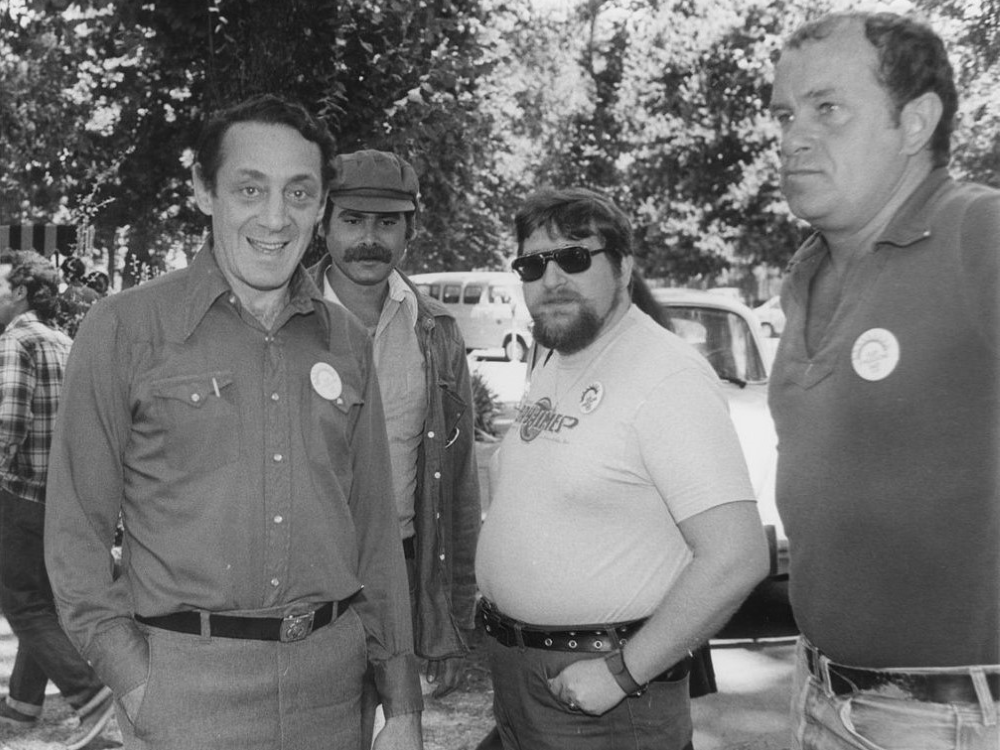
Gale’s Archives of Sexuality and Gender provides access to a rich collection of materials that illuminate the experiences of LGBTQ communities and individuals, primarily in the US.
Gale’s Archives of Sexuality and Gender is a collection of primary source documents concerning the history and study of sex, sexuality, and gender. This review covers the first two modules of the database—LGBTQ History and Culture Since 1940, Part I and Part II— which draw from 20 individual archives including the Lesbian Herstory Archives, the GLBT Historical Society in San Francisco, and the Canadian Lesbian + Gay Archives in Toronto. (The four remaining modules—Sex and Sexuality, Sixteenth to Twentieth Century; International Perspectives on LGBTQ Activism and Culture; L'Enfer de la Bibliothèque Nationale de France; and Community and Identity in North America—are outside the scope of this review).
The database, which is centered on US and English-language sources, is easy to search and use, save a couple of irritants. The price, however, will be prohibitively expensive for many smaller colleges and universities, which may be able to meet their researchers’ needs through open access resources.
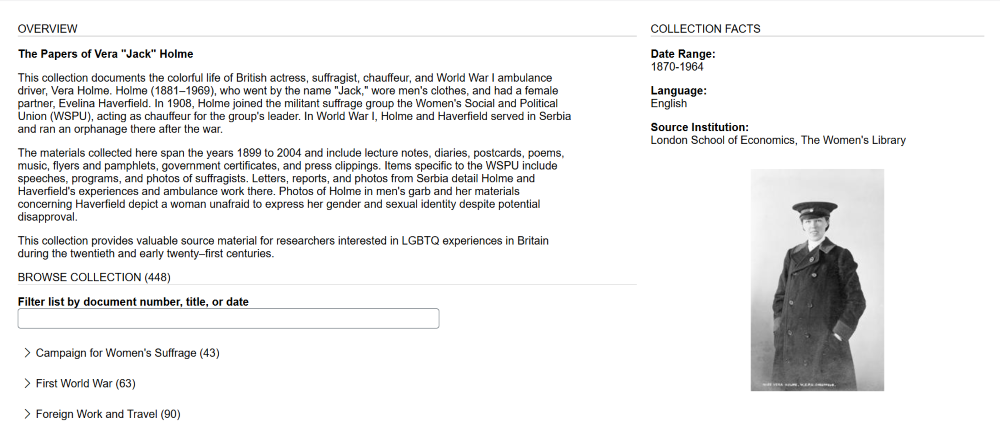
LGBTQ History and Culture Since 1940, Part I and Part II provide access to approximately 2.5 million pages of documents, including private correspondence, newsletters, transcripts from interviews, magazines, reports, and other materials created both by and about LGBTQ individuals. The documents include materials from activist organizations like ACT UP, the group created to engage in direct action in response to the US government’s handling of the AIDS crisis; papers that reveal the stories of individuals like Vera “Jack” Holme, who performed on stage in men’s clothes and, during World War I, served in Serbia with her partner, Evelina Haverfield; and documents that track the evolving political status of LGBTQ people during the period, like the Wolfenden Report from Britain’s Committee on Homosexual Offences and Prostitution (1954–57) which, following the committee’s prosecution of Alan Turing, among many others, recommended the decriminalization of homosexual acts in private (Figure 1).
Gale states that the first two modules of the archive contain “material drawn from hundreds of institutions and organizations, including both major international activist organizations and local, grassroots groups,” but, in reality, they focus primarily on the United States, with Canada and England distantly rounding out the top three represented countries. Non-English-language and non-European sources appear less often, as do international organizations, Black, Indigenous, and People of Color (BIPOC) authors and subjects, and local groups that write in their own languages, though the database does contain a few such sources. For example, the John Kyper Collection contains (among other topics) information about the gay liberation movement in Mexico, although Kyper himself is white and American. The database also includes the papers of Randy Burns, a Native American activist and co-founder of Gay American Indians (GAI).
These subjects are covered more comprehensively by other modules in the collection: Community and Identity in North America, for example, more directly addresses race, while International Perspectives on LGBTQ Activism and Culture focuses on international content.
I began my exploration of the database by searching the keyword “Eisenhower.” I received 1,694 results, broken down by content type: monographs, manuscripts, newspapers and periodicals, and photographs (Figure 2).
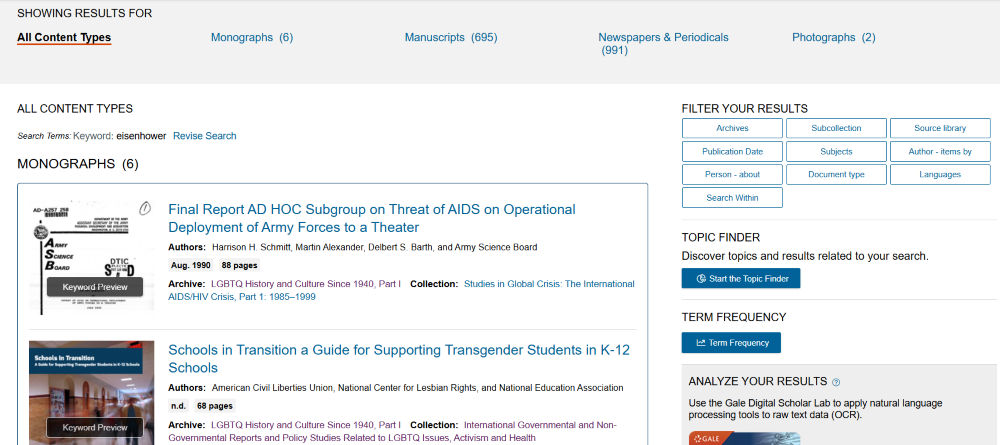
From there, I could filter by archive, subcollection, source library, and subject. I could also use the “Topic Finder,” which suggests additional topics and keywords related to the current search, or the “Term Frequency” tool, which shows the frequency with which a search term appears in the database. Users who subscribe to Gale Digital Scholar Lab have access to a feature called “Analyze Your Results,” which allows the user to apply natural language processing tools, such as name entity recognition and sentiment analysis, to OCR data they have collected from the archive. “Broaden Your Search” allows users to extend their search to other Gale primary source databases their institution subscribes to (for my search, The Times Digital Archive and U.S. Declassified Documents Online yielded the most additional results).
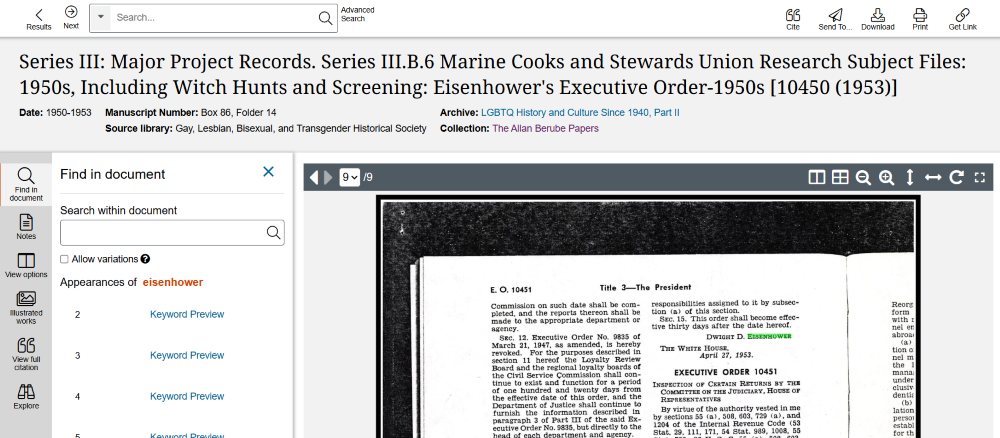
I clicked on the first manuscript in the search results, a copy of Eisenhower’s executive order 10450 (“Security Requirements for Government Employment”) from the papers of Allan Bérubé, a gay scholar and activist who helped found the San Francisco Lesbian and Gay History Project (Figure 3). The executive order effectively banned gays and lesbians from serving in the federal government and the military.
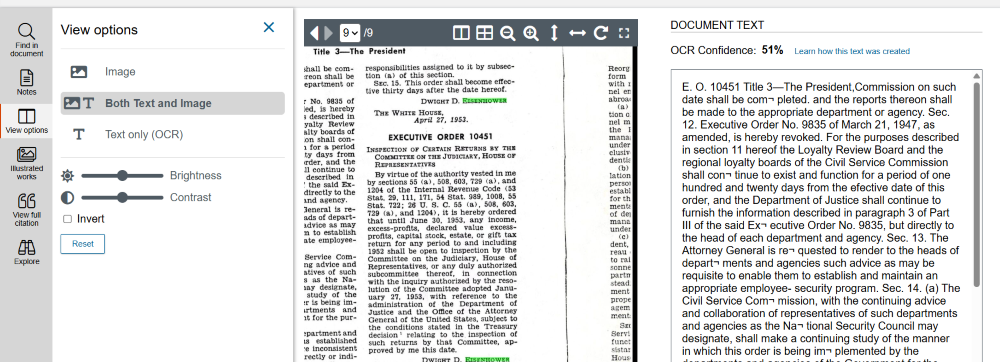
Through a navigation panel on the left, I could search within the document, see series and file information from the physical archival box, and choose to view the scanned document, the OCR text, or both. I could also change the brightness and contrast of the scans, skip to images in the document, and see citation information (Figure 4).
The feature I had the most fun with, “Explore,” shows related primary source documents from all Gale databases owned or leased by the user’s library along with related subject headings that lead to additional primary source documents.
I continued my exploration of the “Eisenhower” search results by clicking on “Newspapers & Periodicals,” where I found an interesting 1995 article from the Wisconsin Light, an LGBT journal that published out of Milwaukee from the late 1980s through the 1990s, about gay survivors of Dachau returning to the camp 50 years after its liberation. Another article, published in the Gay Community News in 1991, discussed the FBI’s surveillance of suspected “sex deviates,” including Adlai Stevenson, between 1937 and 1977, when, with the approval of the National Archives, the files from the program were destroyed.
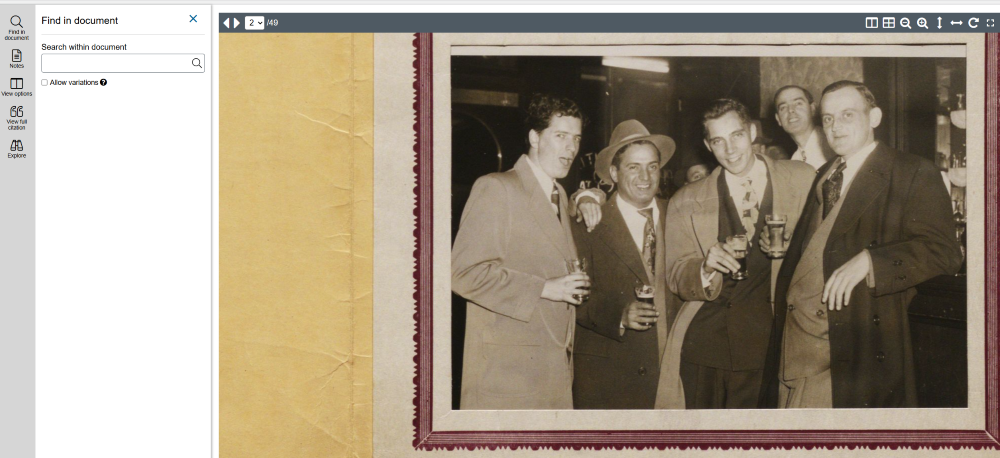
As I explored the platform, I encountered some limitations. The clipping of the article about the FBI files, for example, is very long, so reading it required a lot of zooming in and scrolling. In some other databases, the mouse’s scroll wheel will zoom in and out or move the document up and down; here, in order to zoom, I had to move the mouse to click magnifying glass icons, and to get to the bottom of the article, I had to click and drag it. Similarly, when I browsed a photo album that included interesting images of gay life among Merchant Marines in the 1940s, I was frustrated when I repeatedly had to zoom in or out in order to see the images clearly (Figure 5).
I also discovered a report about the portrayal of lesbians and gay people on the BBC whose metadata says “no date,” while its introduction mentions 2006 and “future years.” A mechanism to suggest updates to metadata would be useful.
Above, I mentioned that subscribers to Gale Digital Scholar Lab can use its processing tools with the OCR data for the archive’s documents—a useful feature. But I wonder about the results. In the manuscripts I reviewed, the OCR confidence rate ranged from 51 percent to 67 percent. Among monographs, the confidence rate was generally higher for born-digital files (87 to 91 percent), but 57 percent for a scan. I also found one document with no OCR at all. This issue is widespread in primary source databases and not unique to Gale, but Gale makes OCR a selling point.
Gale Primary Sources is WCAG 2.2 Level AA compliant according to its April 30, 2025 VPAT. The report mentions that some of the keyboard shortcuts—for example, “topic finder” and “learning center”—may conflict with browser and screen reader shortcuts.
According to an October 2024 update to Gale’s Platform Accessibility Policy, “Requests for accessible versions of historical primary source documents are treated on a case-by-case basis and assessed for feasibility and target turnaround time depending on the length and complexity of the document.” This policy is concerning. It means that although patrons can navigate the database structure using only a keyboard or with a screen reader, once a patron has found an item, there is no guarantee that they will be able to read the entire document, even when it is a born-digital item.
Generative AI was not used in the scanning of the original source documents or the production of this archive (J. Wright, personal correspondence, October 23, 2025).
Gale partners with Portico (an ITHAKA product) to preserve its digital content in case Gale is unable to provide access or is no longer in business.
Gale does not allow its licensed content or its partners’ IP to be integrated into or used to train third-party AI models. They are “exploring secure AI methods like Retrieval Augmented Generation (RAG) to ensure that any AI output is grounded in authoritative, source-specific data” (J. Wright, personal correspondence, November 12, 2025).
Gale provides guidance to scholars working on digital humanities products and teachers who want to introduce text and data mining (TDM) to their students. Gale can also provide access to data delivery for special TDM initiatives outside of Gale Digital Scholar Lab (J. Wright, personal correspondence, November 12, 2025).
Individual patrons are not allowed to request interlibrary loans (ILL) of documents from Gale Primary Sources collections, though a library can request one for its institution. The providing library can either print a copy of the document and send it by mail or it can send the digital copy by secure transmission (such as ILL). The receiving library will need to print out a copy and destroy the digital file.
Gale resources can also be integrated with learning management systems (J. Wright, personal correspondence, 11/12/2025).
Gale provides COUNTER compliant reporting using Scholarly iQ (J. Wright, personal correspondence, 11/12/2025).
Academic library pricing for a module of Archives of Sexuality and Gender starts at $8,014 for perpetual purchase and is based on a number of institutional variables, of which full-time enrollment is one. Other acquisition models, including for consortia, are available (J. Wright, personal correspondence, 11/12/2025).
Gale allows for authentication by IP address, password, Remote Patron Authentication System (RPAS), referring URL, and Shibboleth. A support article details how to set up each option in Gale Admin.
I wrote about several LGBTQ+ databases in a review of Coherent Digital’s LGBTQ+ Social Justice and Culture. Additional relevant products include Readex’s LGBTQ+ Life in America, which collects documents from over 16,000 global news sources. It is divided into three series: 1705–1992: From Earliest Representations through the AIDS Crisis; 1993–2021: “Don’t Ask, Don’t Tell” through the Transgender Rights Movement; and “Don’t Say Gay” to Today: LGBTQ+ Life and Identity in the 21st Century.
Adam Matthew’s 1980s Culture and Society, which focuses on content from English-speaking countries, also covers some of the same ground.
LGBTQ History and Culture Since 1940, Part I and Part II have a number of strengths. The modules include primary source collections from a variety of institutions, and their coverage extends to 2019 (though, because the interface doesn’t permit browsing by year or date range, I could not determine which years were most and least represented). Searching the database is easy, and the results are clearly marked. The scans are high quality, and the interface mimics the structure of an archival box down to series and folders, helpfully orienting the reader. The integrations with other Gale products, including the Digital Scholar Lab and Gale Primary Sources, enrich the tool, and the ability to print and download documents is useful.
On the negative side, the clicking and dragging necessary to work with a scan is frustrating and time consuming. Although the database does contain collections from a variety of groups, such as Native Americans, Jewish Americans, Christian Americans, and Hispanic Americans, its focus on US and English-language content is a limitation.
One of the database’s biggest weaknesses is its application of OCR. As noted above, confidence rates vary considerably, and some scanned documents don’t have OCR at all. Low OCR confidence rates and missing OCR not only affect the ability of researchers to process the data, but they also affect accessibility for people with disabilities.
Another weakness is the price tag. One module starts at $8,014, which makes this resource cost-prohibitive for smaller colleges and universities. The database includes several important collections, but, as I detailed in my review of LGBTQ+ Social Justice and Culture, there are also open access resources covering these subjects. These free options cannot replace the specific collections in this database, but they contain the papers of other LGBTQ+ organizations and cover related people and events.
For institutions that see value in the material for the cost, LGBTQ History and Culture Since 1940, Part I and Part II are suitable for undergraduates, graduates, and faculty, especially in the areas of history, women and gender studies, and sociology. Student organizations and nonprofits concerned with women’s and LGBTQ+ issues might also be interested in this collection.
10.1146/katina-121125-1
Copyright © 2025 by the author(s).
This work is licensed under a Creative Commons Attribution Noncommerical 4.0 International License, which permits use, distribution, and reproduction in any medium for noncommercial purposes, provided the original author and source are credited. See credit lines of images or other third-party material in this article for license information.