



In This Collection, Underrepresented Playwrights Take Center Stage
Aurora Metro Books Collection 2, part of Bloomsbury Drama Online, is an excellent collection of contemporary plays that presents some notable usability challenges.
Aurora Metro Books Collection 2, part of Bloomsbury Drama Online, is an excellent collection of contemporary plays that presents some notable usability challenges.

Aurora Metro Books Collection 2 (Aurora 2), part of the Bloomsbury Drama Online digital library, is a highly diverse and original collection of plays, emphasizing those written by and about traditionally underrepresented groups. While the Drama Online platform presents some notable usability challenges, overall, I recommend the collection, which offers students and faculty access to diverse works, new monologues, and challenging perspectives.
The Aurora 2 collection contains over 100 plays, plus a handful of books about theater, from a diverse set of playwrights. Its content—including the first collection of plays by writers with disabilities published in the UK, six new plays by Iranian writers, two books on theater for young people, and a number of plays based on the lived experiences of biracial and transracial playwrights—offers incredibly broad coverage of underrepresented groups. In Jamaica Boy, for example, playwright Stephen Hoo weaves present-day London and1960s Jamaica together to explore the complex shared cultural history of a young half-Chinese boy and a Jamaican woman in her late 60s. A very different set of topics is explored in Bibi Lucille’s Meat Cute (2023), a play about a young activist who attempts to convert all her dates to veganism. The vast majority of the plays in the collection are less than 20 years old, and a significant number were published in the last five to ten years.
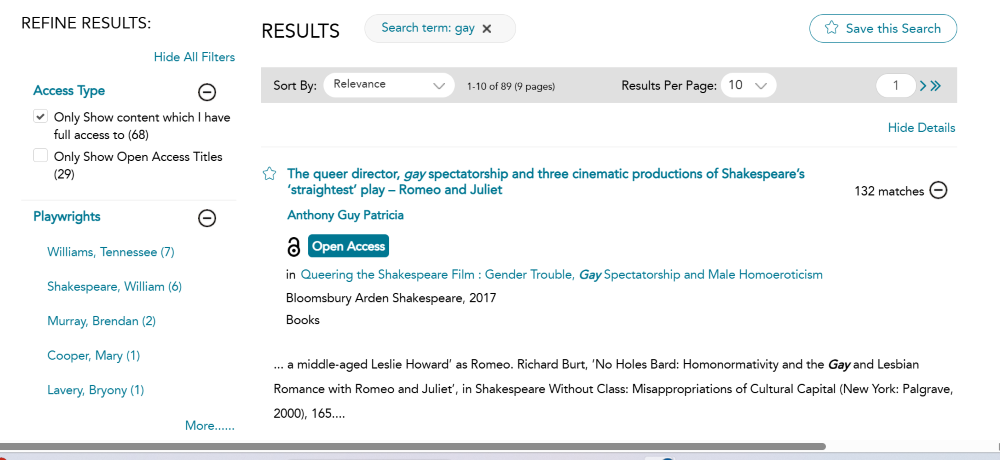
Drama Online’s search experience is excellent, with easy-to-use functionality and a robust set of filters. Users may be confused if their institution only subscribes to a single collection because the search box refers to the whole platform—“Search Drama Online.” When I conducted a quick search using the keyword “gay” (see Figure 1), however, the search results defaulted to “only show content which I have full access to.” I appreciated this feature, which prevented the frustration of encountering materials outside my institution’s subscription and then needing to locate them elsewhere.
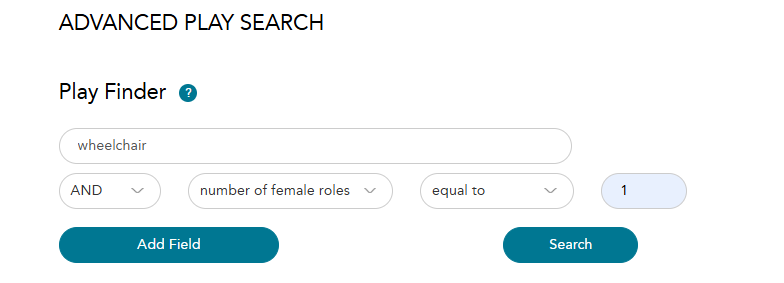
The “Advanced Play Search” feature (Figure 2) was also helpful. I was able to search by keyword and also limit by “number of scenes,” “word count,” “total roles,” “number of male roles,” “number of female roles,” and “number of unassigned roles.” These facets can be refined after the initial search. For example, I searched for the keyword “wheelchair,” and then limited the results to “number of female roles” is “equal to 1.” While this is not a perfect way to locate a play with a role for a female performer in a wheelchair, it certainly got me close enough to figure it out.
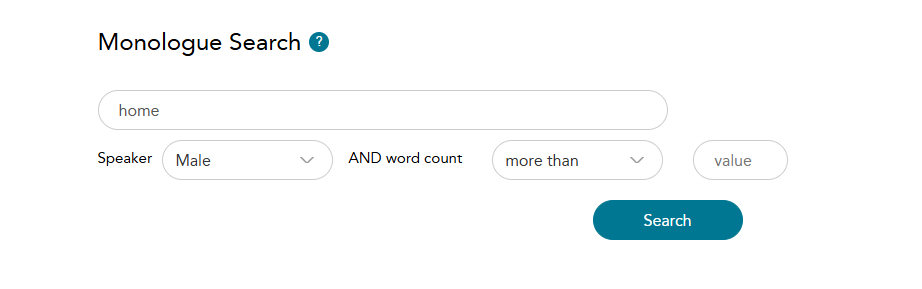
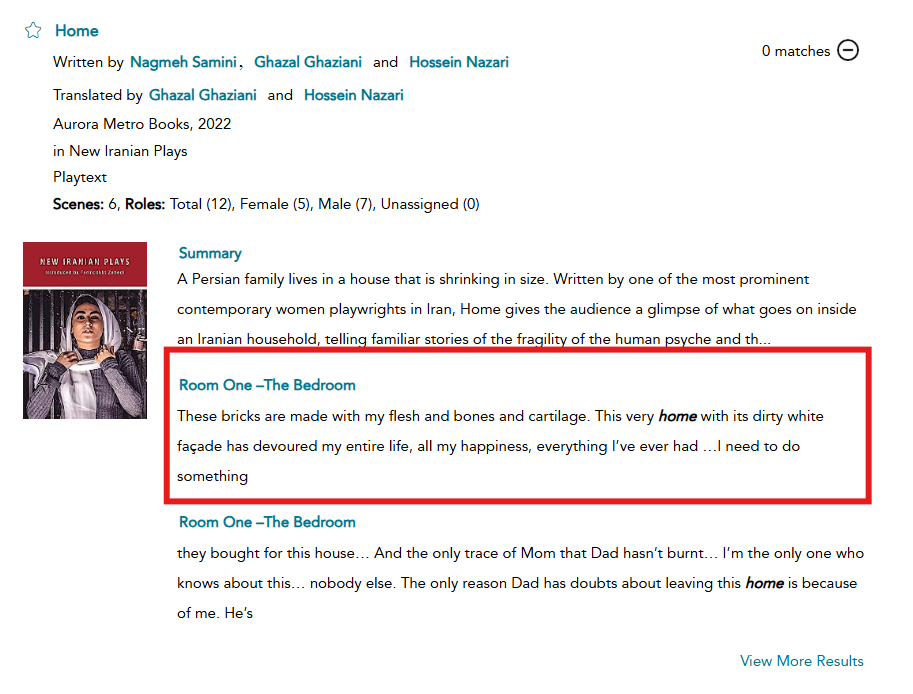
The Monologue Search (Figure 3) is similarly useful. I searched for the keyword “home” and limited the results to male speakers. The results list provided a good number of monologues that all seemed on topic. For instance, the first result was the play Home by the Iranian playwright Naghmeh Samini. When I selected a monologue from the results list (boxed red in Figure 4), the full text of the play opened to the monologue I had chosen. This excellent tool provides a simple way for actors to find new and interesting monologues.
In addition to searching, users can select “Explore this Collection” on the collection homepage to browse a detailed, alphabetized list of every play and book in the collection that includes a direct link to the full text of each—a welcome feature.
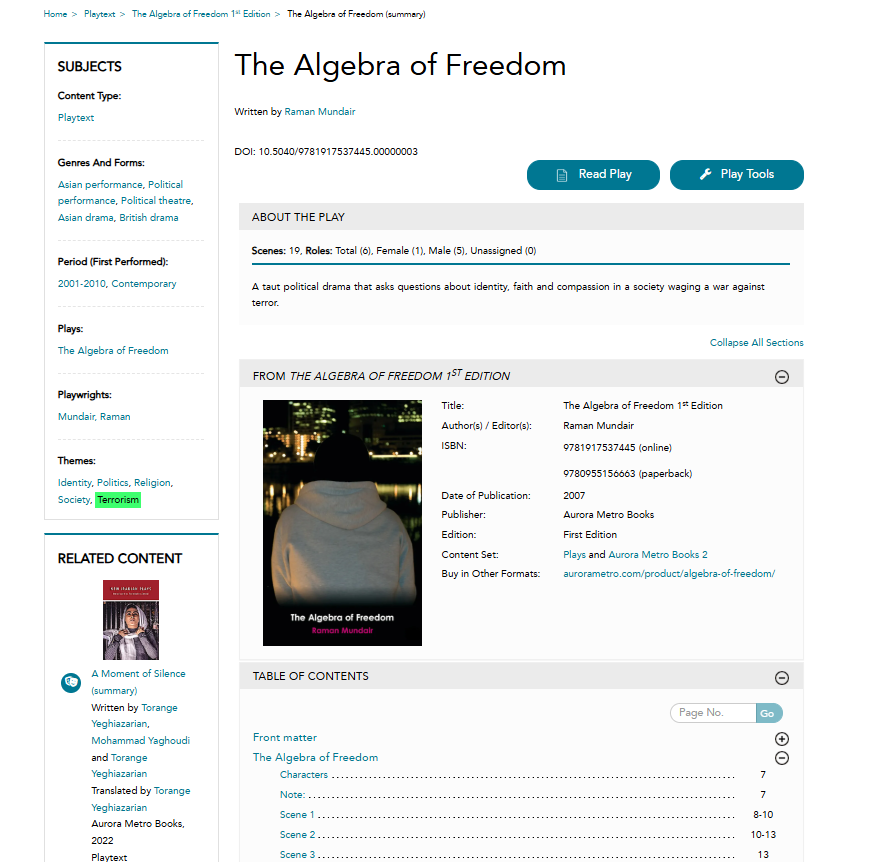
The record for each play includes subject headings, filters, and links to related content (Figure 5). When I selected “Terrorism” under the label “Themes” for the play The Algebra of Freedom, for instance, it took me to a list of three additional plays with that theme, all of which I could open as full text.
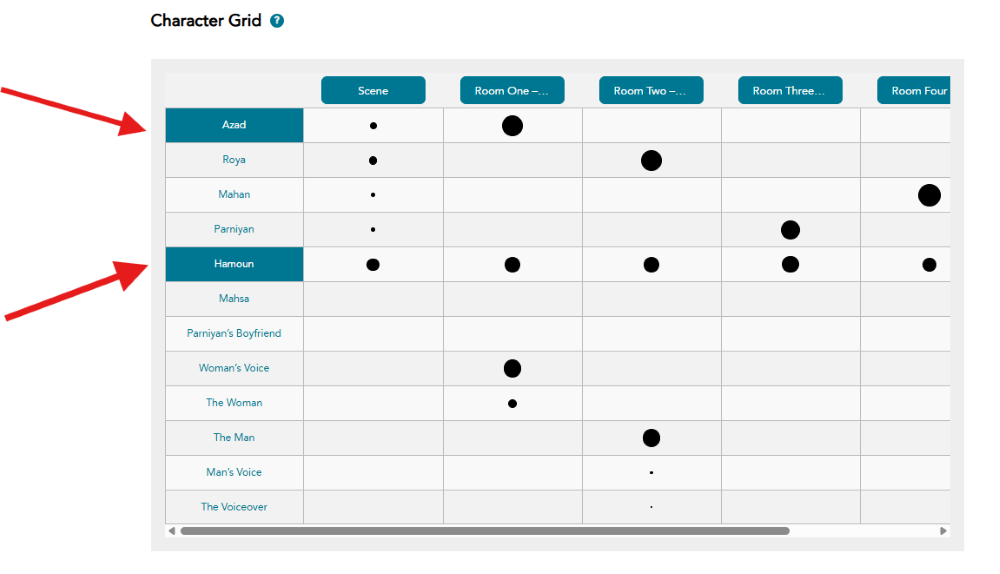
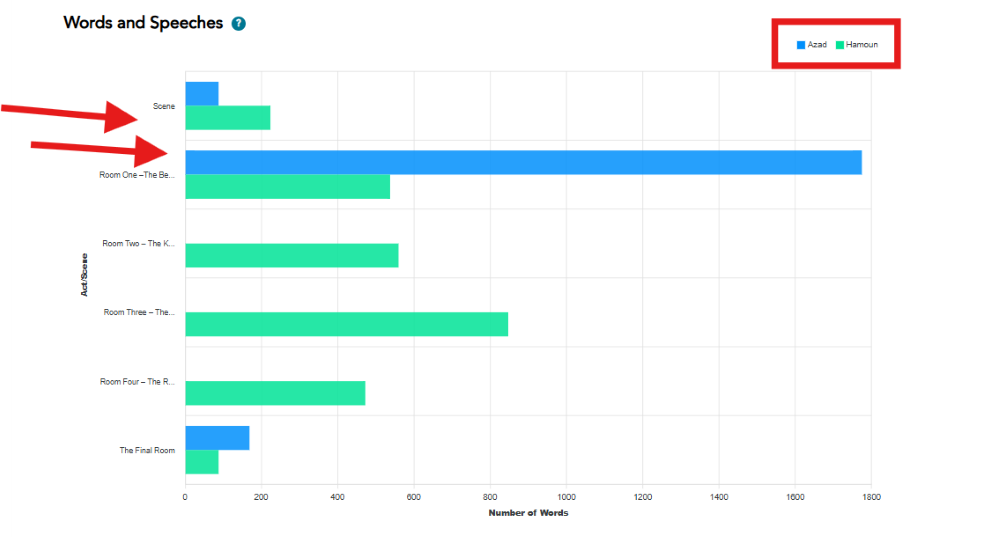
Each record also includes engaging features designed to help users understand key elements of the play. The “Play Tools” function, for example, provides a character grid that shows which scenes each character appears in. If you select a character’s name in the Character Grid—for example, Figure 6 shows a character grid for Home with “Azad” and “Hamoun” selected—a “Words and Speeches” grid (Figure 7) updates to show how many words that character speaks in each scene.
On the other hand, the platform’s interface for reading plays is not user friendly. The text can only be viewed one scene at a time, and there is no “next scene” button to move forward; instead, users must manually select each scene from the table of contents on the left side of the page.
Unfortunately, there is no option to export the content as a PDF or EPUB. In order to read the scenes outside of the interface, I had to “print” each scene as a PDF and combine the individual PDFs into a continuous document. While not unexpected, these limits are a barrier to easy readability.
Bloomsbury’s goal is WCAG AA accessibility compliance. The VPAT that covers all of Bloomsbury’s digital resources, including Drama Online, identifies as major issues that some videos lack transcriptions and that some need more robust audio descriptions. Because the Aurora 2 collection doesn’t contain videos, only text, these issues aren’t relevant. The Library Accessibility Alliance tested Drama Online in 2022 and noted some major issues in terms of screen reader compatibility (Truong, 2022), but the VPAT shows that screen reader compatibility issues have been resolved for book and play texts.
Pricing is determined according to institution size and type; it ranges from $193 to $771 for an annual subscription or from $1,156 to $4,625 for perpetual access, with some consortial discounts available. For perpetual purchases, an annual hosting fee of $200 to $600, which covers all content on the platform, begins after the first year (Bloomsbury Press, 2025).
Unlimited simultaneous users are permitted. The platform supports outbound OpenURL linking from citations. Bloomsbury provides COUNTER 5 usage data (which can be automatically harvested through SUSHI) and MARC records for books and volumes of plays (though not for individual plays).
The platform supports a variety of authentication models, including IP authentication, proxy server access, Shibboleth, and WAYFless URLs.
The Drama Online platform includes other collections that complement Aurora 2, such as Aurora Metro Books Collection 1 and Core Collection: 21st Century Drama.
Alexander Street Press also offers several products—Asian American Drama, Black Drama, and Contemporary World Drama—with related content. But they do not include the specific plays in the Aurora 2 collection and do not match Drama Online’s offerings of recently published works or full‑text works from traditionally underrepresented groups.
Aurora Metro Books Collection 2 is an excellent collection for libraries looking to diversify their play text holdings and provide access to plays not easily available through other platforms. Even for plays that are available as standalone print titles, the collection’s per‑play cost is reasonable—at the top tier, about $45 per play for perpetual access with unlimited users, and for smaller institutions, much less, nearing the cost of buying a single physical book. The Play Tools give users easy ways to explore each work that is unavailable in a PDF or physical book.
The search features are impressive, allowing readers to find monologues and characters easily within specific plays. While the language in the search box referring to Drama Online, rather than an individual collection, is mildly confusing, I find it refreshing that the platform defaults to searching only for items the user can access. As both a user and a librarian, I appreciate that the search is a genuine discovery tool rather than a marketing mechanism.
That said, the readability issues are significant. The lack of a straightforward way to export a play as a PDF or move between scenes using a “next” or “back” button presents a learning curve for readers used to being able to read whole works at once, scroll through entire works, or read offline, detracting from the collection’s overall usefulness.
Ultimately, though, Aurora 2 is a unique collection that provides access to voices and stories that are not always foregrounded. Despite the challenges of reading in the Drama Online platform, the collection offers significant value.
Aurora Metro Books Collection 2 is both a practical resource that helps students find and practice new monologues and scenes and an academic resource that contains works not easily available through other platforms and that highlights underrepresented playwrights. It is well suited for any academic library that supports an active theater program and for any library that supports programs such as critical international studies, disability studies, and women and gender studies.
Bloomsbury Publishing. (2025). Drama Online. Retrieved Dec. 4, 2025. https://www.dramaonlinelibrary.com/home
Truong, J. (2022, January 1). High-level accessibility review – BTAA (Bloomsbury’s Drama Online Platform). Library Accessibility Alliance. https://libraryaccessibility.org/evaluation/bloomsbury-drama-online
10.1146/katina-022726-1
Copyright © 2025 by the author(s).
This work is licensed under a Creative Commons Attribution Noncommerical 4.0 International License, which permits use, distribution, and reproduction in any medium for noncommercial purposes, provided the original author and source are credited. See credit lines of images or other third-party material in this article for license information.