This Tool Cuts Through the Confusion of Transformative Agreements
SciFree’s Journal Search Tool helps researchers navigate the sometimes-confusing array of publishers and journals covered by their institutions’ agreements. Is it worth the administrative hassle?
As libraries and consortia continue to invest in transformative agreements, affiliated researchers need to be able to search across all journals covered by their institution’s agreements to discover titles in which they can publish open access without paying an article processing charge (APC). SciFree’s Journal Search Tool (JST) is one of the first tools designed to help researchers navigate the sometimes-confusing array of publishers and journal titles covered by their institution’s agreements. JST also includes an administrative dashboard that allows institutions to manage their agreements and view usage of the search tool.
Product Overview/Description
Founded in Sweden by Abeni Wickham, who has a PhD in molecular physics, SciFree builds software to support seamless access to research content. In 2020, in collaboration with Stockholm University, SciFree launched JST, which provides a public interface for users to search across all titles available within their institution’s transformative agreements (contracts that redirect subscription payments to support open access publishing, also known as read and publish agreements). This allows researchers to find journals in which they can publish open access without paying an APC.
In addition to a public-facing website, JST offers a search widget that an institution can embed into its website. Institutions manage their own title lists, which they can upload via Excel spreadsheets or enter manually. SciFree maintains journal flips, imprint changes, and ceased titles across all major publishers within a shared database. Title lists contributed by consortia libraries and audited and enhanced by SciFree are available upon request. SciFree also provides title lists for major publishers upon request, but institutions must vet these lists for accuracy and update them each year within the administrative dashboard.
Title lists can include the following fields, enabling researchers to search and/or browse this data across all current transformative agreements: journal title, ISSNs (optional), subjects (optional), CC license types, payment options (e.g., Included in Publisher Agreement, Green OA Deposit, Subscribe to Open, etc.), publishing model (hybrid or open access), and journal URL. SciFree customizes each institution’s public facing portal with their branding and enables the institution to add helpful information, links, and contact info for researchers. In the tool’s backend, institutional admins can upload and edit agreements, view usage statistics, edit branding, and export all journals into a tab delimited (TSV) file. The JST Help Center has step-by-step tutorials and FAQs for administrative users. On the Community message board, subscribers can request new features and learn about the latest updates.
User Experience
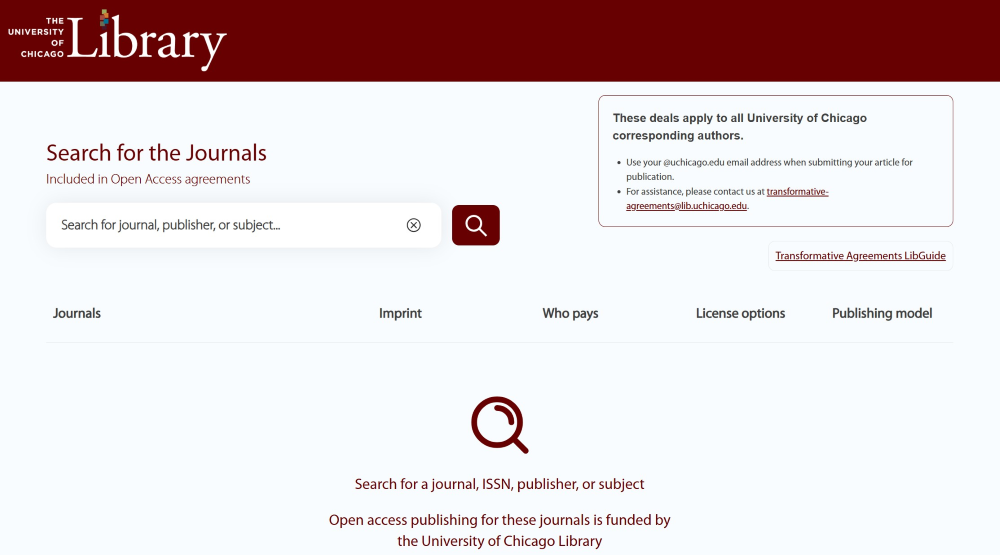
As you can see on my university’s public-facing JST interface, from the homepage, users can search for a journal by title, ISSN, publisher, or subject. Institutions can customize a persistent text box in the upper right corner of the page to provide helpful information to users (Figure 1).
FIGURE 1
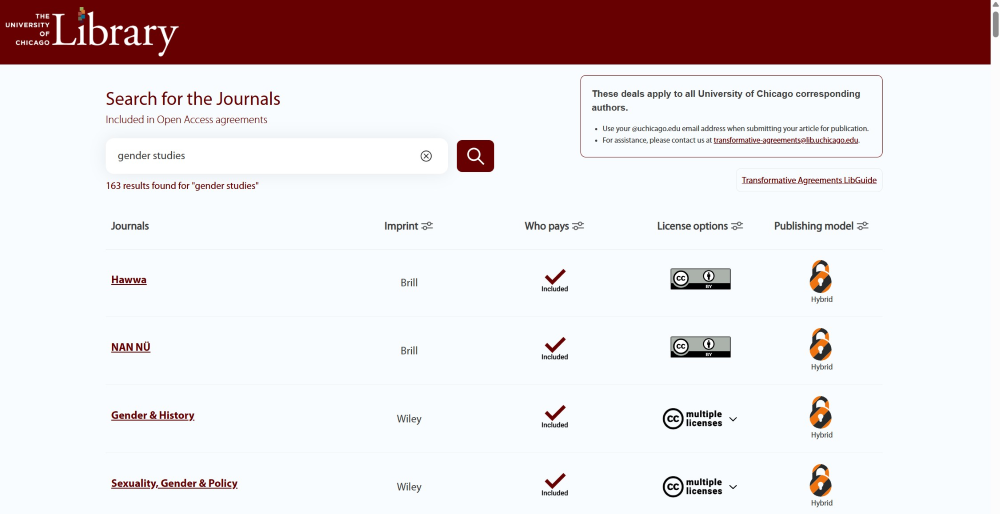
I searched for “gender studies.” The results page (Figure 2) shows relevant journal titles, hyperlinked to each title’s page on the publisher’s website.
FIGURE 2
The user can filter by the imprint, who pays (i.e., the type of agreement), license options available, and publishing model.
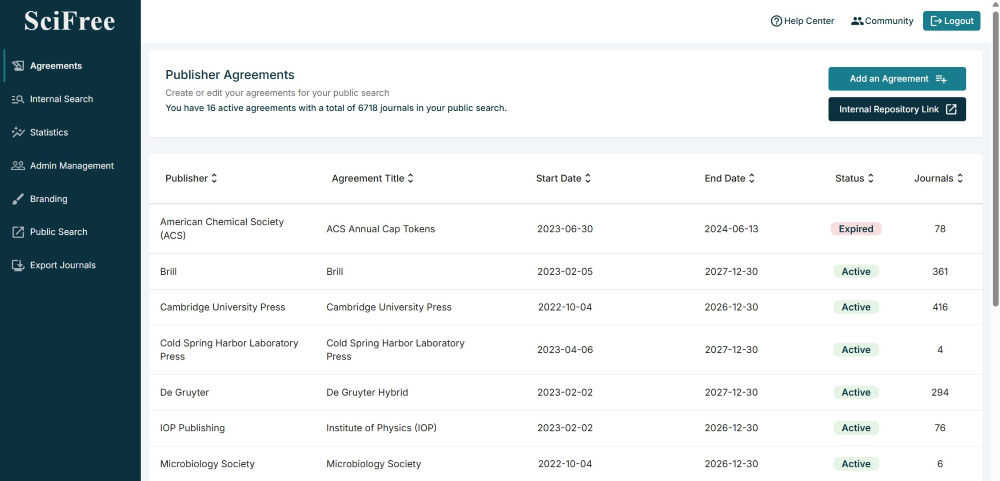
In JST’s administrative backend, staff can create and edit agreements, including start and end dates, add descriptive notes for internal use, and upload title lists in .xslx format (Figure 3).
FIGURE 3
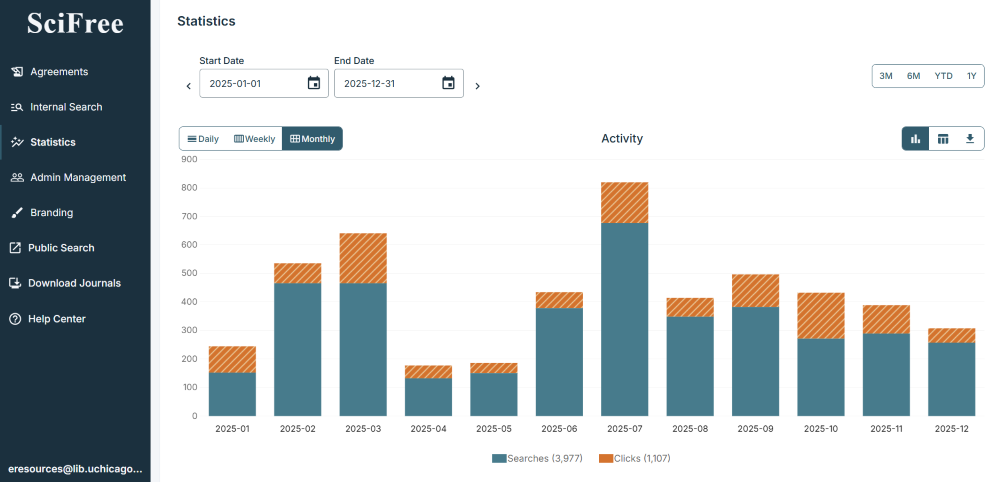
Staff can also view the number of clicks and searches per day, week, and month and see top search terms used, as well as search terms that returned no results. The latter can be particularly helpful by revealing the publishers and journal titles your researchers are searching for with which you do not yet have a transformative agreement. Statistics for the journals clicked on, both by journal title and by publisher agreement, are also available (Figure 4)
FIGURE 4
The JST search interface is compliant with WCAG 2.2 Level AA, and SciFree plans to make the administrative backend fully compliant by late 2026. JST has not yet been reviewed by the Library Accessibility Alliance. A VPAT is available upon request.
Contracting and Pricing Provisions
Subscribers pay a one-time setup fee and an annual charge based on their number of active publisher agreements. If the institution makes changes to the number of transformative agreements mid-term, the change in pricing will be reflected in the following term’s renewal. While pricing is not publicly available, overall, the cost of JST is slightly higher than that of competitor Open Journal Finder (OJF). Discounts are available for consortia. Diamond OA journals and the University’s own publications can be included at no additional cost, but SciFree does charge for the inclusion of Subscribe to Open journals.
In their license agreement, SciFree commits to providing the subscribing institution with a public search page with shortened URL unique to each institution; institutional branding; access to a search widget that can be embedded into the institution’s website; an administrative dashboard allowing each institution to manage their agreements and view usage statistics; and tutorials and help documentation. SciFree staff are available to assist institutions via phone or email up to five hours per year and provide two hours of training on the use of the tool.
Using the Big Ten Academic Alliance’s (BTAA) standard accessibility language, the license includes a commitment to accessibility at WCAG 2.1 AA, meaning the tool complies with the American Disabilities Act Title II regulations that come into effect in 2026 and 2027. SciFree also commits to complying with the European Union’s General Data Protection Regulation (GDPR) and will not share any identifiable usage data with third parties.
Authentication Models
JST is publicly available. Access to the administrative dashboard is provided via a vendor-created username and password. Institutional admins can add additional users as needed.
Competitive or Related Products
Both ConsortiaManager and ChronosHub offer tools that help researchers find journals where they can publish open access without paying an APC. Title lists for transformative agreements in ConsortiaManager’s Open Journal Finder (OJF) are automatically updated, provided the negotiating consortium uses ConsortiaManager and keeps its title lists current. Institutions can also upload title lists they’ve negotiated independently.
ConsortiaManager has its own knowledge base of titles sourced from OpenAlex, Directory of Open Access Journals (DOAJ), and publishers. Institutions can decide whether to show all journals within ConsortiaManager’s knowledge base or only journals associated with that institution’s transformative agreements. In addition to searchable data fields similar to JST’s, OJF also includes the number of articles published and citations made within each journal by researchers affiliated with the institution, the APC price per journal when available and applicable, and the journal’s SCImago rank and H-index. Users can click into the journal’s title to see additional information, such as a list of articles published by affiliated authors and the ratio of open access articles to closed access articles for hybrid journals.
ChronosHub’s Journal Guide allows researchers to search and browse across more than 50,000 journals. Title lists within the Journal Guide are sourced from publishers that ChronosHub partners with, as well as from the JISC Open Policy Finder and OpenAlex. Additional title-level information is sourced from Scopus, Web of Science, and DOAJ. Subscribing institutions can add their branding and messaging to the Journal Guide and upload title lists from transformative agreements, allowing users to search across all journals within ChronosHub or to filter to only those with which their institution has a transformative agreement. The filters offered by Journal Guide are similar to those offered in the other products and the subjects are normalized using Scopus data. Journal Guide also includes the ability to search by funder, pulling information from cOAlition S’s Journal Checker Tool to show a brief explanation of the funder’s self-archival requirements, when available. A summary of each journal links out to author guidelines, information about the publishers’ restrictions for each license type, and APC costs, when available.
All three products offer intuitive search interfaces that allow researchers to quickly filter to find journals by subject, publisher, CC license option, and journal type. In the search results for both JST and OJF, each journal title takes up a small amount of screen space. Journal Guide provides all information about each journal within the results page, which can make it difficult to view multiple journals on the same page without scrolling. ConsortiaManager and ChronosHub each contain additional data, making their tools more robust than SciFree’s. The normalization of subjects within Journal Guide may allow for better journal discovery.
Critical Evaluation
JST offers researchers a straightforward interface to quickly search for a topic or journal and to view and filter by license type, publishing model, and payment options. Its institutional customizations are helpful.
The tool’s administrative dashboard is simple to use and links to helpful documentation. The usage statistics are robust and exportable. The ability to view the top search terms and results can help institutions determine which future agreements to pursue. When assistance is needed, SciFree staff are responsive and helpful.
While this tool helps libraries communicate about their transformative agreements with their researchers, the required management of the title lists by staff can be time consuming. In particular, publisher-provided data within title lists can include non-standard subjects of varying quality, making it difficult for researchers to find all of the available journals within their discipline or topic. If an agreement’s title list is unique to an institution, that institution must request a list from the publisher that includes the license type available per journal and each journal’s publishing model, further burdening staff.
SciFree’s per-agreement pricing model can be expensive for libraries with a large number of agreements. While SciFree does allow libraries to upload publisher lists of three or fewer journals without an added cost, many society publishers with only a slightly larger number of publications must be added to the annual invoice.
Recommendation
For libraries that manage several transformative agreements and want to help researchers search across all agreements for journals in which they can publish open access without paying an APC, SciFree’s Journal Search Tool offers a user-friendly, if administratively burdensome, solution.
10.1146/katina-041426-1
Jessica Harris is the electronic resources management librarian at the University of Chicago. She manages the lifecycle of electronic resources, including license negotiations, authentication, access, and discovery. She has over 15 years of experience managing electronic resources and serves as the chair of her library’s Transformative Agreements Working Group.
Thank you for your interest in republishing! Anyone is free to use and reuse the article text and illustrations created by Katina for non-commercial purposes under a CC BY-NC license. Please see our full guidelines for more information. Photographs and illustrations are not included in this license. This HTML is pre-formatted to credit both the author and Katina.
This is a required field
Please enter a valid email address
Approval was a Success
Invalid data
An Error Occurred
Approval was partially successful, following selected items could not be processed due to error