



This Publication Serves Up News for Spies
Intelligence Online is a niche tool. But for the right audience, it’s a compelling value proposition.

Intelligence Online is a niche tool. But for the right audience, it’s a compelling value proposition.

Intelligence Online is a web-only, daily publication, available in both French and English, featuring news, analysis, and in-depth investigative reporting about global intelligence and international affairs. Its coverage is global and especially strong in its treatment of French interests and Francophone regions. While overly specialized for most academic institutions, Intelligence Online offers value to the defense, intelligence, and diplomatic communities as well as research institutes and news media.
Intelligence Online has been produced since 1989 by Indigo Publications, a Paris-based independent news agency. It is the flagship of a quartet of global intelligence publications, including Africa Intelligence (which focuses on the African continent and the Indian Ocean region), Glitz (the luxury goods industry), and La Lettre (politics and commerce in France). Indigo employs 95 staff and works with 150 freelance journalists globally across its four media properties. Subscribers, who may be individuals or organizations, receive access to new articles published daily and to an archive of over 20,000 articles dating back to 1992.
Intelligence Online reports on intelligence services (also known as spy agencies) and their activities, plus diplomatic and private-sector developments with implications for intelligence (the surveillance industry, private military contractors, government corruption, corporate intelligence, and the like). While its coverage is global, the bulk of its editors and journalists are French, and the publication is particularly strong in its treatment of French interests, Francophone regions, and France’s traditional allies and adversaries. As a result, Intelligence Online complements rather than duplicates most of the intelligence reporting that readers can find in many American or British media outlets, which tend to focus on Anglophone regions, Latin America, Israel, Islamic extremism, and other areas of longstanding particular interest to the US and UK.
Intelligence Online is independent and nonpartisan. It is self-sustaining through the sale of subscriptions and, to avoid conflicts of interest, does not host advertising or engage in consulting. According to Indigo Publications’ founder and board chair Maurice Botbol, most subscribers are from the intelligence community, the armed forces, and the defense industry, with mounting interest from the energy, pharmaceutical, and other industries. As of 2023, according to its website, Indigo earned revenue of €8.8 million, plus a subsidy of €378,000 from the French Ministry of Culture intended to foster the French free press. Indigo is a family business, with Quentin Botbol, the founder’s son, serving as the CEO; the father-son duo controls about 95 percent of the company’s capital.
Intelligence Online is a conventional news website; its layout and functionalities will be familiar to readers of The Financial Times, The New York Times, or World Politics Review. The homepage (see Figure 1) features daily top stories from around the world. Below the top stories are news sections organized by topic and geography. Featured sections include Deep Dives (in-depth investigations), Spymasters (reporting on key intelligence officials), and Spy Way of Life (content about spies’ tradecraft and lifestyles), plus sections focused on the Americas, the Middle East and Africa, Europe–Russia, and Asia–Pacific. Published alongside longer articles are briefs—snippets of global corporate and national intelligence news.
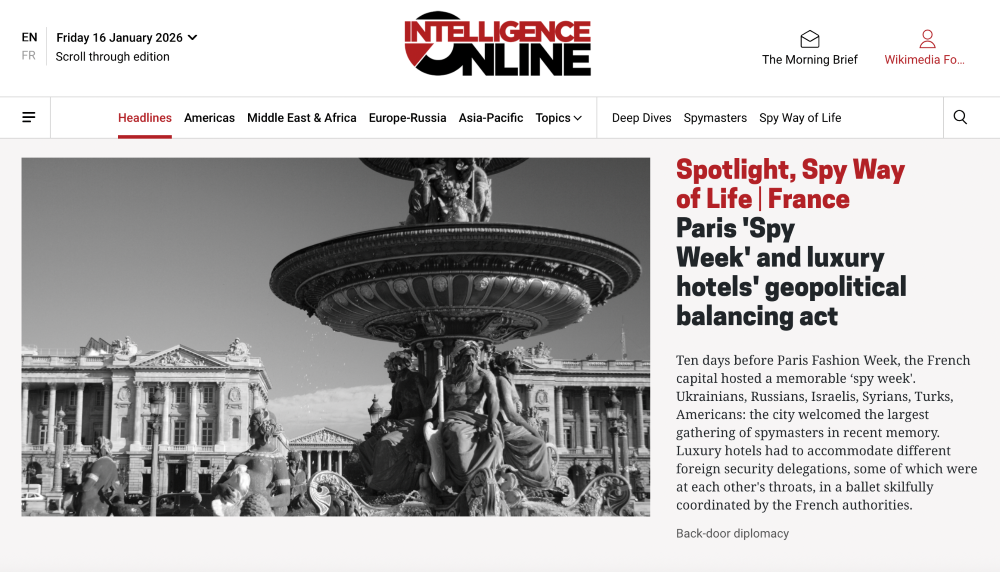
The top navigation bar includes links to each of these sections and links to popular topics—agencies, operations, corporate intel, cybersecurity, information wars, defense, space, back-door diplomacy, and contractors—that users can click into to browse articles. Users can sign up for a weekly email recapping content related to topics and sectors they select. From the homepage, users can click on the “scroll through edition” for a visually appealing single-page view of each day’s articles, which they can scroll through as if they were reading a newspaper.
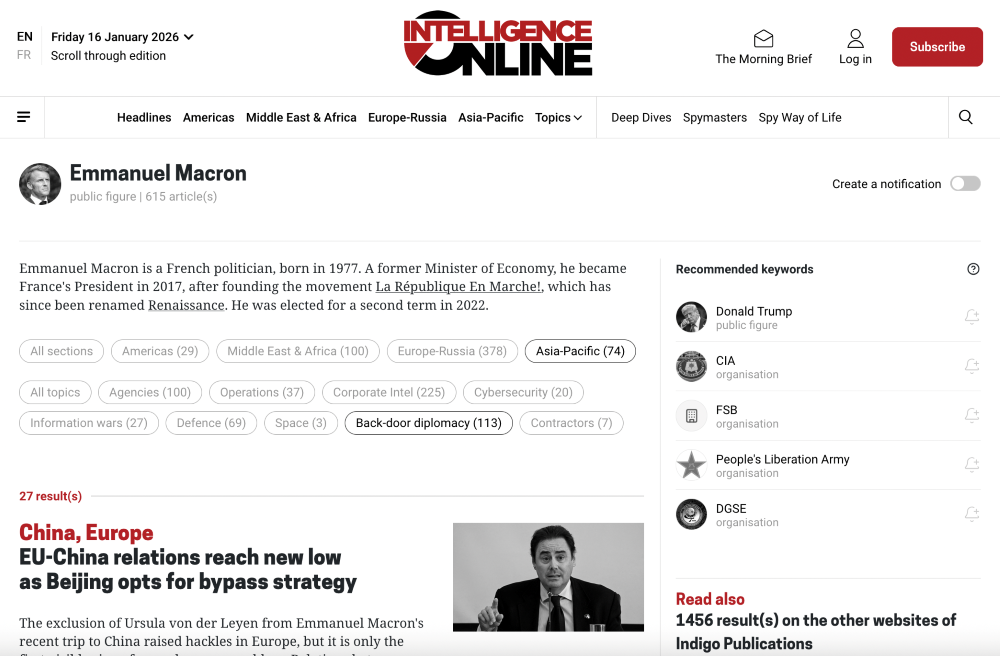
Site navigation is pleasingly straightforward. On the top left, the user can toggle between the English and French editions. At the top right are buttons to (1) sign up to receive Intelligence Online’s daily newsletter, (2) login, or (3) subscribe. Clicking on an article opens the full text, along with a sidebar of related topics. Users can sign up to receive emailed publication alerts for articles on topics of interest—usually public figures or organizations—or click on topics to view related articles and to drill down further. For example, I opened the topic page for Emmanuel Macron, where I was able to limit the results to articles about the French president that also matched the topics “Asia-Pacific” and “Back-door diplomacy.” With all three parameters, this search produced 27 results (see Figure 2).
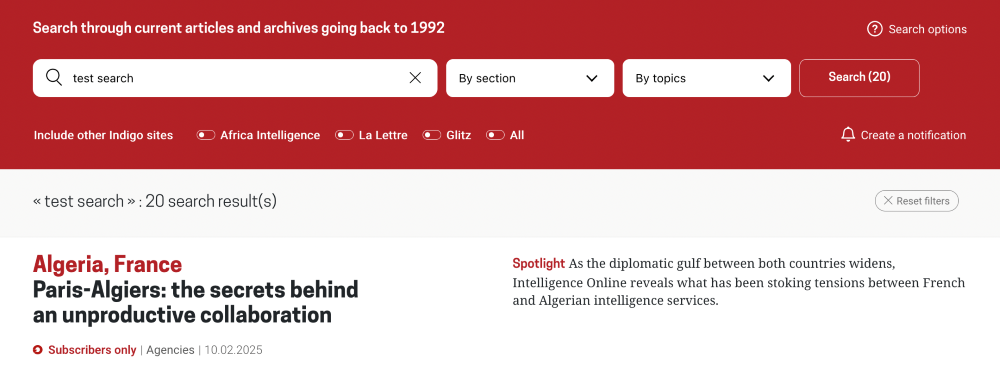
A search icon appears at the top of every page. To get started, users can conduct a basic keyword search. Results display beneath an advanced search panel (see Figure 3), which allows the user to filter by section and topic or to expand the search to other Indigo sites (Africa Intelligence, La Lettre, and Glitz). Exact phrase searching (search terms enclosed in quotation marks) and Boolean operators OR and AND (but not NOT) are supported.
Although it was redesigned in 2025, the Intelligence Online website has lingering problems with accessibility. The WAVE Web Accessibility Evaluation Tool flagged dozens of missing or empty form labels, buttons, and links on the homepage, plus other errors and alerts that could pose challenges to users of screen readers or other assistive devices. These are not necessarily critical accessibility problems but are worth fixing in future development. No VPAT or accessibility roadmap is publicly available for Intelligence Online or sister sites.
Users at any subscribing organization receive unlimited access to all content, including the archive. Academic pricing is based on the number of potential readers; institutions can contact the vendor for a quote. Individual subscriptions are available, but they are costly—$1,450 annually for an individual account, which includes a free second user (for comparison, World Politics Review charges $112 a year for an individual subscription). Trial subscriptions are not offered, but anyone can test out all the features of the website without a subscription; only the full text of most articles is behind the paywall. A free personal account is required to sign up for the daily newsletter or topic alerts. Subscribers may download or email article PDFs.
The Intelligence Online terms and conditions are restrictive by academic library standards but not unusual for news media licenses. They prohibit mass downloading, bot scraping or crawling, or dissemination of full-text articles to nonsubscribers by any means without prior written permission. But users are allowed to reproduce quotes or short extracts from articles and to share up to three gift articles weekly with nonsubscribers. Intelligence Online affirms that it complies with French and European Union privacy laws and does not share personal information with third parties.
Intelligence Online offers user authentication through IP address ranges, EZproxy, or email addresses. Account administrators may authorize lists of nominative email addresses for reader access, or multiple readers are allowed to share a single collective email address.
While Intelligence Online is unique in the English-speaking world, both in its coverage of global intelligence and its strengths in reporting on French interests and Francophone regions, other resources cover aspects of intelligence. Private defense and corporate consulting firms like Janes analyze and report on open-source intelligence and risk. Chatham House, the International Institute for Strategic Studies, and other think tanks publish expert analysis and commentary. Gale OneFile: Military and Intelligence and other research databases offer scholarly coverage of defense, security, and policy. Foreign Affairs, Foreign Policy, The Economist Intelligence Unit, and World Politics Review provide in-depth coverage of economic intelligence and international affairs. The topics covered by Intelligence Online are addressed periodically in mainstream dailies like The Washington Post, The Telegraph, or Le Monde. Still, the singular focus and specialized coverage of Intelligence Online stand out in a crowded field of media outlets old and new.
While expensive and specialized, Intelligence Online is a compelling value proposition for its equally specialized audiences. Its content is robust, distinctive, and balanced. In a 2016 interview, founder and board chair Maurice Botbol described Indigo’s approach as “strictly journalistic … critical but not polemical or partisan” (author’s translation). This commitment to independent journalism is reflected in Intelligence Online’s coverage, which does not appear to be shaped by hidden agendas or personal viewpoints.
The Intelligence Online website is easy and intuitive to navigate, browse, and search. The search engine is lightweight and does not incorporate generative artificial intelligence (AI) features, but it is superior to those of many news sites (The Washington Post, for example, offers only a plain keyword search, and The Guardian uses a custom Google site search). That said, the ability to filter searches by date range and sort results by relevance and date would benefit advanced researchers, especially those interested in older content.
Intelligence Online’s academic pricing and terms of use are generally in line with the cost of institutional subscriptions to The Economist, The New York Times, or other high-profile newspapers. It is expensive for a resource that commands niche appeal, and the average college or university is unlikely to realize value that is commensurate with the cost.
Intelligence Online serves specialized professional audiences. The high-quality content and seamless user experience will appeal to members of the intelligence and diplomatic communities, think tanks, and universities with advanced programs in intelligence and international affairs. In addition, defense contractors, energy companies, and other corporations may wish to consider this resource for their business analysts’ needs.
Indigo Publications. Annual financial statements. Retrieved January 16, 2026, from https://www.indigo.fr/en/annual-financial-statements/
Moinet, N. (2016). Donner aujourd’hui les réponses aux questions qui se poseront demain [Interview with Maurice Botbol]. Hermès, La Revue, 76(3), 152–155. https://doi.org/10.3917/herm.076.0152
10.1146/katina-030526-1
Copyright © 2025 by the author(s).
This work is licensed under a Creative Commons Attribution Noncommerical 4.0 International License, which permits use, distribution, and reproduction in any medium for noncommercial purposes, provided the original author and source are credited. See credit lines of images or other third-party material in this article for license information.