



What Makes This Repository Different? Its Values.
KCWorks for Institutions, an open-source repository service affiliated with Michigan State University, is distinguished not only by its price, but by its mission.

KCWorks for Institutions, an open-source repository service affiliated with Michigan State University, is distinguished not only by its price, but by its mission.

KCWorks for Institutions (KCWorks) is an open-source repository service built on the InvenioRDM repository and managed by Knowledge Commons (KC), a nonprofit academy-owned network affiliated with Michigan State University. KC’s dedication to open access scholarship and accessibility distinguish it from many vendors, as does its university connection.
KCWorks allows users to create and manage custom collections, assign DOIs, save multiple versions of submissions and associate several files with a single work, review statistics on an analytics dashboard, and share data via Open Archives Initiative Protocol for Metadata Harvesting (OAI-PMH) and application programming interfaces (APIs).
KCWorks is new, but rests on years of preparation and planning. KC, formerly known as the Humanities Commons, was formed in 2016 as a scholarly communications repository and networking site. The site’s first repository, Commons Open Repository Exchange (CORE), was built on the Fedora repository. In October 2024, the CORE content was migrated from Fedora to InvenioRDM and the new repository named KCWorks. This transition was spurred by a desire to increase functionality and meet the needs of the various communities using KC. While Fedora is flexible and can be highly customized, InvenioRDM was created to allow users to manage research data and publications without as much development.
In 2024, KCWorks was designated the public access repository of the National Endowment for the Humanities (NEH), underscoring its excellence. (A grant supporting the completion of the required work was terminated by the Trump administration in April 2025.)
Within an institutional instance of KCWorks, administrators can create custom collections and assign managers to review submissions on a collection or repository basis, with discussion between the submitter of a work and the collection manager enabled through a review page. Works can be associated with more than one collection. Collections can be distinguished by type, including event, project, topic, organization, and journal. All submissions to KCWorks are assigned two DOIs—one for the work and one for the specific version—that are registered with DataCite, a non-profit organization that provides the infrastructure necessary to create persistent identifiers for research outputs. Michigan State University Libraries is a DataCite member and pays an annual fee that currently covers KCWorks.
KCWorks allows users to preserve and make discoverable a wide range of content. The maximum file size is 500GB. While all file types can be uploaded, only the recommended file types can be previewed in the browser. For video content, the preview is not currently able to display captions. Captions can be uploaded as separate files on the same work. While not specifically a journal publishing platform, the repository does host journals and includes features like DOI assignment and submission review pages.
To enable discovery, the submission form encourages users to provide detailed metadata reflecting the variety of content the platform hosts. The form automatically saves throughout the metadata entry process, preventing frustration and data loss. The subject field utilizes FAST (Faceted Application of Subject Terminology) and Homosaurus as its controlled vocabularies to support the colocation of similar resources. Users can mark whether generative AI was used in the creation of the work and, if so, how. They can also create metadata-only records.
Once added, content can be exported or disseminated more broadly using OAI-PMH and APIs, allowing libraries to share records in their catalogs or other discovery platforms. Documentation on how to use OAI-PMH is available on KCWork’s “Help & Support” page. For works that are still in progress or should otherwise not be shared, users can make them undiscoverable by restricting the files and/or metadata or applying an embargo.
An analytics dashboard shows top subjects, usage details, top publishers, common work types, record views, downloads, and much more (Figure 1). The basic usage statistics—covering views and downloads—may not meet the needs of all institutions, but they are practical and avoid for-profit metrics, like Altmetrics, consistent with KC’s values and mission to support open research. Users can choose from several built-in visualizations—bar graph, pie chart—or generate CSV, Excel, JSON, and XML files with the raw data. Data is compliant with MakeDataCount and COUNTER standards.
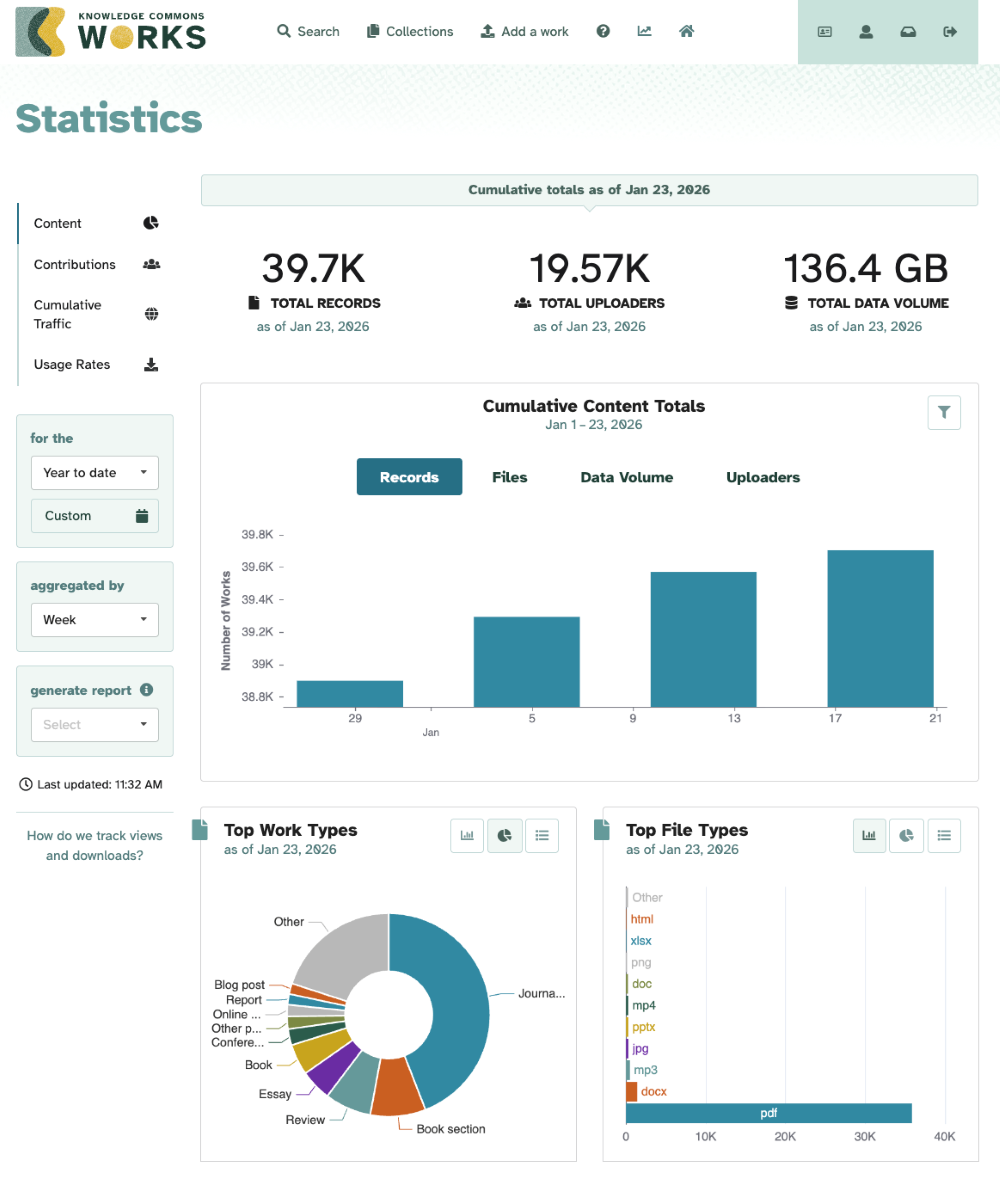
As KCWorks for Institutions is a new service, Michigan State University (MSU) is presently the only institution actively subscribed. Therefore, I will rely on examples from the MSU Commons collection. KC also hosts instances for several societies, including the Art Libraries Society of North America and the Association for University Presses.
The main page of an institutional Commons instance includes a search box, record previews for a sampling of the collection’s content, and three search facets (“Access status,” “Resource types,” and “Language”) (Figure 2). By default, the results are displayed with the newest deposits first.
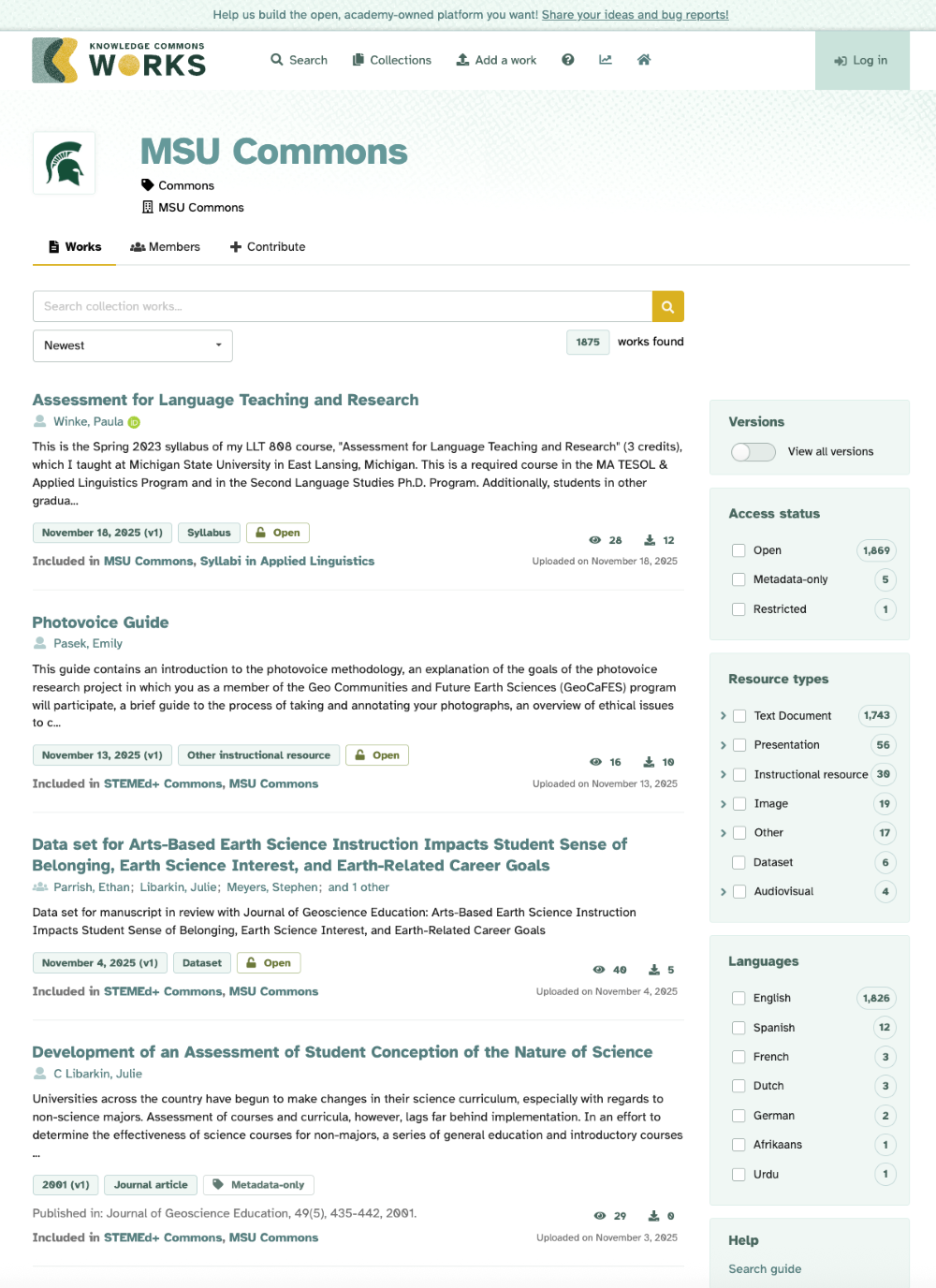
A search guide, linked below the facets on the right-hand side, helps users construct effective searches. Search capabilities include the option to use regular expressions (regex) in search terms and to retrieve values present in particular metadata fields, allowing for more advanced searching despite the repository not including a separate advanced search function.
Because the facets focus on the format of the works rather than their content, they are more helpful for refining results than for initiating a search. Providing facets for additional metadata fields, like subject, would improve discovery.
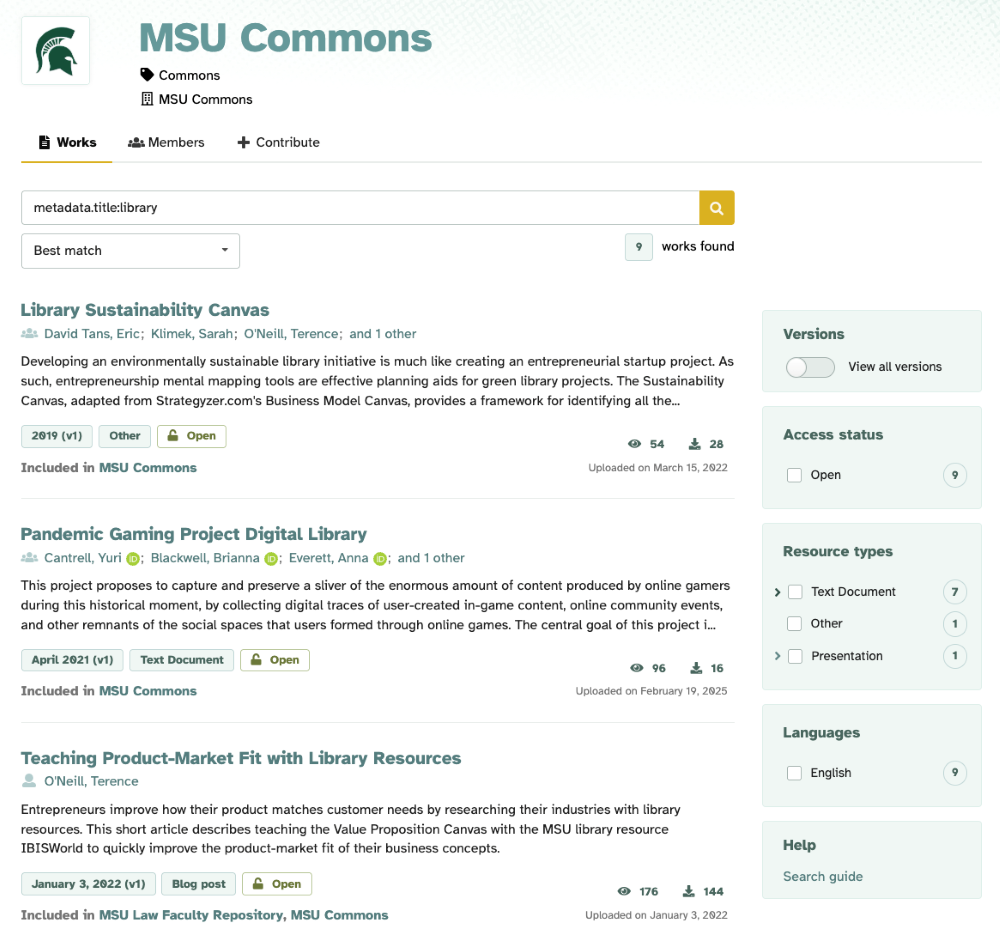
My search for “metadata.title:library”, retrieved 9 results (Figure 3). Each result includes the title, authors (with their names hyperlinked to other KCWorks results as well as badges hyperlinked to their ORCiD or Knowledge Commons profiles). Below the authors’ names a preview of the abstract appears, along with versioning information, the item’s resource type and access status, links to all collections the work is present in, and statistics on views and downloads.
I clicked on the result “Pandemic Gaming Project Digital Library.” A work’s landing page opens on the “Content” tab, which shows a description and a preview of the work (if available) (Figure 4). The “Details” tab contains publication details, identifiers, links to related works, and information about AI usage shared by the depositor. Additional tabs show contributors and statistics on views and downloads and allow the user to download the work and any supplemental files.
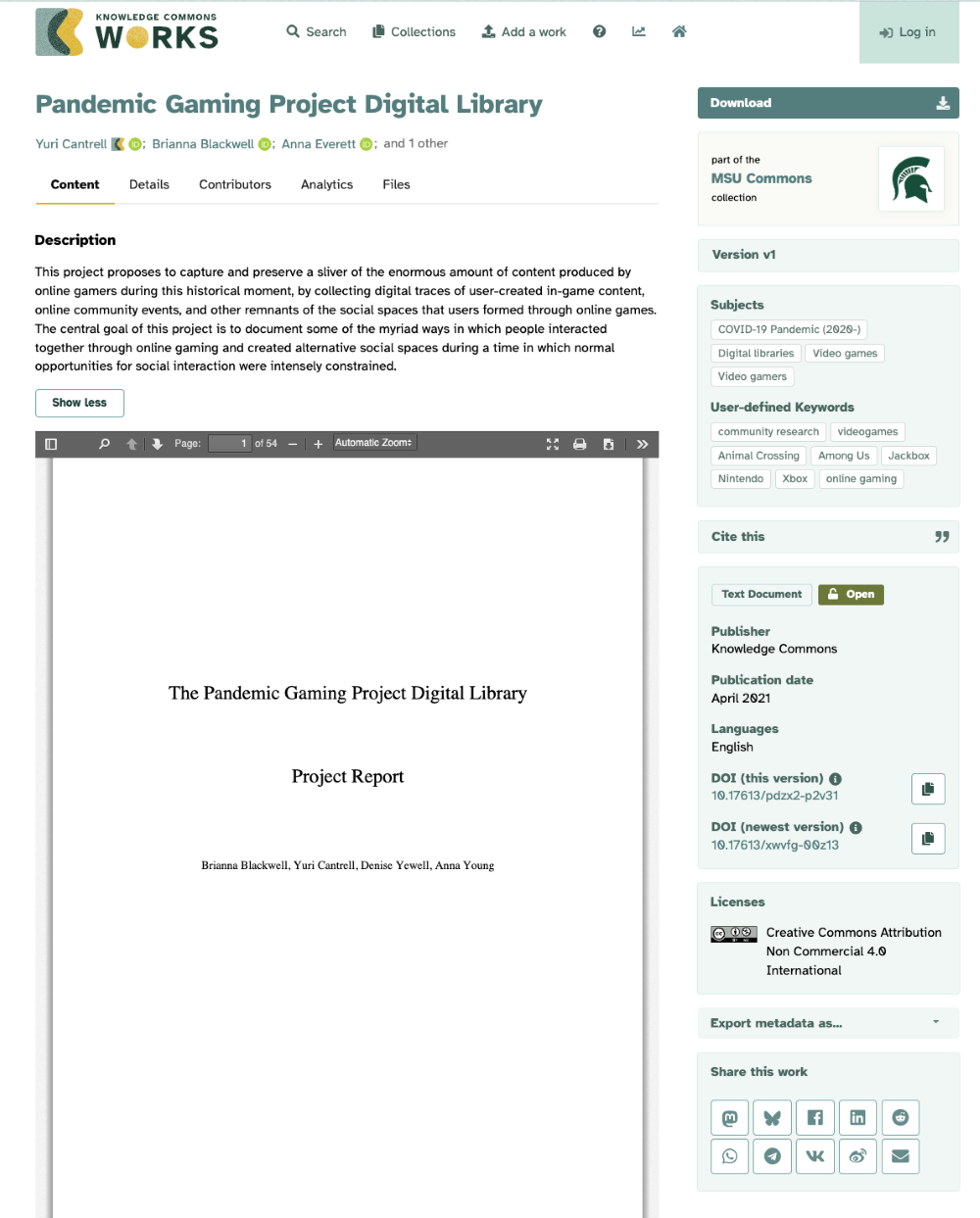
A download button appears at the top right. The work’s metadata, including collections the work is part of (linked to the relevant collection page), versioning, FAST subjects (hyperlinked to works across the KCWorks ecosystem), user-defined keywords, publisher, publication date, languages, DOIs, and licenses, appears in a sidebar on the right.
From the sidebar, a user can also generate a citation, export metadata, or share the work.
In addition to searching a KCWorks instance, users can click the “Collections” link in the page header to browse works across KCWorks by collection.
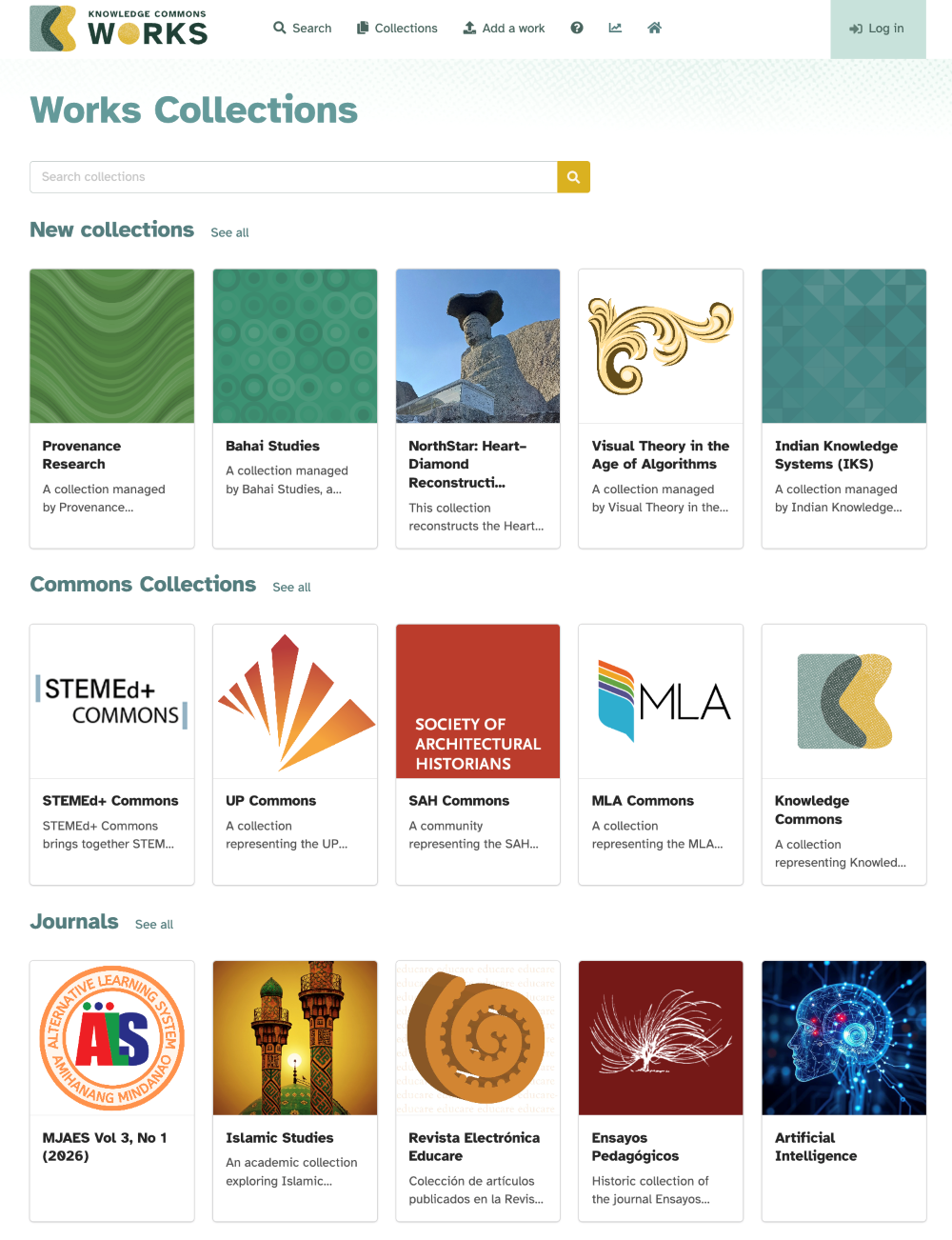
On the Collections page, collections are grouped by type (Figure 5). Within each group, the most recently updated collections appear first. Because only five collections for each group can be featured on the Collections page and the categories are not intuitive, it can be challenging for users unfamiliar with KCWorks to locate a particular known collection. Clicking “See all” is necessary to view all collections associated with a particular type.
The Collections page highlights the diversity of content on KCWorks and raises awareness of a given institution’s works to outside users, but the page is not convenient for users only interested in their institution’s content. For logged-in users, an institution-specific category called “My collections” helps to mitigate this.
Finding sub-collections within larger collections can also be challenging, as users can’t search collections hierarchically. KC staff plan to add support for hierarchical sub-collections during the first quarter of 2026.
KC has prioritized making KCWorks accessible according to WCAG 2.1 AA guidelines, with a particular focus on creating the scaffolding necessary for accessible works of scholarship in a self-deposit environment. A January 2025 VPAT is available. In instances where KCWorks “partially supports” accessibility criteria, the VPAT includes plans for remediation.
Two documents created by KC delineate clear expectations for their current operations and future goals: their terms of use and Principles of Open Scholarly Infrastructure (POSI) Audit.
The terms of use for Knowledge Commons establish the legal framework for the business operations for KCWorks. These terms include granting Michigan State University a license to use posted content with credit where possible. As much of the content shared in KCWorks is assigned Creative Commons licenses, redistribution and sharing of these works is subject to those license terms.
KC attempts to restrict the use of deposits for AI training and commercial gain by banning bots, though this remains an unsolved problem for all repositories. KCWorks does not sync automatically with proprietary platforms like Academia.edu or ResearchGate, reflecting KC’s commitment to open solutions.
The POSI Audit provides potential participating organizations insight into KC’s governance and sustainability. KC plans to draft a living will to address the conditions under which KC might stop operations and how assets would be preserved under the stewardship of a new organization or service. The audit also describes KC’s approach to using grant funds for time-limited activities, rather than ongoing operations, to ensure sustainability. Additionally, KC’s funding page lists grants it has received from a host of funders, including the Mellon Foundation, National Science Foundation, and National Endowment for the Humanities, as well as contributions by supporting member institutions, further emphasizing its successful operations to date and its meaningful impact on open scholarship.
Pricing is based on an institution’s region, type, and size and draws heavily from Carnegie classification. While there are established annual costs, KC is willing to work with institutions to establish a sustainable rate. Discounts are also available to consortia (20 percent off the total cost) as well as minority serving institutions (MSIs). As part of the base annual cost, KC will migrate content to KCWorks from an existing repository.
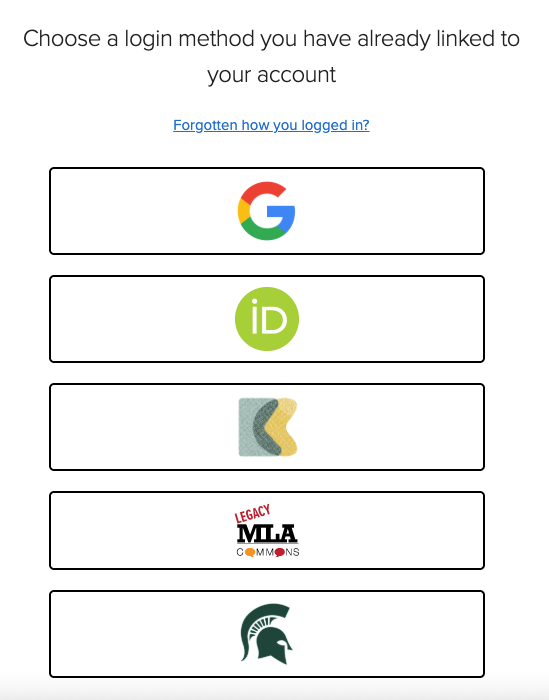
Currently, KCWorks supports five login methods (Figure 6), including ORCiD and, for MSU Commons, SimpleSAML. According to a roadmap outlining their near future plans, KC intends to launch an updated identity management system (IdMS), including single-sign on (SSO), during the first quarter of 2026. Participating organizations can limit posting in their collections to authenticated users.
KCWorks clearly positions itself as a nonprofit alternative to Elsevier’s Digital Commons repository (licensed by bepress), offering all the key features of a repository platform without the association with a commercial publisher. KCWorks even lists the creation of a migration tool for institutions that are leaving Digital Commons as a goal for the first quarter of 2026.
KCWorks distinguishes itself from competitors like Digital Commons, EPrints, and Figshare not only through its pricing, which they promise will match or beat the cost of any institution’s existing repository, but through its values, promoting itself as a repository “built by, for and with the academic community.” When institutions use KCWorks, they can also participate in the Commons community and contribute to the development of the repository.
Other open-source platforms, like DSpace and Hyku, are also closely comparable to KCWorks. But to migrate to either of these platforms, an institution often works with a vendor like 4Science or Notch8. Relationships with such vendors usually only last for the duration of the migration, leaving the institution responsible for long-term maintenance.
With KCWorks, the relationship between the institution and the vendor supporting the repository is long term, and the relationship between the vendor and the repository is closely coupled—KC developed KCWorks—allowing institutions to avoid the logistical load of selecting a platform and a vendor independently. As the developer of the platform, KC is also likelier to be deeply committed to it and support improvements. While KCWorks requires institutions to pay annually for an open-source platform, it also gives them opportunities to influence the platform and contribute to the community of KCWorks members. KCWorks may offer fewer options for customization because each instance is tied to a central platform, but this may change as more institutions with varied needs become members.
KCWorks is a work in progress, but one with compelling grant funding and thoughtfully articulated values and development plans. If your institution wants to be part of a larger community of scholars dedicated to open scholarship, it should consider joining.
The platform’s strengths include metadata and resource management, while search and retrieval could be improved. KC needs to address some accessibility issues, like showing captions within video previews, but they are transparent about their shortcomings and have plans to resolve them. While having only one institutional instance as an example may make attracting new members challenging, being an early adopter will likely come with more influence over development. As an organization, KC has existed for a decade and has plans to sustain itself into the future.
KCWorks is a good solution for institutions that want to use open-source platforms but that do not have the technical staff necessary to complete a migration and manage a repository on their own.
Baca, Larissa. (2024, October 30). Knowledge Commons Works has launched! Knowledge Commons. https://about.hcommons.org/2024/10/30/knowledge-commons-works-has-launched/
Knowledge Commons. (n.d.-a). Accessibility. Retrieved December 5, 2025 from https://about.hcommons.org/about-us/accessibility/
Knowledge Commons. (n.d.-b). Funding & Financial Support. Retrieved December 10, 2025 from https://about.hcommons.org/about-us/funding/
Knowledge Commons. (n.d.-c). Help & Support: KCWorks. Retrieved December 10, 2025 from https://support.hcommons.org/kcworks/
Knowledge Commons. (n.d.-d). Knowledge Commons Future Roadmap. Retrieved December 10, 2025 from https://about.hcommons.org/roadmap/
Knowledge Commons. (n.d.-e). POSI Audit. Retrieved December 10, 2025 from https://about.hcommons.org/about-us/posi-audit-may-2025/
Knowledge Commons. (n.d.-f). Search Guide. Retrieved December 8, 2025 from https://works.hcommons.org/help/search
Knowledge Commons. (n.d.-g). Terms of Use. Retrieved December 10, 2025 from https://about.hcommons.org/terms-of-use/
10.1146/katina-013026-1
Copyright © 2025 by the author(s).
This work is licensed under a Creative Commons Attribution Noncommerical 4.0 International License, which permits use, distribution, and reproduction in any medium for noncommercial purposes, provided the original author and source are credited. See credit lines of images or other third-party material in this article for license information.