



Incarcerated Authors, Sharing Their Stories on Their Own Terms
The American Prison Writing Archive, an open access collection of nonfiction writing by people with firsthand experience of incarceration, fills a crucial niche.
The American Prison Writing Archive, an open access collection of nonfiction writing by people with firsthand experience of incarceration, fills a crucial niche.

The American Prison Writing Archive (APWA) is an open access collection of digitized writings by people who are or have been incarcerated in the United States. The APWA began as an extension of the 2014 book Fourth City: Essays from the Prison in America, which collected nonfiction writing by people incarcerated in the United States. Since then, the project has expanded into a large living archive of more than 4,000 unique works produced inside US prisons, with new writing continually added. Despite some accessibility limitations, the APWA is a uniquely valuable primary source archive offering unparalleled insight into the lived experience of incarcerated people.
The APWA is both a publishing and a preservation tool for incarcerated or formerly incarcerated authors, amplifying the voices of those who have been historically marginalized and excluded from traditional archives. The works in the archive are unedited and freely accessible online, providing an uncensored platform for the authors. The archive primarily consists of essays but also includes poetry and song lyrics. It is hosted by Johns Hopkins University and accessible through their website.
Most authors find the archive through the APWA’s marketing efforts, including newsletters and resource directories distributed in prisons and jails. The APWA gathers basic information and extensive permissions from each author. Authors may publish anonymously or under a pen name, and the APWA does not publish work without explicit consent. Authors retain the copyright for their original work. The permissions form also collects statistical information, including age of first conviction, facility type, and security level, to help users find work by authors from specific demographics. The APWA allows each writer to remove, redact, or change identifying information for each work, giving the authors ultimate control over publication.
Works within the APWA vary widely in subject matter, length, and tone. While all of the works are nonfiction, examples range from poetry exploring coping mechanisms for isolation to autobiographical essays detailing the conditions of the prison and cells in which the authors live. Many of the works capture the pain and frustration of incarceration: “I don’t know what tomorrow inside these walls will bring, but I do know that I’m praying for this prison pain to stop. For more positive support, for my need for encouragement & compassion to be recognized and given without prompting” (Padilla, 2018). Others highlight how hope and inspiration still strike the authors while inside: “In this moment my body maybe trapped in some way; in some slight misfortune, but my mind, my whole infinite being, the true essence of who and what I truly am is absolutely free” (Fransen, 2015). Taken together, these works offer readers an opportunity to engage with the multifaceted experiences of incarceration.
Each piece of writing appears as a digital scan. While most scans are high quality, the digitized text may be difficult to read for some users due to the handwriting or the faintness of ink or pencil. Many of the works include transcriptions prepared by volunteers, increasing accessibility and allowing them to be searched via keyword. Because of the breadth of its materials, the APWA serves as a resource for students, educators, scholars, and activists whose work intersects with the lived experiences of people incarcerated in the United States.
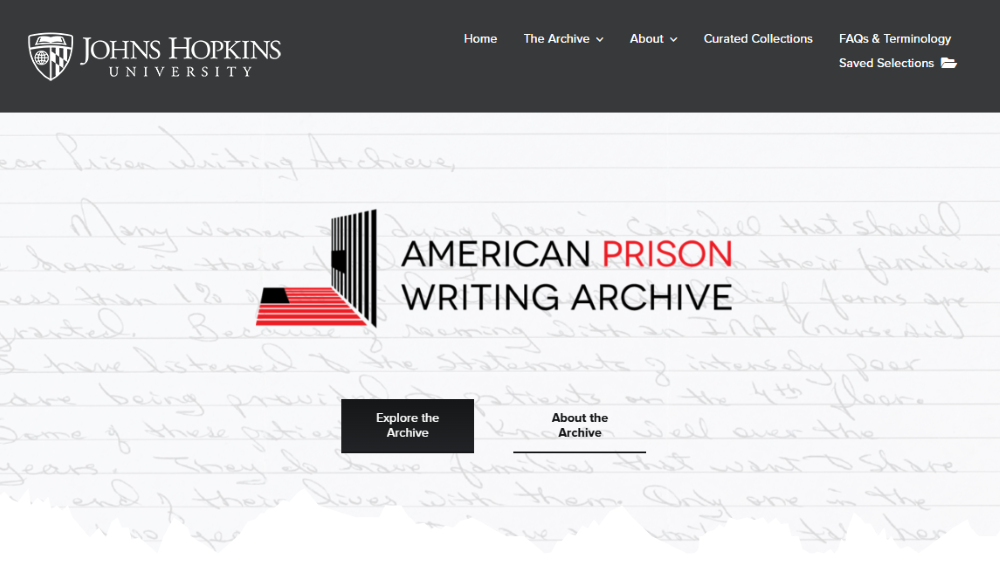
The APWA opens to a clean landing page illustrated with writings from within the Archive (Figure 1). The website has a bold graphic motif in contrasting black, red, and white, evoking a printed newspaper. Headers make it easy to navigate to works, background information, examples of student-curated collections, frequently asked questions, a glossary of commonly used terms, and the user’s saved selections folder. Authors’ and artists’ works are fully credited throughout the site.
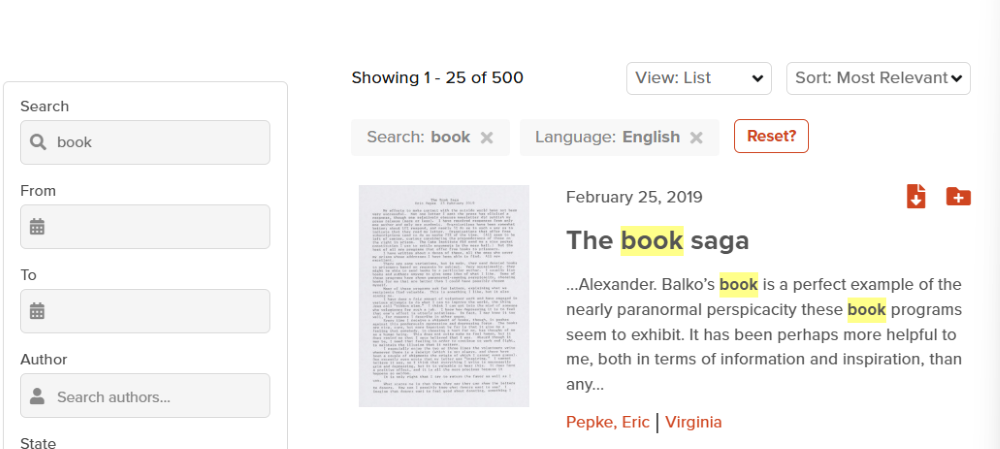
The “Explore the Archive” page offers a simple interface for searching and viewing each work. A free-text search field and facets covering author demographics and other metadata appear in a minimalistic sidebar to the left, with the majority of the page dedicated to scanned images of the work, titles, captions, and author information.
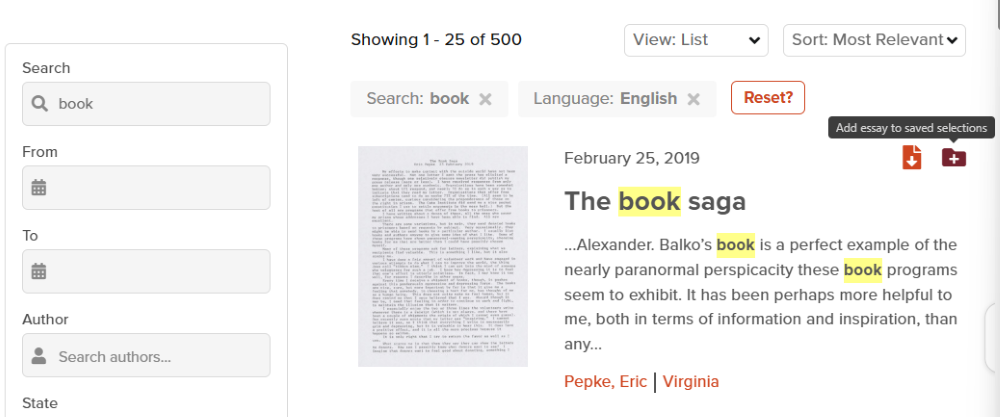
Figure 2 shows my search for “book” in the language “English.” Search specifications are displayed above the results and can be removed one by one or reset entirely. The search terms are displayed in context, highlighted. The free-text search includes work metadata and any transcribed text.
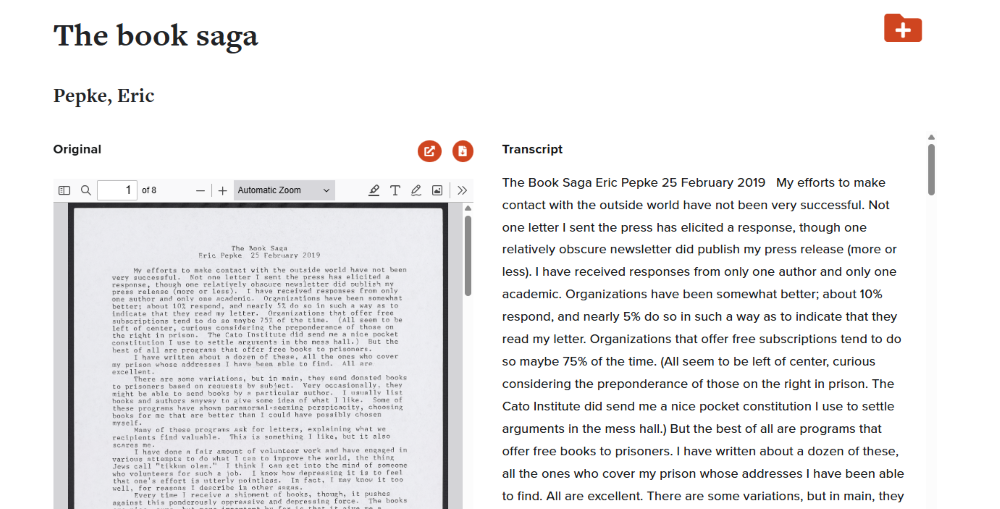
Selecting a work takes the user to an interface that displays the digitized copy and a brief set of metadata in a “details” box. Many works also include a plain text transcription (Figure 3). The image of the work can be marked up via highlighting, text and image insertion, and digital pen, and users can easily adjust the scan size or the number of scans visible on screen. They can also save documents as PDFs or in a “selections” folder, which allows users to download a .zip file containing all digitized PDFs and, if available, .txt transcription files. The “details” section can be expanded to show information from the primary search facets: author, state, date, genre, language, and the work’s length. The metadata is hyperlinked, allowing users to expand their search. For example, if I click the term “California,” it opens a new search showing all work from that state.
The website’s accessibility could be improved. The primary search interface does not have a prominent title or heading, which may be disorienting to new users. I tested the site with the NVDA screen reader and found that several buttons are unlabeled for screen readers, requiring users to infer their meaning based on visual cues. For example, while the “download” and “remove from selections” buttons display text when you hover over them (Figure 4), they do not have alternative text for a screen reader to read.
The interface for viewing works poses additional accessibility challenges. The NVDA reader was not always able to accurately read digitized text, especially handwriting. Many of the works are supported by transcriptions, but the presence or absence of transcriptions is not clearly marked on the title prior to opening the page. There is currently no published information on when transcriptions will be available for works that lack them, and the site does not have a linked accessibility roadmap.
The APWA is freely available online. No logins or passwords are required. The APWA’s digital interface has been supported by grants from the National Endowment for the Humanities and the Mellon Foundation. Initially located at Hamilton College, the archive moved to Johns Hopkins University after receiving a $2.3 million Mellon Foundation grant in 2022 (Wallach, 2022). The grant’s three-year period has just ended; while long-term preservation plans are not publicly detailed, the archive is clearly growing and receiving ongoing support.
Reveal Digital’s “American Prison Newspapers 1800s–present: Voices from the Inside,” supported by JSTOR, offers open access to over 200 serials printed by and for people incarcerated in the United States, complementing the writings available through the APWA. Along with other Reveal Digital collections, it is made freely accessible through donor crowdfunding or grant funding. The collection is much larger than the APWA and offers broader chronological coverage. But it includes far fewer search facets; users must rely on uncontrolled search terms to find relevant material. With newspapers, it’s also unclear how much censorship the authors encountered and how correctional oversight may have affected the content. While Reveal Digital includes a public takedown policy, it is unclear if the works were digitized with the author’s explicit consent.
Another platform similar to the APWA is Minutes Before Six, an open access, nonprofit platform that digitizes the fiction, nonfiction, and artwork of people who are incarcerated. While the content is similar to the APWA, its motive is different: it focuses on fostering direct connections between contributors and the outside world. The platform is organized around contributors, and visitors are encouraged to send comments directly to the authors and artists. Unlike in the APWA, works are vetted by the editor, and not all submissions will be added to the website. Although the collection is smaller than the APWA, it could serve as a complement for readers interested in fiction or art, or for those seeking to connect with authors or artists.
All three products contribute to a growing ecosystem of work by incarcerated authors. The annual PEN Prison Writing Awards highlight fiction, nonfiction, poetry, and screenwriting. Select prizewinning works from 1991–2019 can be viewed on their website, and winners from 2020–2023 have been published in yearly anthologies available for purchase at Amazon. PEN America’s Incarcerated Writers Bureau both publishes selected works and serves as a resource for best practices for people working with incarcerated authors and as an aggregate for publication opportunities for people inside. Similarly, the Minnesota Prison Writing Workshop highlights the work of their students and mentees including books, essays, and videos. The Prison Journalism Project provides a platform for direct news reporting from inside, allowing the people with lived experience to lend their voice to the narrative. In addition to written work, incarcerated creators have also shared their stories through podcasts, such as Ear Hustle, which is produced in San Quentin State Prison. These projects provide additional context and perspectives to support the writing and experiences documented in the APWA.
While a handful of news outlets publish the work of imprisoned writers, there are almost no organizations digitally preserving their work. The APWA fills this essential need. It also offers a unique feature: digital scans of the original handwritten or typed work, which provides context and a sense of intimacy that is lost when the writing is simply transcribed. The APWA has sought to archive these materials ethically and intentionally, allowing access to the author’s work as they intended for it to be presented.
While the concept is exceptional, there are a few weaknesses in both the interface and the content. Very few works currently include subject metadata, so users must rely on uncontrolled free-text searches to find works on specific topics. For example, there are currently six works tagged with the subject of “censorship,” but when I search for the word “censorship,” it returns 29 works. “Censored” returns 16, and the similar word “ban” returns 35. The search function will improve as more works include transcriptions, but for now, creative search strategies will be required to capture works on a particular topic.
The scope of the archive may also make it less appealing to some researchers. While users can search by date, they will find that the majority of the works are from 2017 to 2023, with a few earlier published works digitized by the Archive. The website may also not be suitable for users who need full access via screen reader or other important web accessibility features.
The archive has been stable since its inception and is currently expanding its collection and scope to better represent minoritized groups in carceral settings. After moving to Johns Hopkins, the APWA publicized its plan to archive 10,000 pieces of writing (Wallach, 2022). The “About the Archive” page highlights their commitment to collecting more works by women, gender-diverse, and Spanish-speaking authors. The APWA has put out an active call for nonfiction writing on experiences with incarceration in the United States and encourages its circulation to people inside. As the collection grows, it will become an even richer resource.
As a free, open access website, the APWA offers extraordinary value to researchers investigating the lived experiences of people who are incarcerated. The writings would be of specific interest to scholars and activists whose work intersects with anthropological social justice, first-person narratives, or studies of carceral states and imprisonment.
The APWA also offers ample opportunity for student engagement. The archive’s interface provides an interesting pedagogical tool for exploring how to contextualize writing as a material artifact. The site itself includes examples of collections created by students based on thematic elements. Educators using the APWA as a classroom tool will need to use caution and curate specific pages to ensure accessibility.
Erbil, D. (2020, May 14). The American Prison Writing Archive. ArtsEverywhere. https://www.artseverywhere.ca/prison-writing-archive/
Fransen, J.D. (2015). Being Of light: Meditation and transcendence inside administrative segregation. American Prison Writing Archive. https://prisonwitness.org/apwa-essay/being-of-light-meditation-and-transcendence-inside-administrative-segregation/
Padilla, G. (2018). Prison pain is distinct. American Prison Writing Archive. https://prisonwitness.org/apwa-essay/prison-pain-is-distinct/
Porter, S. (2021, October 13). Digital archive review: The American Prison Writing Archive (APWA). Not Even Past. https://notevenpast.org/digital-archive-review-the-american-prison-writing-archive-apwa/
Wallach, R. (2022, June 15). American Prison Writing Archive moves to Johns Hopkins. Hub. https://hub.jhu.edu/2022/06/15/american-prison-writing-archive-moves-to-hopkins
10.1146/katina-020326-1
Copyright © 2025 by the author(s).
This work is licensed under a Creative Commons Attribution Noncommerical 4.0 International License, which permits use, distribution, and reproduction in any medium for noncommercial purposes, provided the original author and source are credited. See credit lines of images or other third-party material in this article for license information.