



Ebook Collection Surveys Christianity Across Eras and Geographies
Despite uneven coverage, History of Christianity is a useful addition to Bloomsbury’s Theology & Religion Online platform.
Despite uneven coverage, History of Christianity is a useful addition to Bloomsbury’s Theology & Religion Online platform.

History of Christianity is a collection of ebooks that provide “a global view of Christianity and its evolving presence through the ages” (Bloomsbury Publishing, 2025b). The collection includes titles focusing on a range of geographic locations and eras, including Medieval England, Nazi Germany, Africa, South/East Asia, and the United States (see full title list).
History of Christianity is part of Bloomsbury’s Theology & Religion Online (TARO) platform, which offers multiple collections covering topics related to theology, biblical studies, and religious studies (see my previous Katina review on the Paulist Press: Ancient Christian Writers collection on the TARO platform). The 78 ebooks in the collection are published by Bloomsbury Academic and its imprints (including Lexington Books, Rowman & Littlefield, and Scarecrow Press). The content is current, with all but seven titles published in 2010 or later. Some notable titles include the five-volume Encyclopedia of Christianity in the United States, 17 titles from Rowman & Littlefield’s Historical Dictionary series covering Christian denominations, and Documents of the Rise of Christianity, which provides primary source materials from the first five centuries of the Christian era. Bloomsbury has no current plans to update the collection’s content.
Users search the collection or browse its six sections: Histories of Christianity, Histories of Christian Thought, Documents in the History of Christianity, Regional Studies, Denominations and Movements, and Biographies.
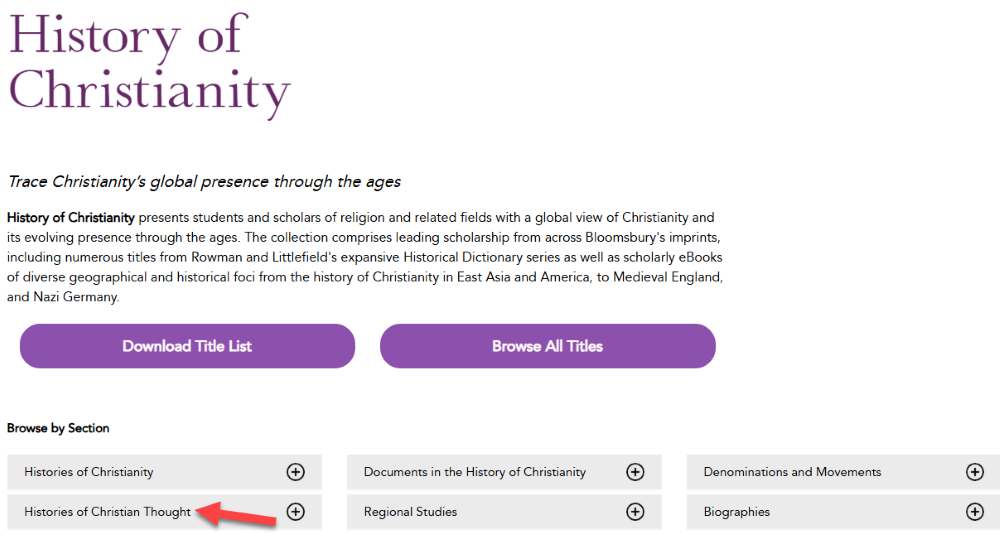
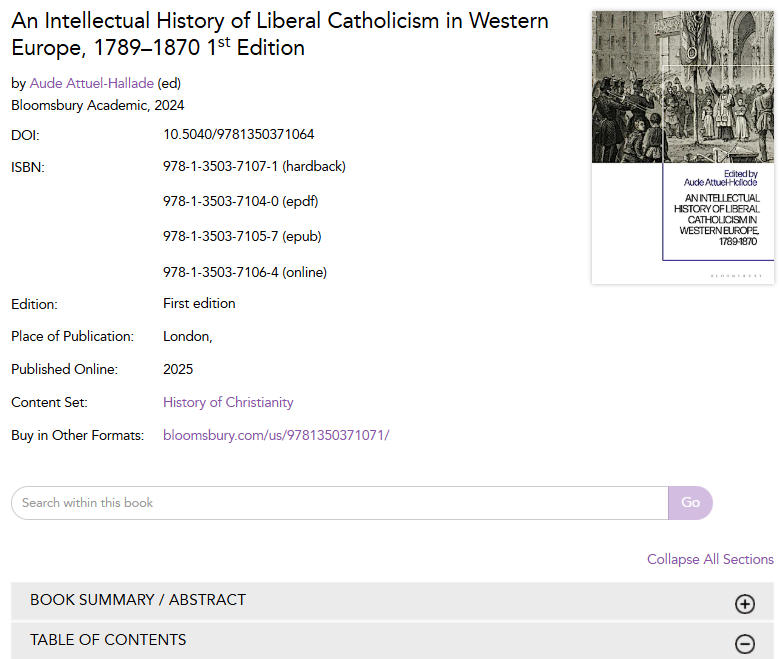
To explore the browse options, I selected “Histories of Christian Thought” (Figure 1). From the 18 titles listed I chose An Intellectual History of Liberal Catholicism in Western Europe, 1789–1870. A landing page for the book showed bibliographic information, a summary/abstract, a table of contents, and the option to search within the book (Figure 2).
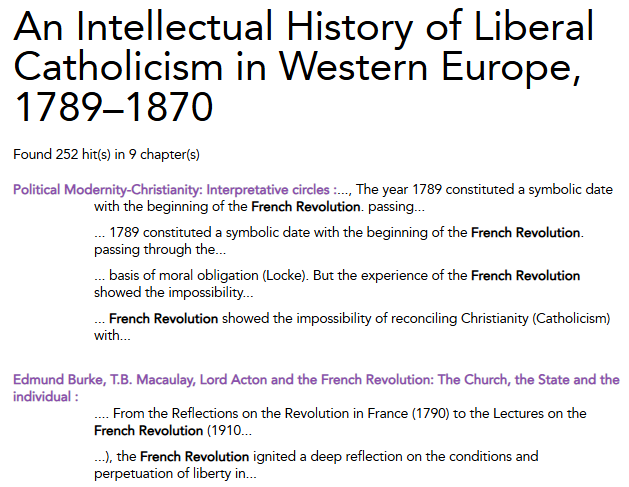
I searched within the book for the phrase “French Revolution.” When I used quotation marks, the search yielded 252 results within nine chapters (Figure 3); when I searched the phrase without quotation marks, I received 809 hits within ten chapters. The search results are organized by chapter and show the search terms in the context of the sentence in which they appear.
Users can also search within the entire History of Christianity collection, as well as across all TARO collections that are available through the user’s institution. This simultaneous cross-search is a considerable advantage of the shared TARO platform. I searched History of Christianity for “Vatican II” (Figure 4).
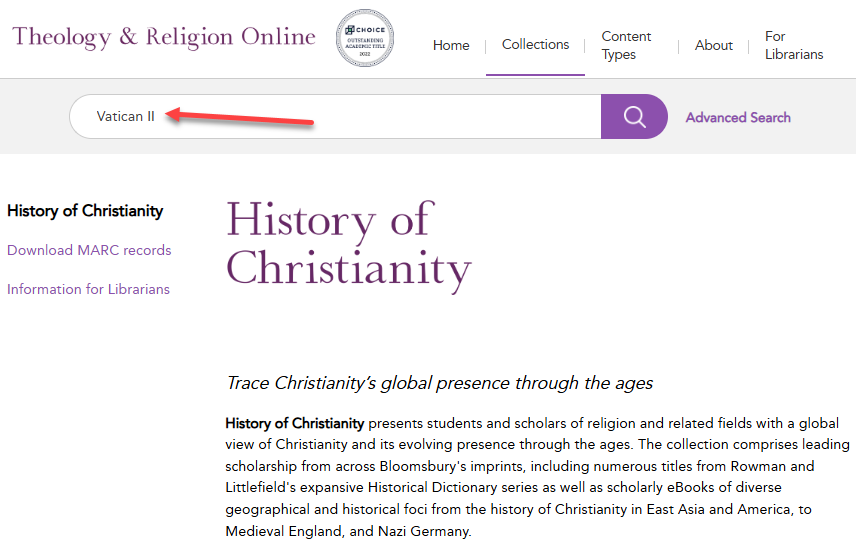
Again, using quotation marks improved my search results: I received 15,470 results without quotation marks, 971 results with.
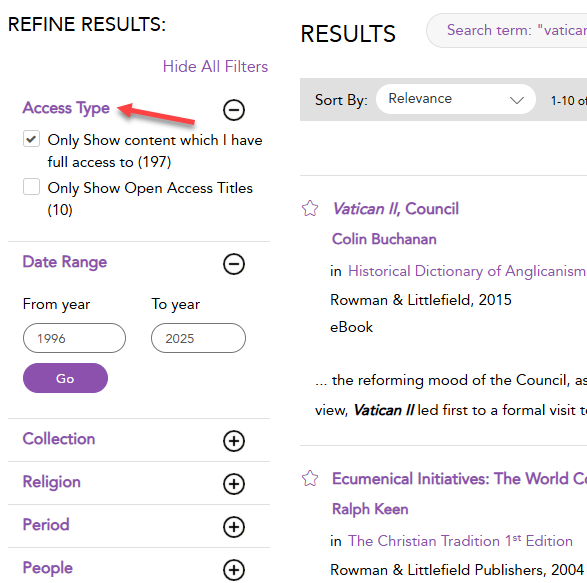
Filters on the left sidebar offer useful options for focusing the search. The Access Type filter, for example, can restrict the search to content the user has access to or to open access titles (Figure 5).
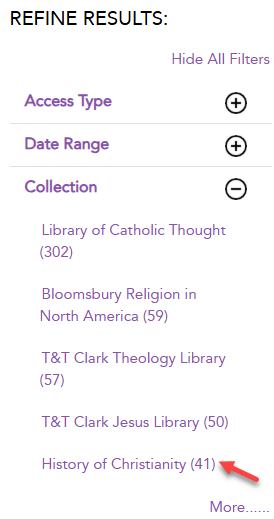
The Collection filter, which allows the user to limit the search to content within the History of Christianity collection, may be useful to libraries with multiple TARO collections (Figure 6).
The Period filter, which filters search results by era, is particularly helpful for the History of Christianity collection.
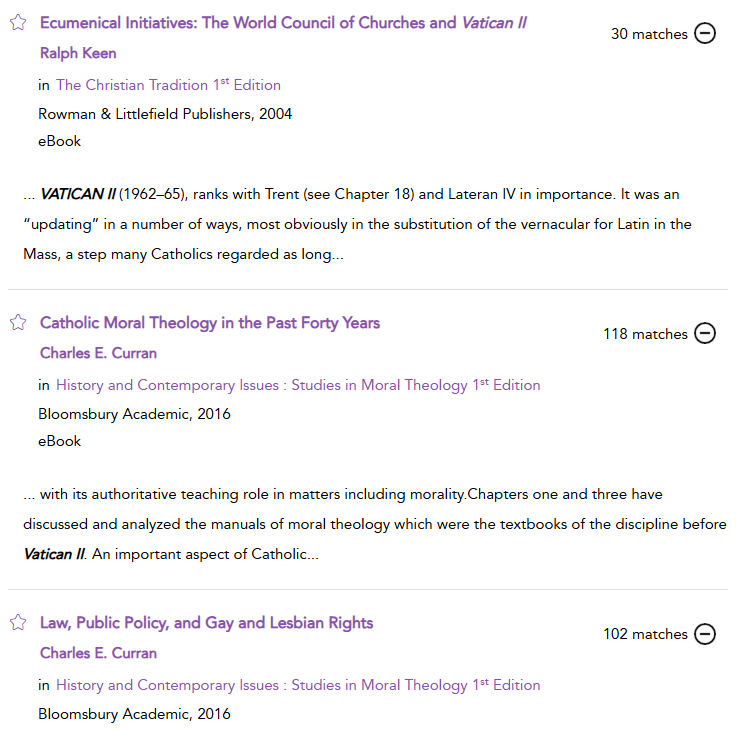
My search results for “Vatican II” included essays on a range of topics. The first three, for example, were “Ecumenical Initiatives: The World Council of Churches and Vatican II”; “Catholic Moral Theology in the Past Forty Years”; and “Law, Public Policy, and Gay and Lesbian Rights” (Figure 7). Nine of the 78 ebooks from History of Christianity were represented in the search results.
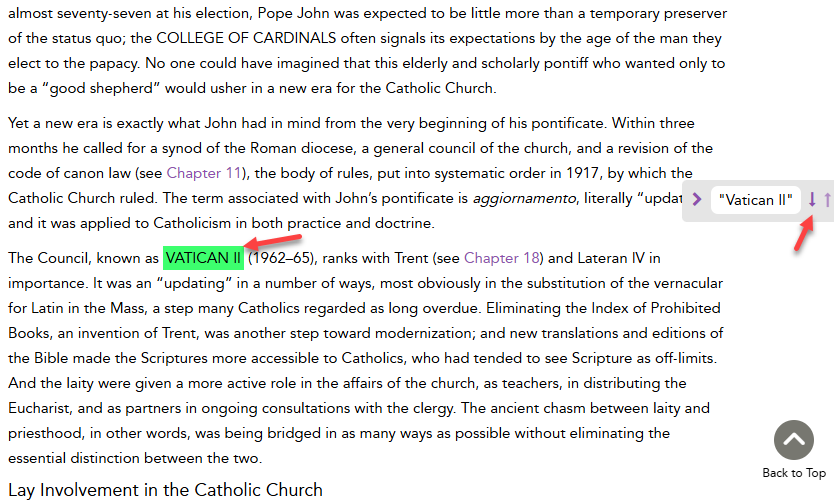
Clicking on a search result brings the user directly to the first instance of the search term within the text of the ebook. A floating toolbar on the right side of the screen shows the search term along with arrows for navigating to the next or previous instance, as well as an arrow to collapse the toolbar (Figure 8).
To save items for future access, a user can create a personal account (which they can also use on any Bloomsbury platform, such as Drama Online or Bloomsbury Cultural History). Saved items can be organized into folders, and citations can be emailed or exported.
Overall, the interface is intuitive and user-friendly for both browsing and searching.
Bloomsbury Publishing aims to comply with Level AA of the Web Content Accessibility Guidelines (version 2.2) for all products on the Bloomsbury Digital Resources platform. As Bloomsbury’s Accessibility webpage notes, Bloomsbury’s sites are built using code compliant with W3C standards for HTML and CSS, meaning it should display correctly in current and future browsers. Their text is resizable (legible at 200 percent zoom) and most of the site is fully accessible through keyboard navigation. The site has been manually tested using screen readers including NVDA 2023, Jaws 2023, and Voiceover on Windows and Mac operating systems. The recently updated VPAT (June 26, 2025) notes a few areas where improvements are ongoing, such as adding alt tags for some images or marking some icons as decorative. It should be noted that the VPAT covers all of Bloomsbury’s online platforms; only part of the evaluation applies to TARO.
I had hoped to find additional accessibility analysis from the Library Accessibility Alliance; their most current review, however, was a January 2022 evaluation of Bloomsbury Drama Online. Since Drama Online is a different Bloomsbury platform, not all of the accessibility evaluation feedback applies to TARO; in addition, the review doesn’t reflect more recent accessibility changes made by Bloomsbury.
Libraries can subscribe to History of Christianity or purchase the collection for perpetual access. Due to the specialized scholarly content in this collection and its appeal to a limited audience, the price does not vary by institution size; perpetual access is $10,198 and the annual subscription is $1,699 for all institutions. Perpetual access also requires an annual hosting fee of $200–$600 (based on institution type and size), starting one year after the library’s most recent purchase on the TARO platform. Consortial discounts may also be available.
Bloomsbury’s license agreement allows users to access the platform’s content online and to save or print single copies of portions of the licensed work. Links to platform content may also be included in electronic course packs and content management systems for courses offered for academic credit, as long as access is restricted to authorized users (e.g., current students/faculty/staff). Text and data mining are prohibited without prior written consent. For academic libraries, a single copy of an electronic original of an individual document may be shared through interlibrary loan for research or private study but not for commercial use.
MARC and KBART records are available to be downloaded from the TARO website. COUNTER 5 usage reports are also available via an administrator portal.
Access is provided through IP-authentication (such as EZproxy). Shibboleth and Open Athens are also supported.
The Cambridge History of Christianity covers similar content, providing “the first complete chronological account of the development of Christianity in all its aspects—theological, social, political, regional, global—from the time of Christ to the present day” (Cambridge University Press, 2025).
Oxford also offers two online collections with complementary content: the Oxford Research Encyclopedias on Religion has a subset on Christianity that includes 240 titles covering themes including the theology and philosophy of religion; religion and art; biblical studies; rituals, practices, and symbolism; and religion and politics. Oxford Handbooks Online: Religion includes 2,666 articles on Christianity. The handbooks cover a range of topics including theology, politics, biblical commentaries, the Reformation, and Anglican studies and noted biblical scholars such as Dietrich Bonhoeffer. Both of these Oxford resources overlap with the Bloomsbury History of Christianity collection, but each resource also offers many unique titles. By comparison, both Oxford collections provide more extensive coverage.
Alexander Street Press’s Twentieth Century Religious Thought: Volume 1, Christianity would be a good supplement to History of Christianity since it provides more coverage of contemporary authors and religious figures such as Karl Barth, Dietrich Bonhoeffer, and Pope Benedict XVI.
Additionally, there are other collections within TARO that offer complementary coverage, such as the Library of Catholic Thought, the two Paulist Press: Classics of Western Spirituality collections (Pre-1500 and Post-1500), and the T&T Clark Theology Library.
History of Christianity is a good addition to Bloomsbury’s Theology & Religion Online platform. The ability for libraries to strategically purchase and curate their own customized theology and religion collection is a real advantage of this resource.
But the collection contains only 78 books; it cannot encompass all aspects of the history of Christianity. Coverage across its six sections is uneven, with some sections containing only a few titles.
Additionally, some of the titles seem quite esoteric. For example, the smallest section, Documents in the History of Christianity, includes three ebooks covering Early Christianity (beginning through 325 CE), the Rise of Christianity (first through fifth centuries), and the Reformation (sixteenth century), leaving leaves large gaps of time uncovered. While the largest collection, Regional Studies, contains 21 books, some of those titles cover obscure communities and geographic areas, such as The Orthodox Church of Ethiopia, History of the Telugu Christians, or The Huguenot-Anglican Refuge in Virginia: Empire, Land, and Religion in the Rappahannock Region.
While the Denominations and Movements section includes 17 historical dictionaries of varying Christian denominations, in each dictionary, many entries run a paragraph or less.
Lastly, the Biographies section includes only seven titles; although A History of the Popes does provide biographies of popes from Peter through John Paul II, many other important figures in the history of Christianity—such as Thomas Aquinas, Augustine, John Calvin, and Martin Luther—go unrepresented.
Although Bloomsbury does not currently plan to add content to this collection, it would be strengthened by strategic additions of primary source documents from the missing eras, biographies of major Christian figures, and wider ranging geographical and cultural coverage.
History of Christianity will primarily appeal to academic or seminary libraries with strong collections in theology or religious studies, and to upper-level undergraduate students, graduate students, faculty, and researchers. It may be particularly useful to institutions with distance education programs or that teach many online or hybrid classes. This resource may partially duplicate print collections for some libraries; however, the ability to search within individual books, as well as to search within the History of Christianity collection and across all TARO collections, is a major strength, making the resource particularly appealing to libraries that already own at least one other TARO collection. To offer more complete coverage of the history of Christianity, libraries may wish to offer this resource along with either the Oxford Research Encyclopedias or Handbooks on Religion or the Cambridge History of Christianity.
Bloomsbury Publishing. (2024). Accessibility. Retrieved January 13, 2026, from https://www.theologyandreligiononline.com/accessibility
Bloomsbury Publishing. (2025a). History of Christianity Title List. Theology & Religion Online. https://res.cloudinary.com/bloomsbury-publishing-public/raw/upload/v1757077814/00_Supplementary%20materials/Humanities%20and%20Social%20Sciences/TARO%20-%20Theology%20and%20Religion%20Online/History%20of%20Christianity/TARO_History_of_Christianity_title_list.xlsx
Bloomsbury Publishing. (2025b). History of Christianity. Theology & Religion Online. https://www.theologyandreligiononline.com/history-of-christianity
Bloomsbury Publishing. (2025c). Accessibility conformance report international edition. https://res.cloudinary.com/bloomsbury-publishing-public/image/upload/00_Supplementary%20materials/VPAT/VPAT2.5_BloomsburyDigitalResources.pdf
Cambridge University Press. (2025). Cambridge History of Christianity. https://www.cambridge.org/core/series/cambridge-history-of-christianity/7B03B6D6CA1680C8B5624BE561EDEBCA
Michel, S. (2025, May 28). Foundational Christian texts, at your fingertips. Katina. https://doi.org/10.1146/katina-052825-1
10.1146/katina-011326-1
Copyright © 2025 by the author(s).
This work is licensed under a Creative Commons Attribution Noncommerical 4.0 International License, which permits use, distribution, and reproduction in any medium for noncommercial purposes, provided the original author and source are credited. See credit lines of images or other third-party material in this article for license information.