



Can An AI-Powered Platform Unleash the Potential of Open Educational Resources?
Sylla shows real promise. But it doesn’t yet work as advertised.

Sylla shows real promise. But it doesn’t yet work as advertised.

As academic libraries expand open educational resource (OER) programs to reduce textbook costs and improve accessibility, one of the most persistent challenges remains labor. Locating high-quality OERs, aligning content to specific courses, and supporting faculty adoption is time intensive, even at institutions with robust OER programs. Enter Sylla, an AI-powered platform designed to help libraries and educators discover, adopt, and export OERs at scale by analyzing course content and commercial textbooks.
In concept, Sylla addresses a genuine need. In practice, however, its strongest capabilities are constrained by workflow instability and incomplete functionality.
Sylla can recommend OERs tailored to a course or topic and can also evaluate commercial textbooks for “flippability”—the likelihood that suitable OER alternatives exist—at the chapter level or across an entire book.
The platform is organized into three stages: Discovery, Adoption, and Export. Users discover OERs using course-based recommendations, AI textbook analysis, or community-shared readers, then bookmark and submit selected resources for approval by a designated system administrator. Approved resources can be exported into a single compiled PDF reader intended for student use. This three-part structure positions Sylla as a workflow platform rather than simply an OER discovery platform.
When workflows function as intended, Sylla’s user experience is structured and coherent. But at other times, the experience is buggy and unclear. This variability matters because it affects the usability of the platform’s strongest features within typical librarian and faculty OER workflows.
Creating a Course
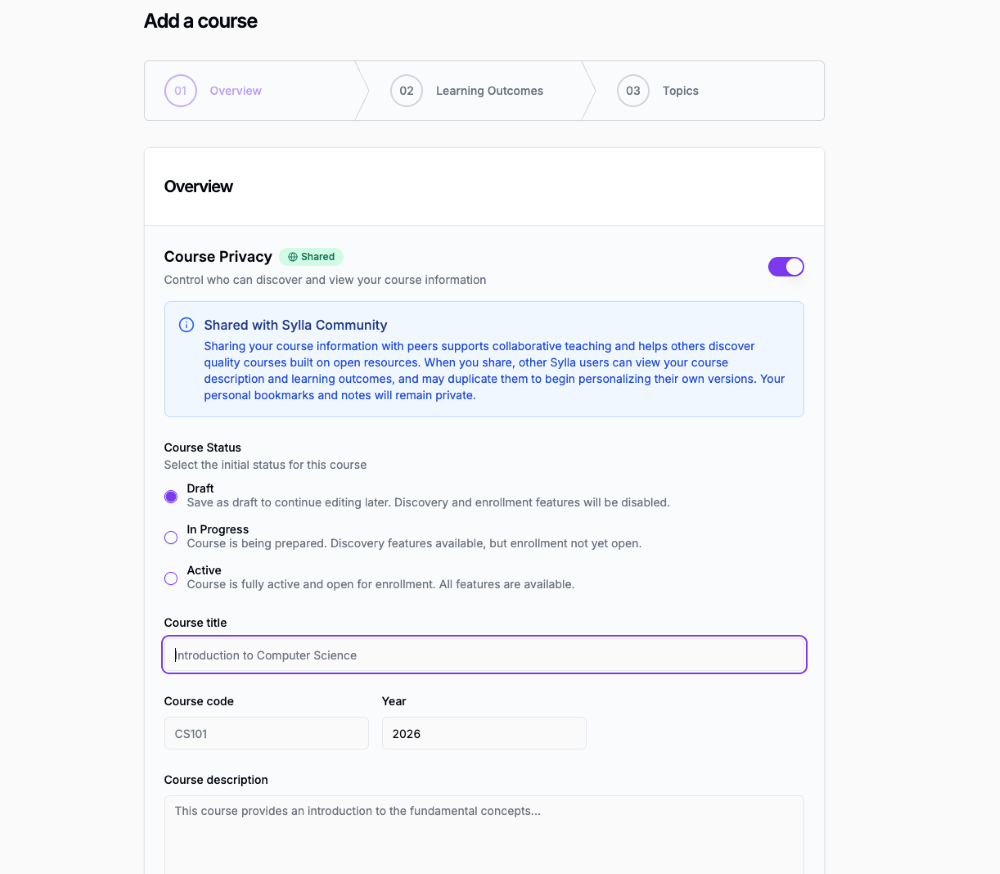
Because every exported reader is associated with a specific course, Sylla’s workflow hinges on course creation. Users can create courses manually through a guided workflow (Figure 1) or upload syllabi and course outlines through the “Import from File” tool, which populates course information automatically. In testing, syllabus upload performed well and extracted relevant information effectively. The platform encourages users to add detailed course descriptions, learning outcomes, and topic structures, emphasizing that richer course data produces stronger recommendations.
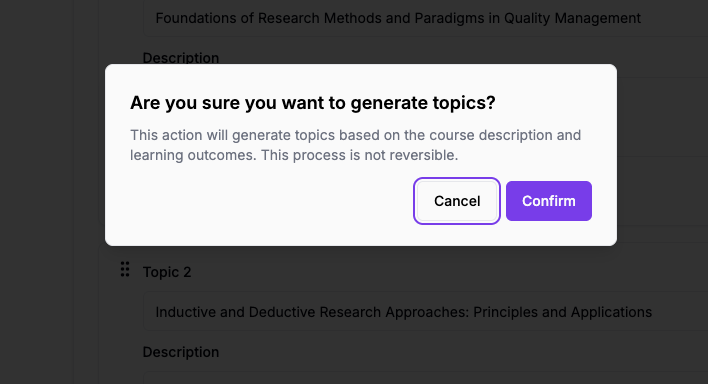
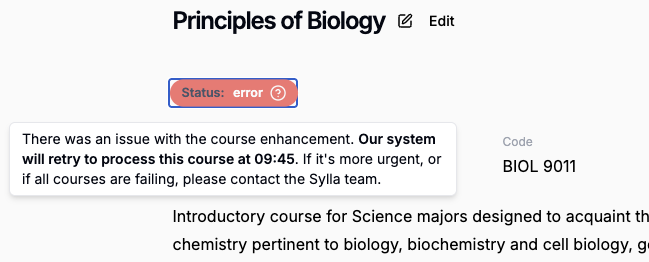
But the course creation workflow includes misleading messaging and, more importantly, blocking errors. For example, each time I attempted to generate a topic list using the AI feature, Sylla warned that the process “is not reversible,” even though suggested topics can be easily deleted and replaced (Figure 2). More significantly, after successfully creating courses and linking resources such as commercial textbooks, the platform repeatedly produced a “course enhancement” error that prevented access to the Discover OER Content feature (Figure 3). This effectively made it impossible for me to use course-based discovery for user-created courses, even after all previous steps had been completed successfully.
Discovery by Book
Sylla’s “Discovery by Book” workflow is one of its most distinctive features. It is designed to recommend OER replacements for commercial textbooks at the chapter level or across the entire book. In practice, however, this workflow depends heavily on Sylla’s Search tool, which is currently a point of friction.
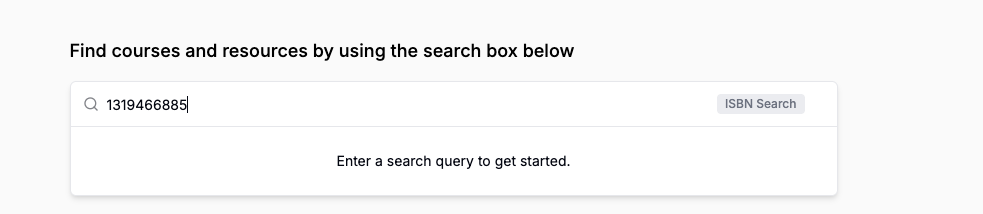
Although the platform says Search supports title and ISBN queries, title searching often fails to surface specific, widely used textbooks, and the suggestion dropdown does not consistently include sufficient identifying information to distinguish between similarly titled works. ISBN searching, which should serve as the most reliable workaround, also proved unreliable in testing. I sometimes received the message “Enter a search query to get started” even after I had entered an ISBN (Figure 4).
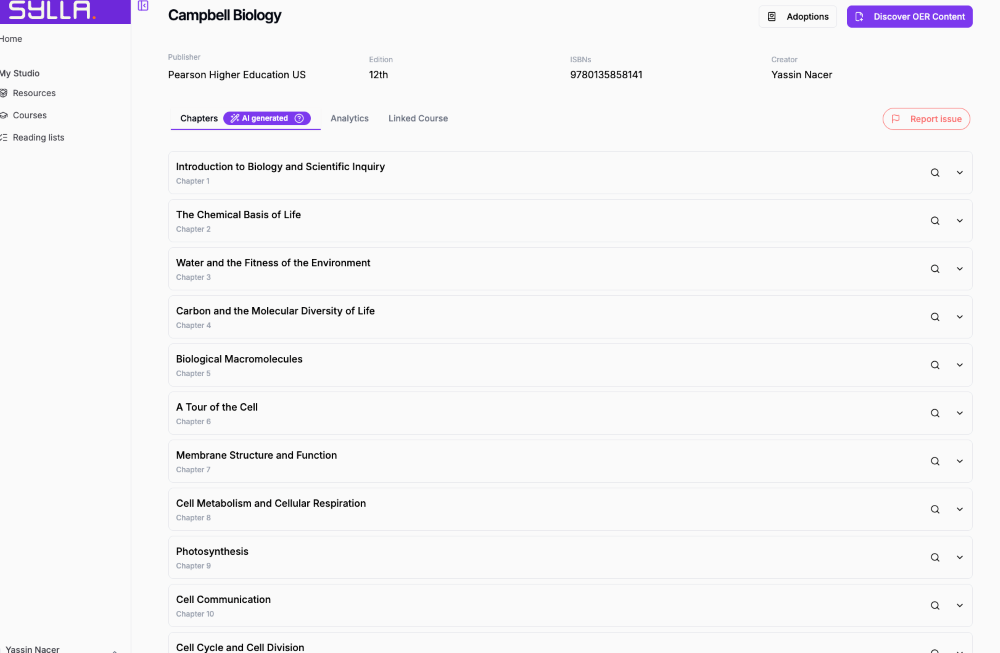
When the platform can locate the correct textbook, Sylla’s AI layer performs impressively. For example, the AI-generated table of contents Sylla produced for Campbell Biology was surprisingly accurate, even though the tool cannot directly search commercial textbooks and instead appears to reconstruct tables of contents from publicly available sources (Figure 5). The “flippable” judgment was useful and seemed plausible, and both chapter-level and whole-book OER replacement recommendations were strong. In particular, the platform’s AI-generated explanations of how closely each suggested replacement aligned with the original textbook chapter effectively supported evaluation and decision-making.
At one of the most important stages of the workflow, however, Sylla encountered difficulty. When I attempted to bookmark suggested chapters or books, I received an error message stating, “Unable to load saved learning resource information. Please ensure the selected item has valid data.” Since bookmarking is the mechanism that moves discoveries into adoption workflows, failures at this stage substantially limit the practical value of the otherwise strong recommendation engine.
Discovery by Course
Sylla’s course-based discovery workflow is the platform’s central use case. Users access the Discover page either by selecting the Discover OER Content button on a course page or by clicking a magnifying glass icon next to an individual topic or linked resource. The Discover interface supports both topic-level and course-wide searching and presents ranked OER recommendations. Users can view, bookmark, or hide results or copy links, in addition to refining results using filters for publisher, license, and search approach.
In testing, course-based discovery worked well when I used sample courses provided by the Sylla. Recommendations were relevant, the interface was straightforward, and bookmarking worked as expected. But when I tried to create my own courses, enhancement errors prevented access to Discover OER Content entirely (Figure 6).

Adoption, Approval, and Exporting
When discovery and bookmarking work properly, Sylla’s adoption pipeline provides a clear structure for moving resources from consideration into actual use: Bookmarked resources are added to a course’s Adoptions List, where they can be submitted for approval and reviewed by an administrator. Approved resources can then be exported into a compiled PDF reader delivered via email.
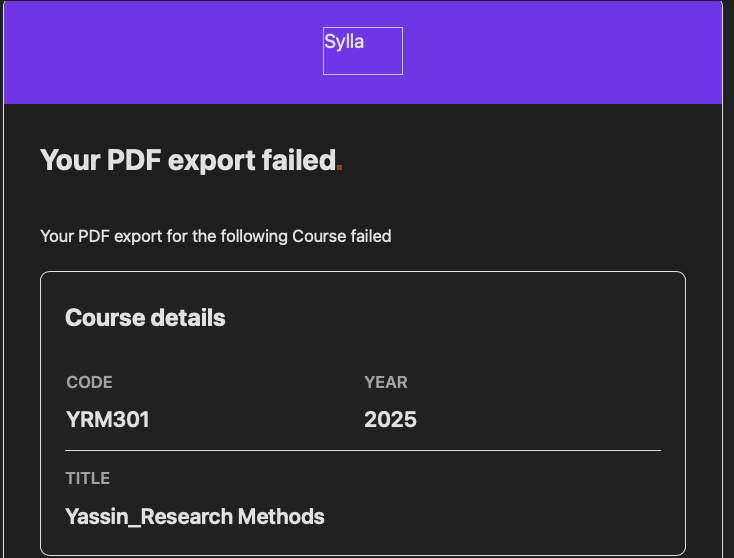
In testing, when I was able to access the discovery workflow, the bookmarking and approval steps functioned consistently. Exporting, however, proved less reliable. In one case, when I attempted to export a course reader, I received an email notification that the PDF export failed (Figure 7). Because exporting the reader is the platform’s final delivery step, failures at this stage are significant. Even when earlier steps work as intended, an unreliable export process prevents the platform from producing usable course materials.
Sylla’s pricing is not publicly listed. The platform appears to be offered as an institutional product rather than an individual subscription. If libraries request pricing details directly from the vendor, they should clarify what is included in onboarding, training, integrations, staff support, and ongoing development.
Many institutions already rely on established tools and library services for OER discovery and adoption. Related products include OER Commons, which offers robust OER discovery but lacks Sylla’s adoption workflow, AI assistance, and export tools, and Open Textbook Library, which provides vetted open textbooks but is less suited to chapter-level replacement. Both OER Commons and Open Textbook Library are free to use.
Sylla’s distinguishing feature is its attempt to use AI to help scale OER discovery, adoption, and export, all in a single platform.
Sylla’s AI discovery and explanatory layers can produce highly relevant recommendations and help users understand why a resource may be an appropriate replacement for a given commercial textbook, making them its strongest features. Its adoption and export workflows are also well designed and would be useful for OER programs requiring consistent oversight and documentation. When Sylla works end-to-end, it offers a compelling model for scaling OER adoption.
But Sylla currently feels unfinished. Search limitations create issues for textbook workflows, and course creation issues can prevent users from using discovery features entirely. User-facing messaging is sometimes misleading, and errors reduce confidence in the reliability of the workflow. Until course creation and enhancement are stable for end users, Sylla’s strongest capabilities will remain difficult to use consistently.
At this stage, I would not recommend Sylla for most institutions as a ready-to-implement solution, particularly for libraries with moderately sized OER programs that already have the capacity to provide discovery and consultation services.
That said, Sylla is a platform worth watching. Its underlying approach addresses a real need, and its AI features show real promise. With improvements to search reliability and course creation and clearer system messaging, Sylla could become a strong—even indispensable—tool for institutions seeking to scale OER adoption beyond individual courses. The platform may eventually be most valuable for institutions pursuing large-scale OER expansion, where librarian-mediated OER discovery alone may not be feasible.
For now, though, Sylla is a promising but evolving product best suited for careful piloting and future reassessment.
10.1146/katina-021926-1
Copyright © 2025 by the author(s).
This work is licensed under a Creative Commons Attribution Noncommerical 4.0 International License, which permits use, distribution, and reproduction in any medium for noncommercial purposes, provided the original author and source are credited. See credit lines of images or other third-party material in this article for license information.