



A Streaming Service for Spanish Teachers? ¡Qué útil!
Platino Educa offers a curated selection of high-quality Spanish language films for educational use. With stable content and fair pricing, it’s worth a look.
Platino Educa offers a curated selection of high-quality Spanish language films for educational use. With stable content and fair pricing, it’s worth a look.

Platino Educa is an educational streaming platform that features a curated collection of Spanish and Ibero-American audiovisual materials. Created by Entidad de Gestión de Derechos de los Productores Audiovisuales (EGEDA), a nonprofit collective management organization for intellectual property rights owned by film producers, the platform has stable content retention and strong curricular alignment, with minor limitations in subtitle availability and user support resources. In this review, I’ll explore the platform’s key features, including its unique pricing structure.
Designed for use by Spanish teachers and exclusively available in the United States, Platino Educa emphasizes audiovisual literacy and cultural learning alongside traditional language instruction. Content is delivered through an unlimited concurrent pay-per-view streaming model and includes full-length films, selected scenes, and accompanying educational materials, such as teaching guides and key sequences designed to be used in the classroom.
Notably, the platform contains 70 of the Academy of Cinematographic Arts and Sciences of Spain’s list of 100 must-watch Spanish films for students as well as special content selected to advance the United Nation’s 2030 Agenda. All titles are chosen in collaboration with renowned institutions in the fields of cinema and education to support curricular needs. The collection currently includes more than 300 titles, all exclusively available through the platform, which are listed on Platino Educa’s website. New content is regularly added to the platform, and the catalog has the potential to grow to as many as 400,000 titles. Subscribers can restrict content they deem inappropriate at the institution or class level.
Because EGEDA preserves producers’ ownership of the content, fees paid for Platino Educa go directly to film producers and into the film industry of Spain and Latin America. The platform offers stable licensing with one hundred percent content retention since its launch.
From the landing page, users can search or browse content (Figure 1).
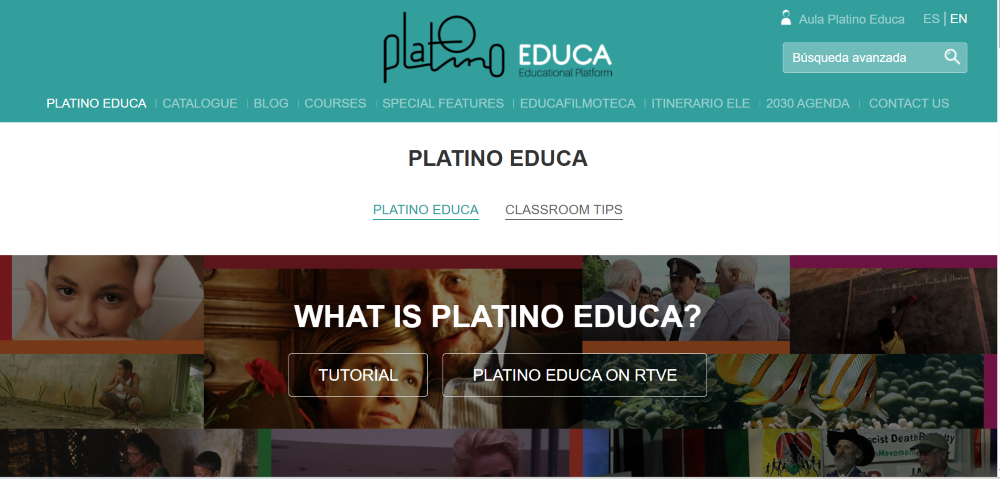
The user can toggle the platform between English and Spanish, and a search field at the top right supports keyword searches in either language. For a more advanced search, users can filter by age rating, pre-defined collections (focused on audiovisual literacy, Spanish language instruction, and different subject areas), and themes (the United Nations 2030 agenda, arts, filmmaking).
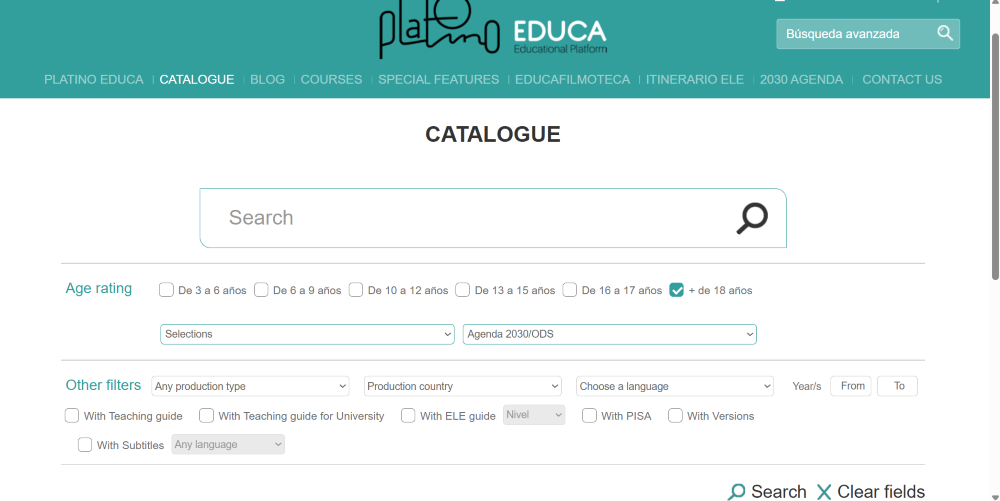
Users can further filter by production type (an A–Z list of options from advertisements to web series); production country; language; and publication year range. Check boxes at the bottom of the page allow the user to limit the search to results with a teaching guide, with a teaching guide for university classes, with an ELE (Español como Lengua Extranjera, or Spanish as a Foreign Language) guide, with resources related to the Organisation for Economic Co‑operation and Development’s Programme for International Student Assessment (PISA), with multiple versions, and with subtitles (any language). Below the search fields, all the films in the collection are listed alphabetically.
I tried out the search by selecting the 18+ age-rating category in combination with the 2030 Agenda/Sustainable Development Goals (ODS) theme and received 17 results (Figure 2).
Users can view results in an alphabetical list or as a visual grid featuring the films’ posters. This dual-display option supports both efficient scanning and visual browsing. A search for a film by title—for example, Bagatela—leads directly to the video (Figure 3).
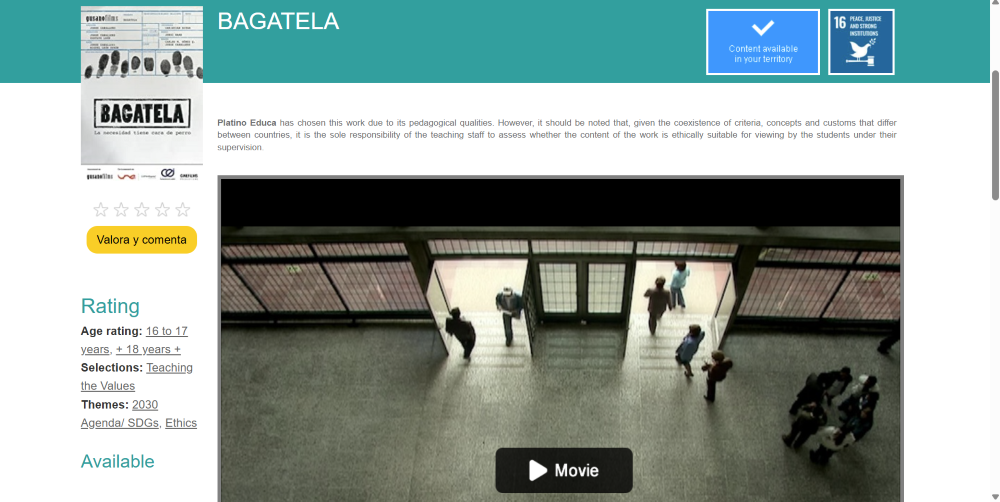
Detailed metadata, including a synopsis, production information, available film sequences, and a gallery of still images, appears below and alongside the video. Every title comes with a teaching guide, which includes a summary of the film, background information on the filmmaker and additional instructional materials.
Platino Educa’s accessibility features include icons to indicate whether a work comes in different versions, has subtitles, comes with a teaching guide, has corresponding PISA resources, or is available in a given location. Some films lack subtitles. The platform doesn’t mention WCAG.
The Terms of Use warn that the viewing experience depends on factors such as location, bandwidth, and internet speed. Users agree to settle disputes through binding arbitration under the US Federal Arbitration Act. The governing law is that of the state of South Carolina.
Platino Educa operates on a capped pay-per-view pricing model, with an annual minimum fee that covers a set number of complimentary plays. After the minimum number of complimentary plays is reached, additional plays are charged at a rate of $3.20 per play. The minimum platform fee and the number of complimentary plays are customized based on institutional factors such as full-time equivalent (FTE) enrollment, institutional size, and whether the university is fully online. For example, an institution with FTE of less than 6,00 receives 94 free plays and pays a minimum fee of $300 annually, while an institution with FTE between 20,000 and 40,000 has a minimum annual fee of $800 and receives 250 free plays.
To assist with budgeting, pricing caps are in place for the first three years. Platino Educa sets a strict maximum spending limit (also based on your school’s size). Once the maximum fees are reached, colleges continue to access all Platino Educa films and materials for no cost. Trial access is available, allowing librarians to evaluate the platform’s content, functionality, and overall usability prior to purchase.
To use Platino Educa, you must be a teacher, student, or administrator currently employed by or enrolled in an educational institution with an active paid license. Users who wish to view content can receive a personal code that allows them to create a username and password or access the platform through an authorized static IP address.
The product most closely comparable to Platino Educa is Digitalia Film Library, a streaming platform featuring more than 1,800 films and documentaries from 51 countries in 42 languages, ideal for language, cultural, and media studies. Digitalia, however, is designed for general entertainment rather than formal classroom instruction and does not include learning guides, while Platino Educa is explicitly aligned with curricular use.
Platino Educa complements widely used streaming video services such as Kanopy by providing access to high-quality Spanish and Latin American films. A key strength of Platino Educa is its stable licensing model, which has maintained one hundred percent content retention since the platform’s launch, ensuring long-term reliability for academic programs. Its value to the library and educational community has been further recognized through industry accolades, including the Best New Product Award at the Charleston Conference in 2022 (Hawkins, 2022).
But the platform has some limitations. It would be helpful if all audiovisual materials had subtitles. While users can email Platino Educa with questions, the platform could use a more robust FAQ page and tutorials to help users search, features available on platforms like Kanopy and Swank.
Platino Educa fills a notable gap in access to high-quality, curated Spanish and Latin American audiovisual materials for educational institutions. While the platform has some limitations, its strong educational value, pay per view pricing model, and stable content retention make it worth a look.
Hawkins, D. (2022, November 3). Charleston Premiers. The Charleston Hub. https://www.charleston-hub.com/2022/11/charleston-premiers-5/
10.1146/katina-032426-1
Copyright © 2025 by the author(s).
This work is licensed under a Creative Commons Attribution Noncommerical 4.0 International License, which permits use, distribution, and reproduction in any medium for noncommercial purposes, provided the original author and source are credited. See credit lines of images or other third-party material in this article for license information.