



With Evolving Collections, This Research Database Explores Urgent Global Challenges
Oxford Intersections carves out a unique niche, offering interdisciplinary analysis and international perspectives on timely topics.

Oxford Intersections carves out a unique niche, offering interdisciplinary analysis and international perspectives on timely topics.

Oxford Intersections is a unique, high-quality scholarly resource published by Oxford University Press (OUP), designed to provide thorough, peer-reviewed, interdisciplinary analysis of urgent and challenging global issues through evolving collections of 6,000–10,000-word articles.
I recommend this resource for academic institutions supporting undergraduate, graduate, and faculty research, particularly those valuing international, interdisciplinary perspectives and requiring maximum currency on rapidly changing subjects.
The platform, which launched in 2025, is organized around themed collections, or “Intersections,” each of which is intended to grow from an initial 30–35 articles to approximately 300 articles over a three-year period, after which the content will be complete and owned in perpetuity by the purchasing institution. As of December 2025, there are four Intersections—AI in Society, Racism by Context, Social Media in Society and Culture, and, the most recent release, Borders. Going forward, OUP plans to release four new Intersections annually.
Rather than generating singular reports that limit subject coverage and voice, the product presents each topic through multiple peer-reviewed articles commissioned from leading scholars. This structure ensures a genuine diversity of viewpoints. For instance, the Intersection AI in Society features 116 articles, including varied titles “AI and Antifeminism Backlash,” “Artificial Intelligence and the Future of Nuclear Weapons,” “AI Personhood from the Perspective of Jewish Philosophy,” and “Human–AI Friendship Is Possible and Can Be Good.”
The content for each Intersection is curated by a dedicated editorial team, whose members and advisory board are drawn from across the world. For example, the editorial team for AI in Society includes members from Japan, Germany, Israel, the UK, Australia, the United States, Norway, India, the Netherlands, and Canada.
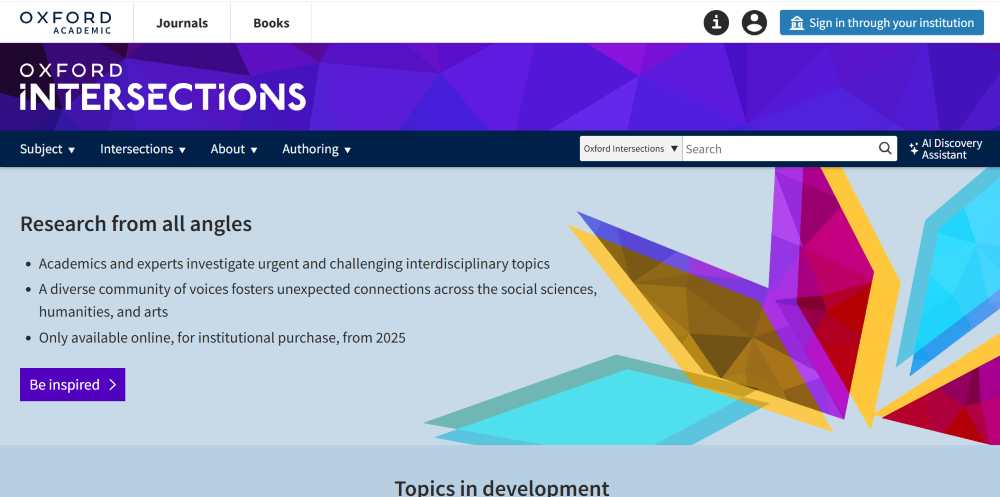
The Oxford Intersections homepage offers a launchpad to individual Intersections, updates on forthcoming topics, and a feed of the latest published articles (Figure 1). Navigation primarily occurs via the “Intersections” drop-down menu, which currently lists the four available topics.
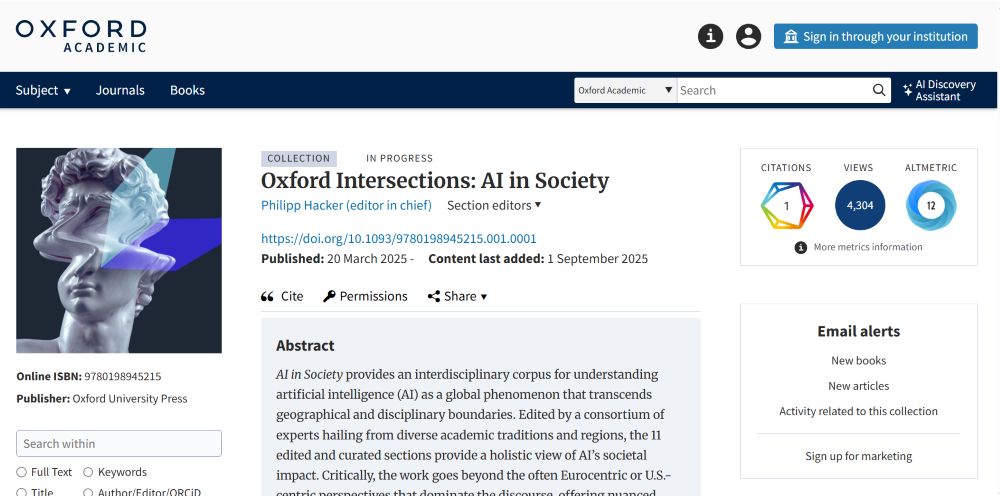
Selecting an Intersection takes the user to a dedicated homepage for that topic, which features a prominent abstract describing the topic’s interdisciplinary approach and an outline of the editorial oversight (including section-specific editors) (Figure 2). Articles are displayed below the abstract, with default sorting by title (A–Z); users can also sort by title (Z–A), date (newest or oldest), or relevance.
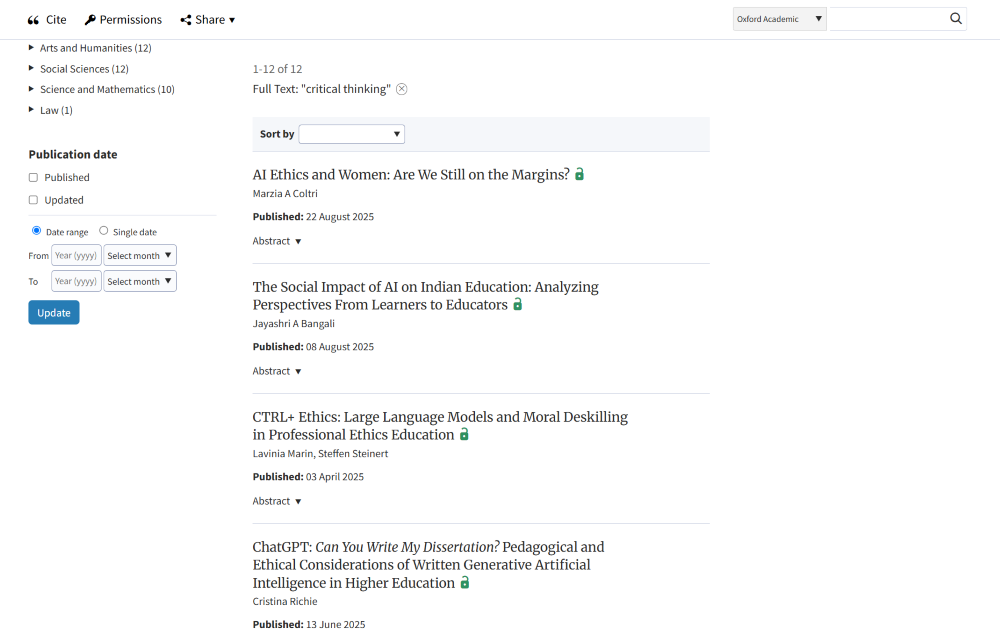
While browsing is efficient for the current article volume, the expected growth to approximately 300 articles per topic necessitates good search functionality. The search interface, positioned on the left-hand sidebar, includes both a standard keyword box and options for field-specific searching, allowing for the creation of complex queries. The search functionality demonstrates both precision and limitations when dealing with conceptual terms: a test search for “critical thinking” retrieved 12 results out of 116 total articles in the Intersection AI in Society, and the number remained unchanged whether or not I used quotations. When I sorted by relevance, I found the initial four results highly pertinent (Figure 3). The remaining articles, however, primarily mentioned the concept within literature review sections rather than addressing it as a core subject.
When browsing, users can filter based on OUP’s broad subject categories (e.g., Arts and Humanities), which can be expanded to narrower sub-disciplines, each with a corresponding article count. Topic-specific “Section” headings allow for precise searching within the editorial framework. While the underlying scope of these sections is clearly defined in documentation OUP provided me, the lack of on-screen explanation may limit users’ ability to navigate them intuitively.
On the right sidebar, the metrics box prominently displays usage statistics for the entire Intersection, including total citations, views, PDF downloads, and Altmetric stats (refer back to Figure 2). Beneath this, users can sign up for alerts to track activity related to the specific collection, which is useful for staying abreast of new article releases during the three-year publishing cycle.
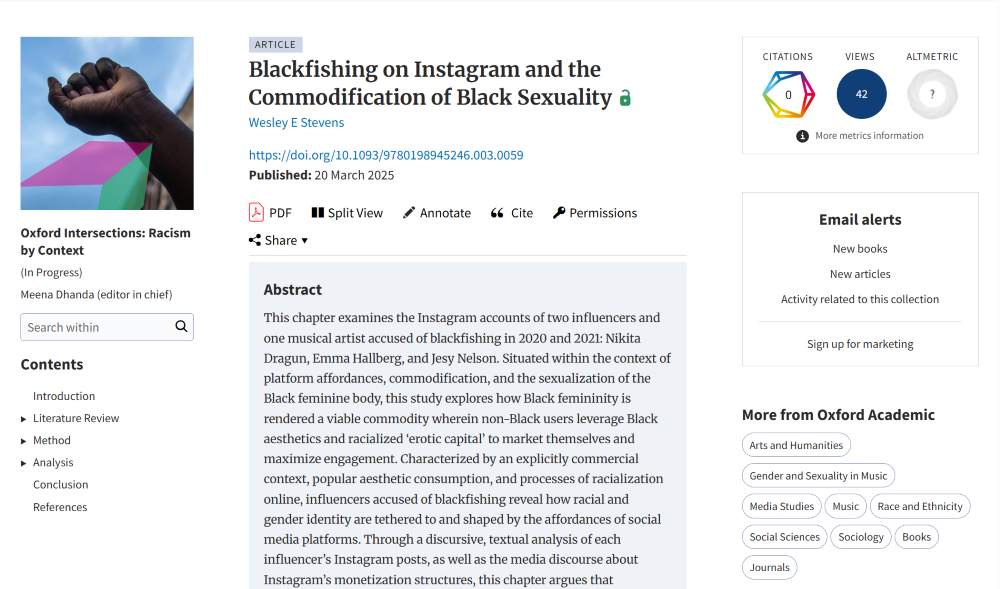
The article reading environment is well designed and feature rich. A linked navigation menu, allowing the user to jump to different sections of the article, remains visible on the left as the user scrolls through the article (Figure 4). Clicking on “Split View,” shifts this navigation pane to the right and clears other visual clutter for an optimized reading experience (Figure 5).
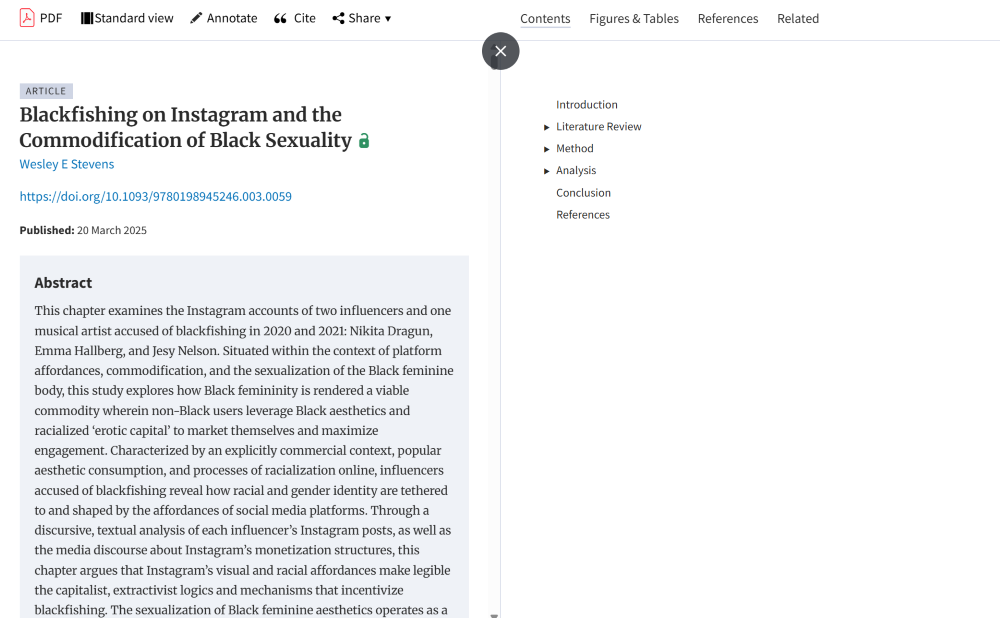
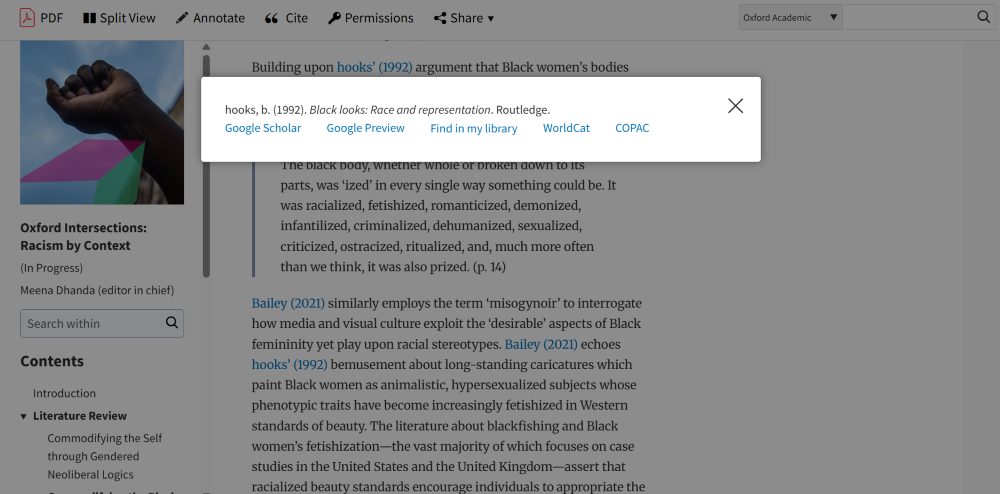
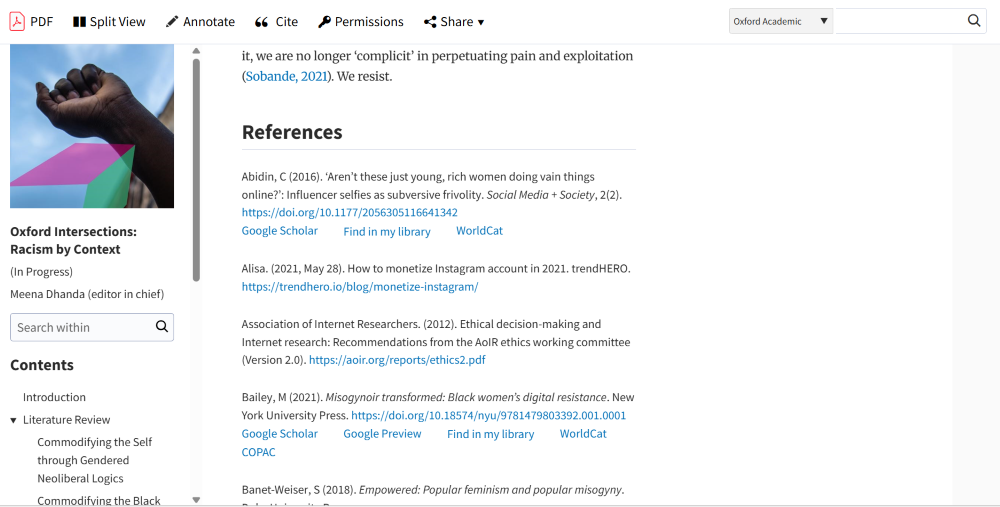
Standard features include PDF viewing, a citation export tool compatible with bibliographic managers, and an “Annotate” function (which requires the user to create an individual account). All keywords and cross-references within the text are hyperlinked, connecting users to related content, often to other OUP products (Figure 6). The extensive, scholarly references are similarly linked, showing options for source retrieval (Figure 7).
OUP demonstrates an active commitment to accessibility compliance, an increasingly urgent issue for US-based academic libraries facing the ADA Title II digital accessibility deadline (mandated for many state and local organizations by April 2026). OUP is currently working toward adherence with WCAG 2.1 Level AA guidelines (and some 2.2 requirements). While the publisher notes in its accessibility statement that users with visual, hearing, or motor impairments may still encounter barriers with some older content or dynamic features, it claims general inclusivity and plans to issue an updated VPAT (Voluntary Product Accessibility Template) later this year.
The licensing agreement for Oxford Intersections reflects a permanent-purchase model, prioritizing perpetual access rights. The core provision is the one-time, perpetual access fee. This means the institution owns the purchased content indefinitely, including the articles currently available and all articles commissioned and added over the scheduled three-year publishing period for each Intersection series. To safeguard this investment, OUP participates in dark-archive initiatives such as Portico and CLOCKSS/LOCKSS. OUP also ensures the long-term usability of the content by committing to migrate the files to new formats as technology evolves, protecting the perpetual investment.
Rights granted to the subscribing academic institution include:
The agreement features a robust clause supporting non-commercial research: “Authorized users at an academic institution are explicitly permitted to make copies of articles or portions thereof for non-commercial Text and Data Mining (TDM).” However, the clause stipulates that any copy made for TDM must be solely for that purpose, must be accompanied by sufficient acknowledgment if the results are published, cannot be transferred, and must be promptly destroyed once no longer necessary for the research.
Oxford Intersections provides pricing for academic institutions via a five-tier model based on full-time equivalent (FTE) enrollment. For context, the one-time cost for my public university with undergraduate and master’s programs and approximately 7,000 FTEs is $3,112 per Intersection. Although not available yet, OUP is planning to offer a nominal discount for orders through consortia, or for orders of all Intersections (volume discount).
Oxford Intersections provides access for authorized users both on and off campus via a range of standard and federated identity management systems. Available authentication mechanisms include:
Oxford Intersections occupies a unique niche among academic library resources, which are typically dominated by either broad-coverage aggregator databases or deep, discipline-specific resources. The product’s key differences are its editorial structure, its focus on urgent, challenging subjects, and its three-year content ceiling of approximately 300 articles per topic. This model places it in contrast with, yet parallel to, several types of competitors:
Major multi-disciplinary aggregators like ProQuest and EBSCO (e.g., Academic Search Complete) offer millions of articles across thousands of journals, books, and proceedings. While these platforms contain the scholarly content necessary to research Oxford Intersections’ topics, they lack Intersections’ curated, structured, and interdisciplinary approach. Users on these platforms must build their own intersectional search queries, whereas Intersections delivers the connections immediately via its editorial framework.
In contrast, resources like APA PsycInfo (social sciences/behavioral studies) or specialized ProQuest social science databases offer great depth within their respective fields. They overlap with Intersections on subjects like social media, racism, and AI ethics. But they are fundamentally single-discipline indexes, whereas Intersections’ value is derived from commissioning work that combines these fields (e.g., philosophy, computer science, and law in AI and Society).
Finally, Intersections distinguishes itself from traditional reference resources designed for introductory or lower-level undergraduate use, whose topical overviews are typically written for high school or lower undergraduate students and are not peer-reviewed. In contrast, Intersections’ 6,000–10,000 word articles are scholarly, stand-alone, and peer reviewed, making it a source for more specialized and detailed topics.
In summary, while no single product currently duplicates Oxford Intersections’ unique model of select, globally commissioned, interdisciplinary scholarly topics, the platform competes for library budgets with the broad coverage of aggregators and the deep disciplinary strength of specialized indexes.
Oxford Intersections is distinguished by its strong content. The global, interdisciplinary editorial teams and accomplished scholars writing articles ensure high academic quality, cross-disciplinary perspectives and a rigor suitable for upper-level undergraduate, graduate, and faculty research. In addition, a focus on current and challenging subjects makes the resource relevant to researchers who want to address contemporary issues.
Due to the way content is released (100 articles per year; 300 total after three years), “when to purchase” presents a dilemma. Purchasing an Intersection early maximizes its currency but means the library pays for a collection that is initially low volume and that may not address specific research questions or topics. Waiting three years ensures a complete collection but sacrifices the timeliness of the initial content. A tough choice indeed.
From a user-interface point of view, the ability to browse by topical categories that are unique to each Intersection is valuable. Currently, however, users are forced to guess the scope of these customized internal categorizations; an integrated definition (such as a clickable information icon) would provide helpful clarity. The alternative, “Subject” browse, relies on the OUP platform’s subject browsing schema and is too broad and generic for the highly specific nature of the Intersections articles, thus providing limited utility.
The email alerts feature allows users (especially faculty and graduate students) to keep current with new content and utilize the product as intended—as a source for timely, evolving research. Outside of this, through KBART files, MARC records, and upcoming article-level metadata, OUP is striving to provide access through discovery services, which are often used by library patrons as the first stop in locating information on specific topics.
The one-time perpetual access fee model, combined with explicit permissions for non-commercial TDM and ILL, provides excellent value and supports modern research trends.
Oxford Intersections is best suited for upper-level undergraduate, graduate, and faculty research that requires international and interdisciplinary perspectives on contemporary issues. The articles’ scholarly depth, specialization, and global authorship make the resource less appropriate for introductory courses or general audiences seeking broad overviews.
The product’s one-time purchase model and perpetual access provide strong long-term value, though its discoverability through library discovery services remains a potential challenge. Institutions that actively promote the platform—particularly through subject guides, instruction sessions, and the built-in email alerts—will realize its full potential as an evolving source of current research.
10.1146/katina-120325-1
Kevin McDonough is a reference and electronic services librarian at Northern Michigan University.
Copyright © 2025 by the author(s).
This work is licensed under a Creative Commons Attribution Noncommerical 4.0 International License, which permits use, distribution, and reproduction in any medium for noncommercial purposes, provided the original author and source are credited. See credit lines of images or other third-party material in this article for license information.