How Two Canadian Organizations Created a National Model for Diamond Open Access
TheCanadian Research Knowledge Network and Érudit transformed their vendor-client relationship into a collaborative partnership to support open access without author-facing fees. What can we learn from their approach?
Canadian organizations are known for their strong collaborations. Eleven years ago, our organizations—the Canadian Research Knowledge Network (CRKN) (Canada’s national university library consortium) and Érudit (Canada’s foremost research dissemination platform)—launched the Partnership for Open Access (POA). In an era before the term diamond open access (OA) had entered our lexicon, the POA transformed a vendor-client relationship into a collaborative partnership to support OA without author-facing fees.
In this article, we will outline how the POA provides unique support for diamond OA in Canada and explore the challenges that libraries and consortia face when they support values-based initiatives.
Canada: A Diamond Open Access Incubator?
A number of factors contribute to Canada’s vibrant diamond OA ecosystem, which includes approximately 450 active diamond OA journals, primarily in the humanities and social sciences (HSS) (van Bellen & Céspedes, 2025).
First, two programs—one in the province of Quebec and one at the federal level—provide direct, operational funding to Canadian scholarly journals. (The federal program supports HSS journals exclusively.) For decades, these programs have subsidized journal production and allowed journals to innovate, including around OA. Most recently, these programs have pivoted to supporting diamond OA journals exclusively. By 2028, the journals funded by these programs (approximately 175 as of writing) must move to diamond OA and adopt best practices in OA publishing, including aligning with Directory of Open Access Journals (DOAJ) criteria, demonstrating the influential role that funders play in supporting equitable and sustainable OA.
Canada is also a leader in funding open infrastructure. Through the Social Sciences and Humanities Research Council of Canada and the Canada Foundation for Innovation, the Canadian government funds a partnership between Public Knowledge Project (PKP), developer of Open Journal Systems, and Érudit. The partnership, called Coalition Publica, provides open infrastructure for journal publishing, journal dissemination, and research in HSS. Both PKP and Érudit are university-based, non-commercial organizations, which allows them to pursue activities motivated by academic values, such as openness and responsible innovation, instead of profits.
While government funding of open initiatives in Canada is crucial, academic libraries have also made essential contributions. Canada is lucky to have a strong national library consortium in CRKN that is both able and willing to lead on issues related to open scholarship, allowing for broad strategies in support of OA. Through CRKN, Canadian university libraries have had the opportunity to invest in a range of open initiatives, including the Sponsoring Consortium for Open Access Publishing in Particle Physics (SCOAP3) and the Global Sustainability Coalition for Open Science Services (SCOSS), in addition to the POA.
The final piece of the Canadian diamond OA puzzle is a nationwide network of library publishing programs hosted in university libraries. Over 40 libraries provide journal publishing or hosting services, often exclusively for OA journals (Betz et al., 2025). These programs, and the dedicated scholarly communications librarians that run them, give journals access not only to technical services, such as website hosting and persistent identifiers, but also to librarians’ expertise around best practices and quality standards.
While all of these pieces have contributed to a remarkable adoption of diamond OA among Canada’s journals, the picture is not entirely rosy. Diamond OA is free to read and free to publish, but it is not free to produce. The Partnership for Open Access demonstrates a successful model for advancing diamond OA at a national scale.
Partnership for Open Access: A Canadian Experiment
The transformation of the relationship between CRKN and Érudit began in 2014, when, instead of entering into a subscription-based arrangement, 53 participating libraries contributed to directly sustain 112 Canadian scholarly journals. Under the POA, users at participating institutions gained enhanced access to content across the Érudit platform, including 26 fully OA journals and an additional 86 journals with a reduced embargo period. The new model strengthened the foundation for equitable access to Canadian research while maintaining vital support for journals transitioning to or maintaining OA publishing before the use of article processing charges (APCs) became widespread. In addition to redefining the financial relationship between CRKN and Érudit, the POA also reinforced a collective investment in the visibility and sustainability of Canadian scholarship. This collective investment expanded beyond Canada’s borders in 2018 when Érudit established POA agreements with the Couperin consortium in France and the Bibliothèque Interuniversitaire de la Communauté française de Belgique (BICfB).
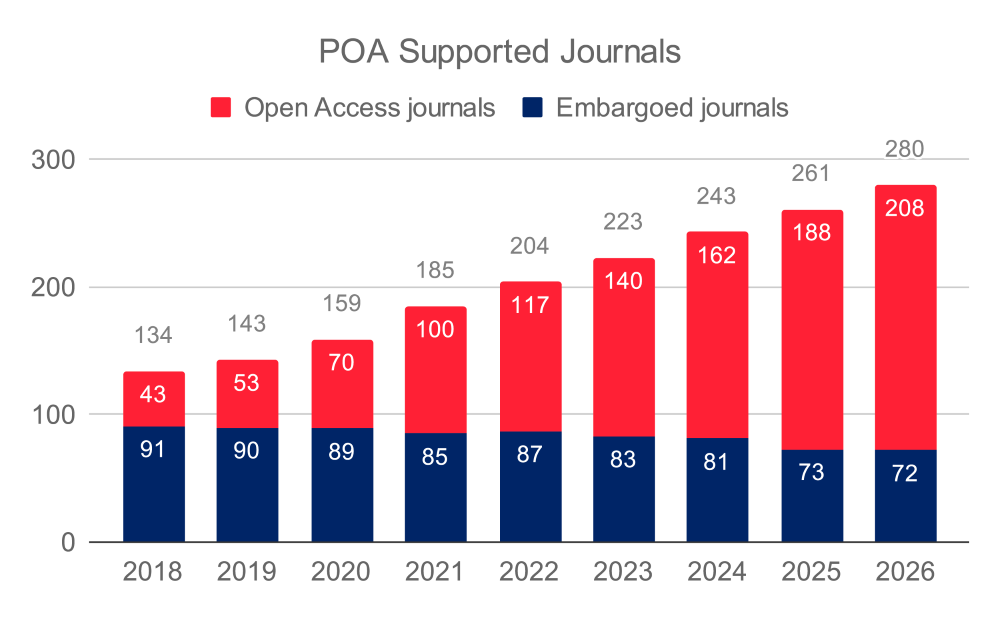
The partnership between CRKN and Érudit marked its 10-year anniversary in 2024. Over the past decade, the number of journals hosted on the Érudit platform has grown from 112 to 243, including 162 that are now fully OA. As of 2026, the POA will be supporting 280 scholarly journals, with over 200 publishing in immediate OA without APCs (Figure 1).
FIGURE 1
The 2024 renewal of the partnership established four key objectives: to accelerate the adoption of OA in Canada without relying on APCs; to strengthen engagement with libraries and journals in building a resilient, community-driven publishing ecosystem; to advocate for the diamond OA model; and to secure the long-term stability of the POA. To support these goals, beginning in 2027, each participating library will increase its financial contribution, allowing the partnership to provide more revenue to journals and better position our researchers and journals to meet current and future OA funding policy requirements.
The renewed investment reflects CRKN and Érudit’s shared commitment to sustaining Canadian scholarly publishing, but it comes at a time of considerable financial strain across the postsecondary sector.
Financial Challenges in Canada
In recent years, Canadian universities and, by extension, Canadian university libraries have faced serious financial challenges. The vast majority of collections expenditures at Canadian libraries are billed in US dollars. According to the Bank of Canada, the CAD to USD exchange rate has increased every year since 2021. As a result of the exchange rate increase alone, a product billed in USD that cost $1,000 CAD in 2021 would cost $1,120 CAD today, a 12 percent increase. Additionally, according to EBSCO’s most recent Five Year Journal Price Increase History, the average serials title price has increased 13.2 percent since 2021. That means that a title that cost $1,000 CAD in 2021 would cost $1,319 CAD today.
While these financial realities have placed a gradual, but significant, pressure on library budgets, government funding has largely remained flat, or at best increased below the rate of inflation. Even where funding has increased, it has frequently been offset by tuition caps or limits for domestic students. As a result, universities have increasingly relied on international student enrollment to maintain their operations. Recent immigration policy changes, however, have dramatically reduced the number of international students attending Canadian post-secondary institutions. In January 2024, for example, the Government of Canada announced a 35 percent reduction in the number of permits issued to international students. Further cuts—somewhere in the neighborhood of another 50 percent—were announced in the 2026 federal budget (Liddle, 2025). While colleges have been more significantly affected than universities, the impact on university revenues has been and will continue to be widespread. Institutions in British Columbia and Ontario have been particularly hard hit (MacDonald, 2024).
Libraries are suffering the consequences. When the University of British Columbia announced the cancellation of its SAGE and Public Library of Science (PLOS) agreements last year, it referenced unsustainable costs, the exchange rate, and the reduction in international student enrollment.
Against this backdrop, university libraries find themselves inundated with OA initiatives, including “transformative agreements,” “Subscribe to Open,” and infrastructure support requests. The POA stands out as an academy-owned diamond OA partnership supporting journals at the national level. CRKN members recognize the long-term value of the partnership and continue to invest in a model that strengthens equitable, non-commercial OA in Canada.
The POA: A Model for National-Scale Diamond Open Access
Moving from a vendor relationship to a partnership enabled CRKN and Érudit to build a community-owned publishing ecosystem that privileges bibliodiversity, sustainability, and collaboration. Collaboration has been essential to the development of the POA and will be essential to its future. But in the scholarly publishing ecosystem, collaboration is not always the easiest way to work.
In 2024, as CRKN and Érudit worked to develop a framework for the next five years of the POA, they held more than 40 meetings, gave eight co-presentations, and collaborated on communications campaigns and materials. Working together in this way was a deliberate strategy to keep both organizations invested in the partnership and its diamond OA model.
In addition to collaborating with each other, however, CRKN and Érudit both needed to continuously engage with their stakeholders—primarily CRKN’s member libraries and the journals on Érudit’s platform—to ensure that the new partnership agreement would meet everyone’s needs. But the financial pressures facing the libraries, including declining budgets, often conflicted directly with the journals’ need for sustainable revenue to support their editorial and production processes. The journals will require more financial support to sustain the transition to diamond OA, even as commercial publishing agreements eat up ever growing portions of dwindling library budgets and libraries look to decrease costs.
While there were moments when the competing needs of the organizations’ stakeholders felt irreconcilable, we grounded our partnership in shared values: Knowledge should be accessible to all, meaning no paywalls and no APCs. But the infrastructure and labor necessary to publish and share knowledge must be funded sustainably and fairly. Scholarly publishing requires bibliodiversity to support different kinds of research, and community/academy-owned open infrastructure is best positioned to focus on high-quality research without needing to answer to shareholders and bolster profit margins. Finally, Canadian HSS researchers deserve and require a platform to disseminate their work, something the POA provides that simply does not exist elsewhere.
We believe that the diamond OA model we are building is the best option for journals. They can transition to OA knowing that they are backed by the long-term support and expertise of the Canadian library community through CRKN and the content, infrastructure, and advocacy expertise of Érudit. And we believe that Érudit’s infrastructure capabilities and CRKN’s network give us the capacity to execute this model nationwide.
By changing the financial relationship between Canadian libraries and journals, CRKN and Érudit have shown that national-level collective support for diamond OA publishing can be impactful and efficient. We firmly believe that the POA is a compelling model for national-level support for diamond OA journals.
Research, however, is not and cannot be confined by national boundaries. The free exchange of knowledge envisioned from the beginning of the OA movement was always meant to be international. So, while support for diamond OA publishing may begin within a single nation, it should not end there. Libraries that are committed to advancing diamond OA as a model should be prepared to invest locally while looking for opportunities to support journals beyond their borders that align with their values and research needs.
A strong ecosystem that enables the free exchange of research knowledge requires strong collaboration at both the national and international level. The POA advances a vision where collective support for diamond OA publishing has strong national roots that are complemented by international investment. This broad-based support can help create a future in which diamond OA publishing can thrive, making knowledge accessible to all.
References
Betz, S., Uhl, E., & Nason, M. (2025). Low-key load-bearing: Defining the national role of Canada’s library publishing programs. The Canadian Journal of Information and Library Science, 48(1), Article 1.https://doi.org/10.5206/cjils-rcsib.v48i1.22132
Van Bellen, S., & Céspedes, L. (2025). Diamond open access and open infrastructures have shaped the Canadian scholarly journal landscape since the start of the digital era. The Canadian Journal of Information and Library Science, 48(1), 96–111.https://doi.org/10.5206/cjils-rcsib.v48i1.22207
10.1146/katina-011526-1
Jason Friedman is the assistant dean, collections and discovery, and collections strategy librarian at the University of Saskatchewan. He is a member of the Library Management Team and is responsible for the overall vision for library collections. Previously, he worked at the University of Ottawa library before moving to the Canadian Research Knowledge Network, where his roles included member services and licensing officer; manager, member and metadata services; and senior manager, heritage services.
Jessica Dallaire-Clark is senior coordinator, open access development, at Érudit. Most recently, she was the project coordinator of Coalition Publica, a partnership between Érudit and the Public Knowledge Project to advance research dissemination and digital scholarly publishing in Canada. While her current work focuses on journal publishing, her background is in scholarly book publishing, with previous positions at the Awards to Scholarly Publications Program (ASPP) and the University of Ottawa Press. Open access has been a common aspect of all her professional work to date.
Claire Duncan is senior manager, strategy and engagement, at the Canadian Research Knowledge Network (CRKN). She works with her team to lead CRKN’s communications, drive member and stakeholder engagement, and develop CRKN’s strategy. Claire has worked with the academic research community since 2017, including working as production editor at a small Canadian STEM journal. She holds a PhD in English literature from University of Toronto.
Amanda Holmes is senior licensing officer at the Canadian Research Knowledge Network. In her role, Amanda brings 5+ years of academic library experience and 5+ years of consortium experience to her work as a lead negotiator. She holds a BA from Carleton University and a library technician diploma from Algonquin College.
Thank you for your interest in republishing! Anyone is free to use and reuse the article text and illustrations created by Katina for non-commercial purposes under a CC BY-NC license. Please see our full guidelines for more information. Photographs and illustrations are not included in this license. This HTML is pre-formatted to credit both the author and Katina.
This is a required field
Please enter a valid email address
Approval was a Success
Invalid data
An Error Occurred
Approval was partially successful, following selected items could not be processed due to error