



This Resource Targets Environmental Policy Professionals, But May Have Broader Appeal
E&E News is pricey, but the platform could be useful for any reader who needs up-to-date environmental news—even undergraduates.

E&E News is pricey, but the platform could be useful for any reader who needs up-to-date environmental news—even undergraduates.

E&E News is a publishing platform and aggregator of news about environmental policy and law. The articles are easily readable, and while the search abilities of the platform aren’t robust, they do include several useful filters. Overall, while this specialized platform targets professionals working on environmental policy, it may also be of use to students and researchers at all levels.
There are five publications under the E&E News umbrella—Energywire, Climatewire, E&E Daily, Greenwire, and E&E News PM—employing upward of 60 reporters. Each publication focuses on a specific theme, with most coverage focused on current events. For example, Energywire addresses “news across the energy sector,” including “technological developments and issues facing energy infrastructure to relevant legislative and regulatory changes” (Energywire, n.d.). E&E News, which describes itself as non-partisan and fact-driven, does not publish opinion pieces or original research.
In 2020, E&E News was acquired by POLITICO, which said it would preserve its journalistic integrity (E&E News had been independent since its founding 22 years prior) and invest resources to expand “audience and impact” (Cooke, 2020). To this day, E&E News describes itself as a “distinct brand and product,” separate from POLITICO. That said, E&E News and POLITICO share a publishing platform and infrastructure.
E&E News publishes between 25 and 30 articles every day, most behind a paywall. It aggressively promotes its daily newsletters, encouraging subscribers to sign up and curate the newsletters they wish to receive via email. It’s harder to search for older articles than in databases meant for in-depth research on a topic. (More on this below.)
E&E News describes its subscribers as professionals working in the energy and environmental sectors including government, law, advocacy, industry, and academia. The platform is most appropriate for readers who already have a solid understanding of the topics covered and want to stay current.
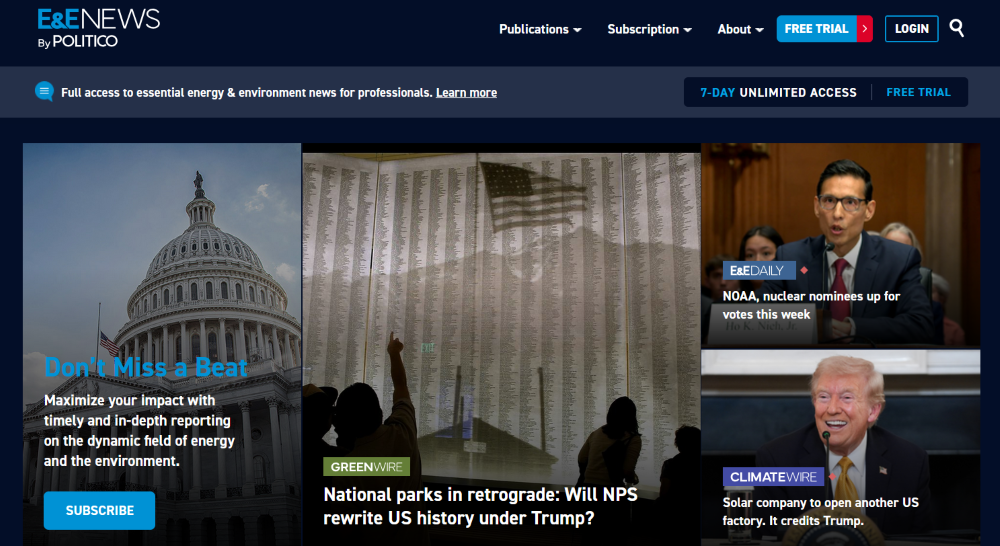
The homepage for non-subscribers compiles articles from all five publications, providing a snapshot of the overall energy and environment landscape (Figure 1). Current articles appear near the top, with the headlines displayed over large images. Buttons to filter by publication are conveniently located below the headline stories (Figure 2).
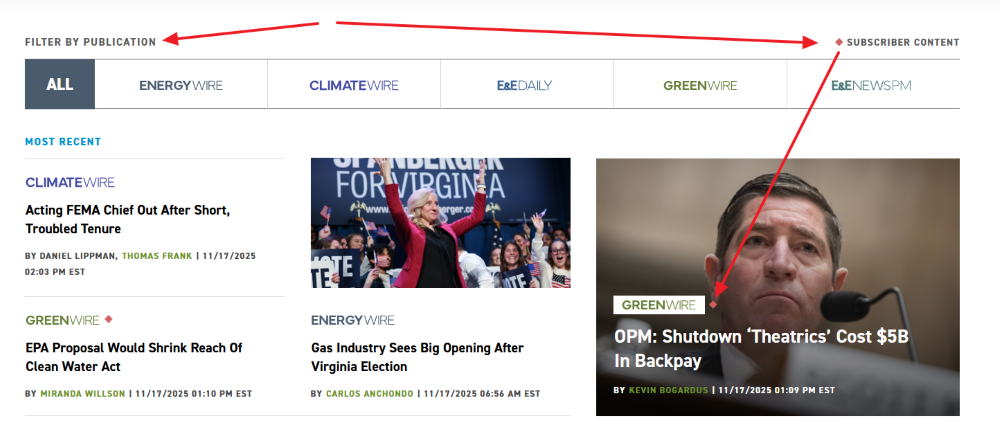
Links take the reader to the individual E&E publications (EnergyWire, ClimateWire, etc.). A red diamond appears near the title of each subscriber-only article, though when the title appears on a story with a large image, the indicator diamond can be hard to see (Figure 2).
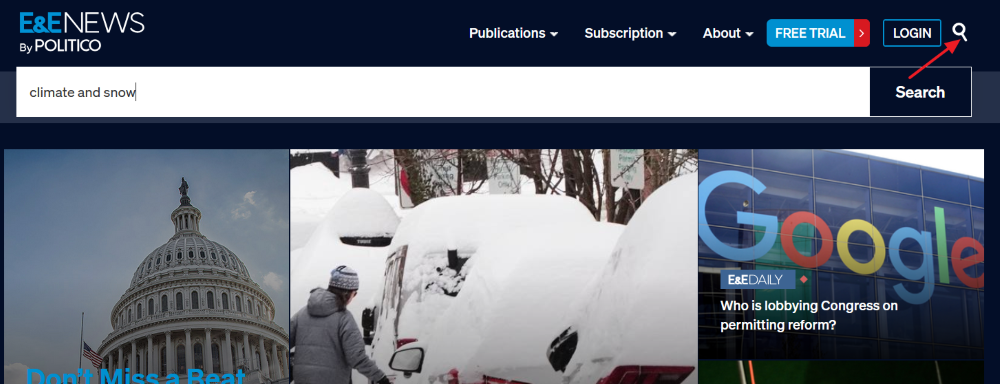
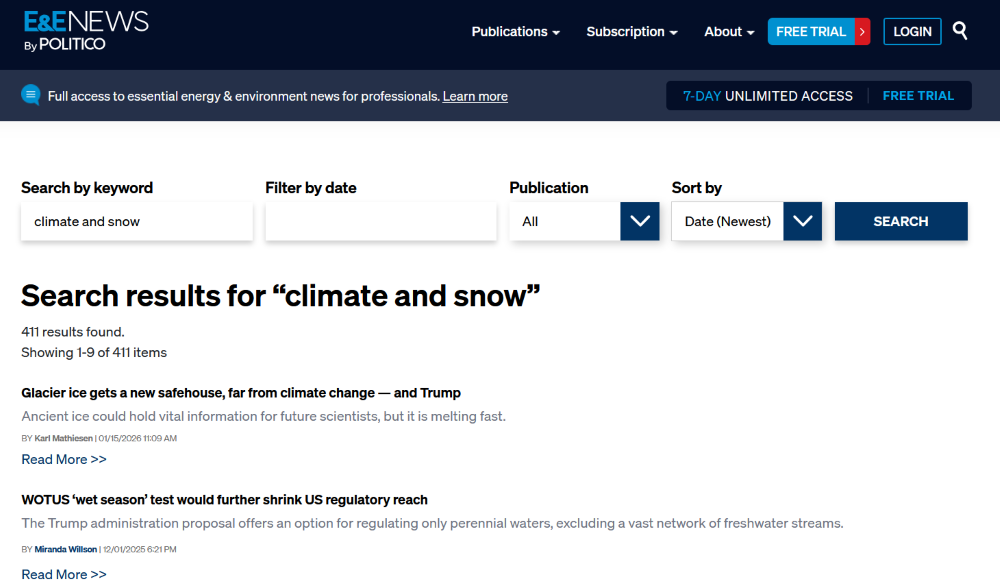
To search the free site, the user must click on a magnifying glass tucked into the upper left corner of the page (Figure 3). On the search results page the user can filter by date and publication or sort by date or title. Unfortunately, the red diamond indicator disappears on the search page, meaning a reader can’t differentiate between free and paid articles without clicking through (Figure 4).
The landing page for subscribers looks a little more like a database, while still being designed to allow easy access to recent articles through headlines (Figure 5). A “card” for each article links to the full text; articles are also presented through multiple “Trending In” lists, a “Most Read” list, and a list of “Top Stories” for each publication.
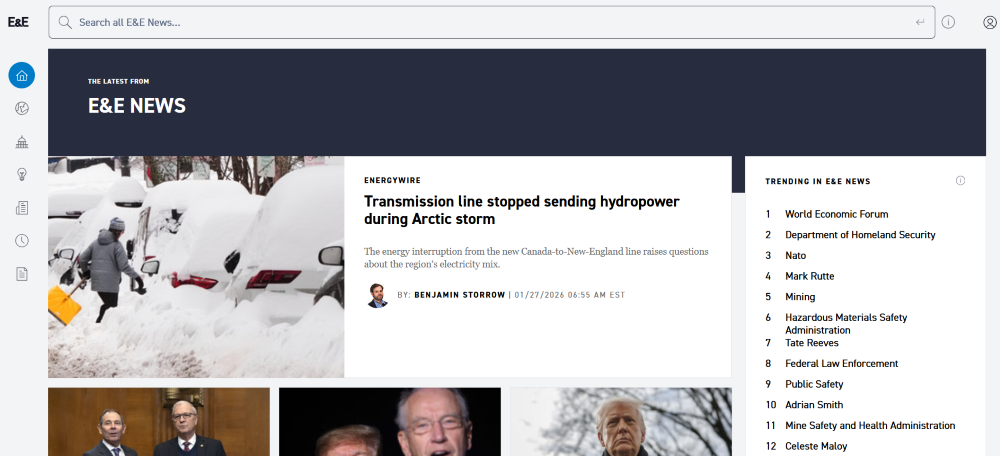
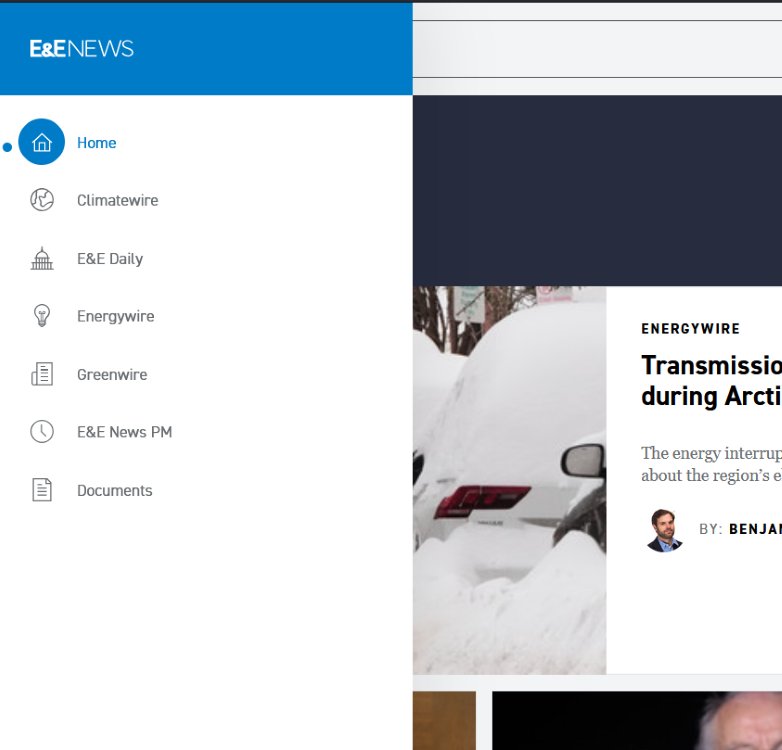
As on the free site, there are links to the individual publications, here listed along the left side of the screen (Figure 6).
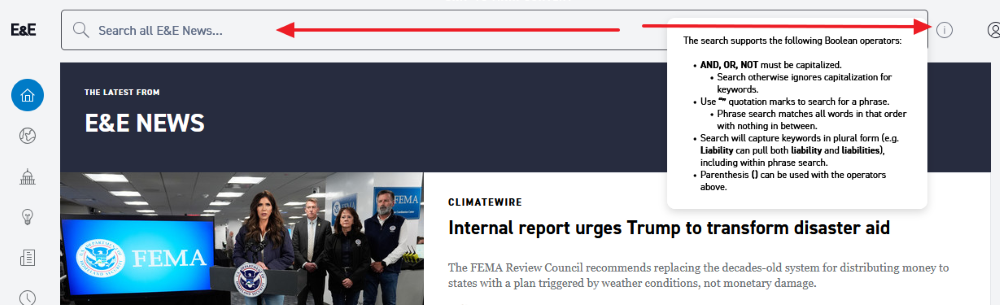
The search on the subscription site is a little more elegant than on the free site, with the search bar appearing at the top left of every page. Clicking on an “information” icon to the right of the search bar opens search instructions, which explain that Boolean operators, parenthetical nesting, and quotation marks can all be used (Figure 7). While there is no wildcard option, the search retrieves the plural form of keywords.
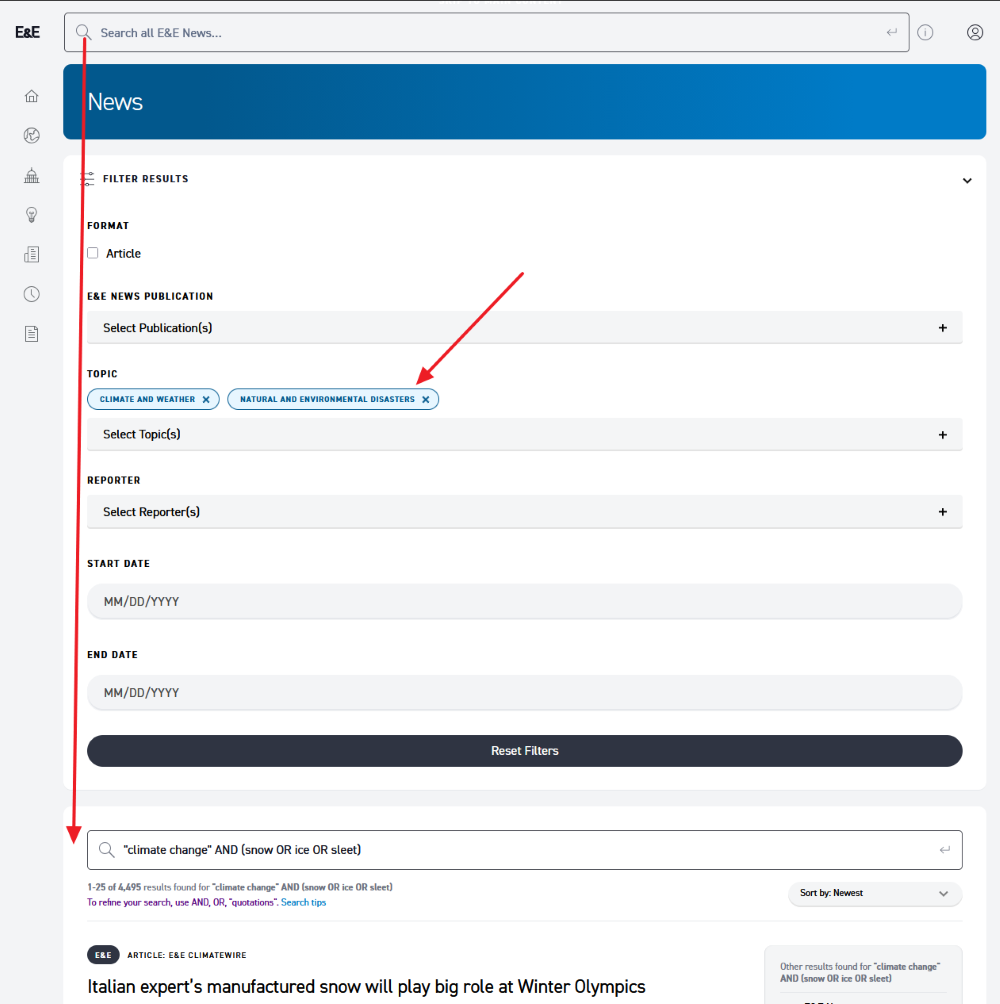
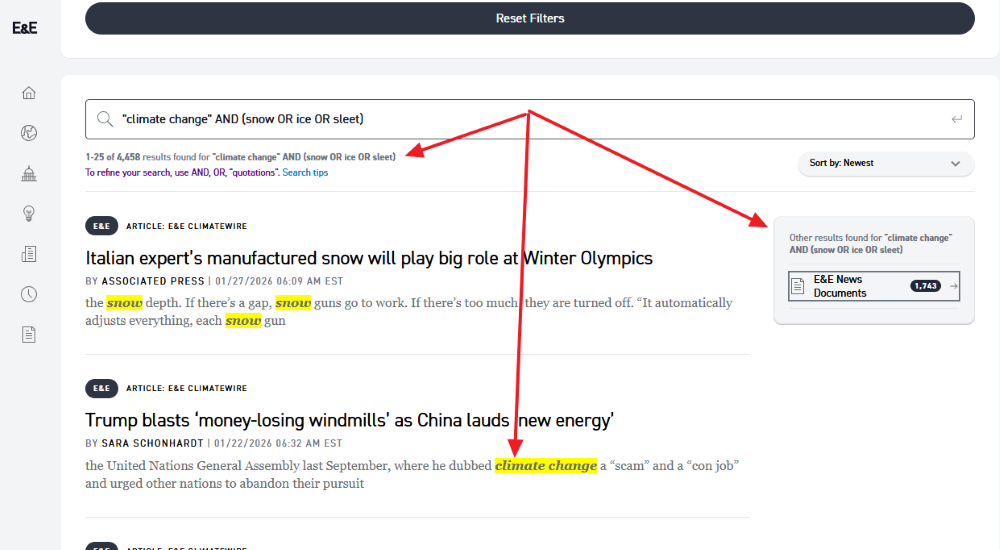
When I searched for “climate change” AND (snow OR ice OR sleet), the platform returned nearly 5,000 results. The search filters appeared in a spacious box at the top of the results page long before any results loaded (Figure 8), which I found cumbersome. But with such a broad search, it makes sense that a researcher may want to immediately narrow their results. Users can filter by publication, topic, reporter, and date. It’s unclear how the articles are sorted into topics, but it is possible to choose more than one topic.
The list of results has a couple of nice features that help researchers find what they are looking for. In addition to search hints appearing below the search bar, the keywords are highlighted in the preview text for each result, making it easy for the user to see where the keywords appear and if they need to make any changes to the search. In addition, a small box on the right side of the screen directs users to the E&E News Documents—a collection of supplementary materials, from court records to studies, regulatory comments, and even polls and petitions, related to the search (Figure 9). Overall, the search is simple but functional.
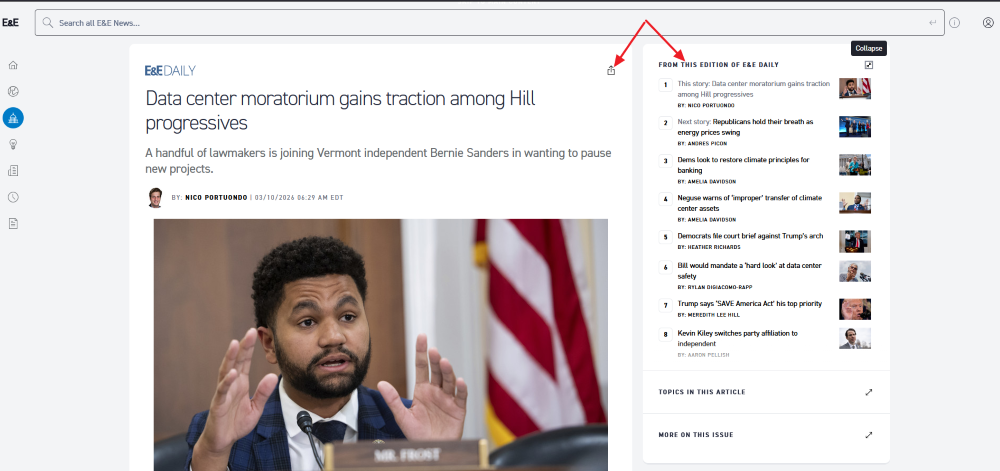
All articles can be shared in a variety of ways, including through email, link, or social media. On the right side of the article page is a helpful set of related resources, including links to related articles in the current issue, links to articles on related topics, and the “More on This Issue” section, which includes a wonderful timeline of related events (Figure 10).
Sienna Brown, an account manager at POLITICO, told me that the POLITICO Pro platform, into which E&E News is integrated, went through a VPAT 2.5 audit in 2025, with the final report published in November. The platform was analyzed based on the Web Content Accessibility Guidelines (WCAG) 2.0, 2.1, and 2.2 and supports or partially supports all applicable criteria.
According to the report, there were only two areas of the E&E News website requiring adjustment, both related to links in the reporter’s biography section. The larger platform needs to address a few marginal issues around color choices, especially related to contrast and link identification, as well as screen reader usability, that do not affect most of the article content. In addition, for a few images, more information is required for screen reader functionality. For example, if data is being presented as a graph, occasionally the graph won’t be described accurately or at all.
The biggest issue regarding accessibility is that none of this information, or any information about the accessibility of the digital platform, appears on the E&E News website. I was able to relatively easily obtain the report from Brown, but this took several days. While users of the digital edition of POLITICO, which is laid out like a magazine and optimized for touchscreen readers, can contact support services through a “Contact Us” link, the only way to contact E&E News on the free site is through a form that doesn’t list “support” or “help” as an option. On the E&E subscription site there is no “Contact Us” link, probably to encourage users to seek help through their institutions.
Overall, out of approximately 45 applicable WCAG criteria, 29 were fully supported and 16 were partially supported with minor exceptions. Aside from the lack of accessibility information on their website, E&E News does a good job of meeting accessibility requirements.
E&E News does not currently offer an AI search, citation generator, or summary option on either their free or paid platform. The platform does, however, allow IP-authenticated subscribers to use AI tools to scan the site, assuming that their institution’s firewall permits scanning. According to Brown, E&E staff are discussing a future expansion of AI functionality, though they are not yet sharing concrete plans.
E&E News subscriptions are processed through POLITICO. Contracts can be drawn up for an entire institution with access based on IP address, or the platform can be licensed to an individual college or department; law schools, for example, frequently request E&E News. Interlibrary loan is allowed, and users can share individual articles, as mentioned above, or include them in course packs. While COUNTER-compliant statistics are not available, subscribers can request a variety of statistics based on IP access through their representative.
Pricing is based on full-time enrollment and runs higher than average compared with other news outlets. At my institution, for example, when POLITICO took over E&E News, the subscription price jumped significantly and was higher than other platforms with comparable news volume. Enrollment, however, can be determined at the level of an individual college or department. More detailed information is available from the vendor.
A variety of authentication options are available; IP authentication is the most used. Single sign-on is not supported.
Two prominent products are similar to E&E News. Gale in Context: Environmental Studies is a large database focused on environmental content, including much more than news articles. A novice may find it somewhat harder to navigate than E&E News, but its search is much more powerful, an advantage for researchers.
Environmental News Service (ENS) is another news platform that, like E&E News, publishes original articles. But it’s unclear how many articles are published through this service, and it’s difficult to search, filter, or sort results. When I searched for 2026 in the search bar (the search does not support more advanced searching), only one article appeared. In addition, few of the articles are credited, with most authors appearing as “News Editor.” E&E News is likely to be a better resource for professionals or academics who can afford it.
E&E News has created a niche for itself in the area of environmental news, with a particular focus on policy.
While the search functions of both the free and paid sites are less robust than database searches, they are probably appropriate for what E&E readers need. A researcher probably isn’t going to sit down and develop an extensive search strategy for the articles on E&E News. However, an aide who needs a to quickly survey current articles on a subject area, such as the climate or energy, could easily find the most recently published items and narrow the results.
While the main audience for E&E News includes professionals in law and policy, given the abundance of connected resources, like the topic timeline offered for each article, it could also be a useful resource, for example, for an undergraduate who needs to brainstorm a topic for a paper or understand the general landscape of environmental affairs.
Michigan State University Libraries, where I work, acquired E&E News some years ago at the request of a faculty member in in the journalism department who wanted to have students write an environmental article for the local publication The Great Lakes Echo, which is produced by the Knight Center for Environmental Journalism. The instructor asked our environmental sciences librarian to acquire the publication to give students multiple examples of environmental reporting.
The platform is relatively expensive, but competitive for departments that need access to its very specific content.
E&E News is a great resource for readers interested in the current state of climate and energy policy in the United States. The coverage is up-to-date, thorough, and readable by a broad audience, including the general public, undergraduates, and researchers at all levels. But given the high price tag, institutions with budget constraints may prefer to license E&E News to the specific departments or people who need access to this information quickly and efficiently.
The author would like to thank Eric Tans, science coordinator and environmental sciences librarian at Michigan State University, for his assistance with the environmental journalism example.
Cooke, M. (2020, December 29). POLITICO acquires E&E news. POLITICO Press. https://politi.co/3rBF842
Energywire. (n.d.). E&E News by POLITICO. Retrieved March 18, 2026, from https://www.eenews.net/publication/energywire/
10.1146/katina-031826-1
Copyright © 2025 by the author(s).
This work is licensed under a Creative Commons Attribution Noncommerical 4.0 International License, which permits use, distribution, and reproduction in any medium for noncommercial purposes, provided the original author and source are credited. See credit lines of images or other third-party material in this article for license information.