How Participatory Funding is Transforming Open Access
Collective library investment aligns open access publishing with the core values of librarianship. Models like MIT’s Direct to Open and JSTOR’s Path to Open point the way toward a more inclusive and resilient future for scholarly communication.
Over the past three decades, open access (OA) has progressed through multiple models—gold, green, hybrid, bronze, and diamond—each of them contributing to the broader goal of free and unrestricted access to scholarly literature. Today, more than half of newly published research output is openly accessible.
But despite momentum driven by research funders, governments, and initiatives such as Plan S, a complete open knowledge ecosystem that supports equity, sustainability, reuse, and collective stewardship remains unrealized. Restrictive publisher policies, copyright retention, limits on repository self-archiving, and high article and book processing charges (BPCs) continue to shape an uneven landscape.
These challenges are particularly pronounced in the case of scholarly monographs. Monographs, which remain essential to humanities and social science research, involve higher production costs and longer publishing cycles than journals, making gold open access funded through BPCs difficult to scale and, in many cases, inequitable. Mandates from organizations such as UK Research and Innovation (UKRI), cOAlition S, and Horizon Europe have raised expectations for openness, yet available funding rarely covers the full cost of monograph publishing. While infrastructures such as OAPEN and Directory of Open Access Books (DOAB) have improved discovery, visibility, and trust in open access books, sustainability remains a concern. Commercial pressures, limited library budgets, and the dominance of large publishers further complicate the landscape.
In response, libraries and university presses have begun to experiment with participatory, community-funded approaches that move beyond author- or funder-paid open access. Among these, Direct to Open (D2O) and Path to Open represent significant attempts to realign monograph publishing with the values of open knowledge.
In this article we will explore how these models work, the impact they have, and the particular role they offer libraries.
Direct to Open: Immediate Openness Through Collective Library Action
The D2O model, launched by MIT Press in 2021, pools library funds to make selected frontlist monograph titles open access upon publication, providing broader access than title-by-title licensing and purchase and allowing authors, irrespective of their affiliation or funding, to publish OA without having to pay BPCs. Beginning in 2026, the program will include titles from Duke University Press and Goldsmiths Press.
The program’s annual participation fees are determined based on a library’s size, type, and collections budget in addition to the country in which it is located. They are also dynamic, dependent on the number of libraries that participate: the greater the participation, the lower the fees. MIT Press aims to publish 80 to 90 titles through D2O each year. As an incentive, participating libraries receive term access to backlist collections (~2,650 titles across the humanities and social sciences (HSS) and science, technology, engineering, art/design, and mathematics (STEAM) collections) plus a 25 percent discount on MIT trade ebooks.
Since 2022, MIT Press has published a total of 320 books through D20—207 in HSS and 113 in STEAM—by 455 authors in 31 countries based at 210 institutions. 407 libraries and 13 consortia from around the world, mostly the Global North, have participated (MIT Press, 2025-b). These include the Indira Gandhi Institute of Development Research (IGIDR) in Mumbai, where one of us, Shamprasad Pujar, serves as chief librarian.
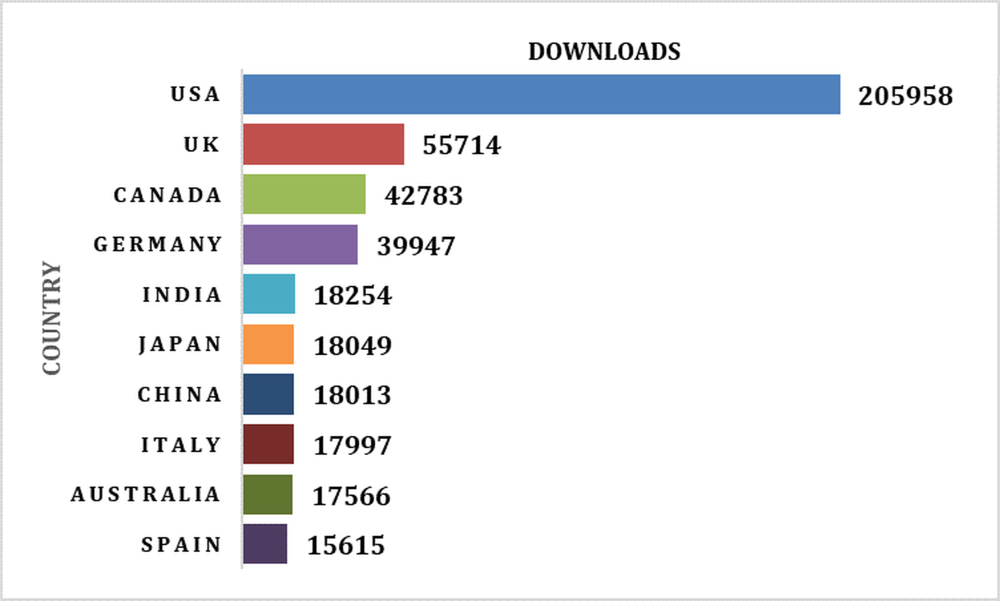
According to the 2025 D2O Impact Report, MIT’s open access HHS books are used 2.26 times more than comparable paywalled books, and their open access STEAM books 1.6 times more. Similarly, open HHS books receive 8 percent more citations, with open STEAM books receiving 5 percent more. As of February 2025, books in the program had been accessed 705,000 times by readers around the world. Figure 1 shows the top 10 countries by number of downloads (MIT Press, 2025-a).
FIGURE 1 Top 10 countries accessing books made open under D2O by number of downloads.
At IGIDR, our participation in the program gives us access to 4,100 total titles this year (1,151 HHS backlist titles in addition to the frontlist titles we have helped to publish open access). Our users engage with the collection consistently: from 2022 to 2025, a total of 699 uses were recorded for 237 backlist titles averaging, 2.8 uses per user and approximately 3 uses per title. In addition to the material benefits of our participation in the program, we experience a great sense of satisfaction from enabling more equitable distribution of knowledge.
Path to Open: Delayed Openness and Support for University Presses
In 2023, JSTOR developed the Path to Open model in collaboration with American Council of Learned Societies (ACLS), University of Michigan Press, and the University of North Carolina Press. Path to Open provides participating libraries access to frontlist HHS titles published by around 50 small and medium university presses, which become open access three years after publication, enabling authors to reach global audiences and readers to get permanent access to high quality scholarship. Fees are based on a participating library’s JSTOR classification. At present, around 260 libraries participate, most of them from the Global North (Lenahan, 2026). With 300 new monographs published each year, the program aims to include 1,000 titles when an initial 3-year pilot finishes at the end of 2026.
Last month, the program’s first 100 titles made the transition to open access. According to JSTOR, in just five weeks, the newly opened titles received 30 percent more use than in the entirety of 2025, when they were behind a paywall (JSTOR, 2026).
The following table compares the key features of D2O and Path to Open.
Direct to Open
Path to Open
Launched by MIT Press in 2022
Launched by JSTOR in 2023 in collaboration with ACLS, UMP and NC press
Books published by MIT Press, plus two additional presses starting in 2026, in HSS and STEAM
Books published by 40+ university presses in HSS
Tiered participation fee based on library size/budget
Participation fee based on JSTOR institutional classification
Titles made OA immediately; participating libraries get backlist access + 25 percent discount on MIT Press trade ebooks
Participating libraries get immediate access to titles which become OA after 3 years
320 titles have been published OA since 2022; 80–90 title annual target
First 100 titles became OA in 2026; approximately 1000 total titles targeted in pilot
407 libraries and 13 consortia have participated
260 libraries participating
Libraries as Active Stewards of Open Knowledge
Libraries, which have experience addressing copyright and fair use, assessing the impact of research, promoting the use of institutional repositories, and negotiating with publishers, have always been natural partners of the OA movement. They also have a vested interest in open access publishing, which helps them to connect users with a greater amount of information and save their collection development budgets. Through their advocacy and support, they are not only encouraging authors and publishers to move toward open access publishing; they are also adapting themselves to the changing landscape of scholarly communications (Engeszer & Sarli, 2014).
Participatory models of open access—which, in addition to D20 and Path to Open, include Subscribe to Open, Opening the Future, and various diamond OA models—offer libraries a more significant role than other OA models. Through financial investments aligned with the values of librarianship and values of their institutions (Verbeke & Brundy, 2024), libraries directly facilitate the development of infrastructure, workflows, and collaborative frameworks that contribute to a more equitable and sustainable ecosystem for open access book publishing.
Libraries also mediate between publishers, scholars, and institutions. This work starts with faculty briefings, webinars, and outreach activities in which they explain how these models work. For example, a library may host a short session for faculty to show how a modest annual participation fee can make hundreds of monographs openly available without author BPCs. Libraries also gather feedback from researchers on subject coverage and preferred university presses, which they can share with providers such as MIT Press or JSTOR. Working through consortia, they aggregate demand and coordinate commitments, lowering costs and increasing impact.
The participatory approach aligns OA publishing with teaching and research needs, builds institutional buy-in, and ensures authors are not burdened with processing charges, supporting the credibility and sustainability of these initiatives.
Conclusion: Building a Shared Open Knowledge Ecosystem
While participatory OA models offer enormous promise, their future hinges on various factors: library budgets, broader participation to reduce the cost to each library, increased participation from the Global South, expansion of collections beyond HSS, integration with institutional, national and international OA policies such as Plan S, support for smaller presses, the adoption of technology, including AI, for greater discoverability.
Still, Direct to Open and Path to Open represent a meaningful evolution in open access publishing for monographs. By shifting financial responsibility from authors to collective library investment, these models align scholarly publishing with the core values of librarianship: equity, access, preservation, and shared stewardship. While challenges remain, particularly around participation and long-term funding, these initiatives demonstrate that when libraries, presses, and scholarly communities act together, open knowledge is not only achievable but sustainable. As participatory models mature, they offer scholarly communication a viable foundation for a more inclusive and resilient future.
Engeszer, R. J., & Sarli, C. C. (2014). Libraries and open access support: New roles in the digital publishing era. Missouri Medicine, 111(5), 404–407. https://pmc.ncbi.nlm.nih.gov/articles/PMC6172089/
Shamprasad M. Pujar is chief librarian at Indira Gandhi Institute of Development Research, Mumbai, India. He is responsible for overseeing library operations, digital collections, open access initiatives, repository management, and technology initiatives in library services.
Anjaneya Reddy is currently serving as deputy librarian at the Indian Institute of Management Bangalore (IIMB). He oversees library operations, collection development, digital resources, and user services and drives technology-enabled initiatives. Earlier, he was associated with NITK Surathkal, IGIDR Mumbai, and Alliance University, Bangalore.
Thank you for your interest in republishing! Anyone is free to use and reuse the article text and illustrations created by Katina for non-commercial purposes under a CC BY-NC license. Please see our full guidelines for more information. Photographs and illustrations are not included in this license. This HTML is pre-formatted to credit both the author and Katina.
This is a required field
Please enter a valid email address
Approval was a Success
Invalid data
An Error Occurred
Approval was partially successful, following selected items could not be processed due to error