What Can You Do When the Digital Key Won’t Turn? Visit a Library.
Recent outages of Amazon Web Services and Cloudflare are a stark illustration of our digital vulnerabilities. They are also an opportunity for libraries to remind users of their resilience.
Our digital world is built on a cloud. “Everything in one place” was sold as convenience, but it also created a single point of failure. The internet is not abstract—it still runs on hardware—only now the responsibility of managing that hardware is often outsourced, and risk can feel diluted when it’s shared.
But if our information is stored in one place, where do people go when the digital key doesn’t turn, leaving all of us locked out at the same time?
The recent major outages of both Amazon Web Services (AWS) and Cloudflare are stark reminders that cloud-based information is not inherently permanent or universally accessible. From the business owner unable to research state planning information on the New Jersey Transit website to the student who couldn’t read an article on the ProQuest website, many people found themselves in frustrating situations when these services went down (Murdoch & Associated Press, 2025; Marianopolis College Library, 2025). But how many of them thought of visiting the library?
Libraries have built resilience into their infrastructure, continually adapting to meet the evolving needs of their users. But promotion of library services—both academic and local—often comes second to service itself, which can lead to gaps between people’s perception of the library and the services and information available. These outages are an opportunity for libraries to remind their communities—whether academic or local—that when the internet goes dark, the physical library remains a bedrock of information access.
The Myth of Digital Permanence
AWS provides infrastructure and computing services that enable around one third of the internet to work (Richter, 2025). It also stores data for companies and connects web traffic to their platforms.
As people began circuiting apps and websites on Monday, October 20, 2025, an internal AWS technical failure transformed routine into chaos. A software bug had deleted the internal address for a critical database service called DynamoDB (AWS, 2025). Think of DynamoDB as a paper map in the glove compartment. AWS, riding shotgun, couldn’t locate the map to keep the vehicle on track to its final destination.
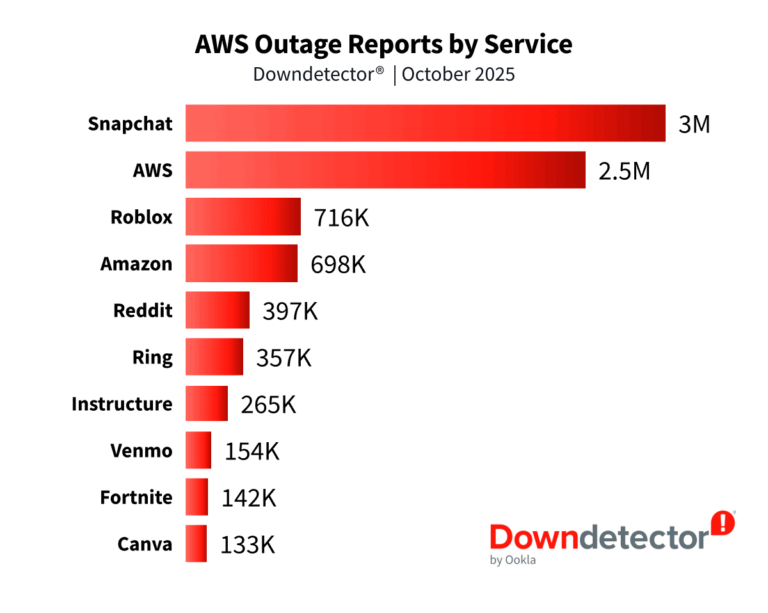
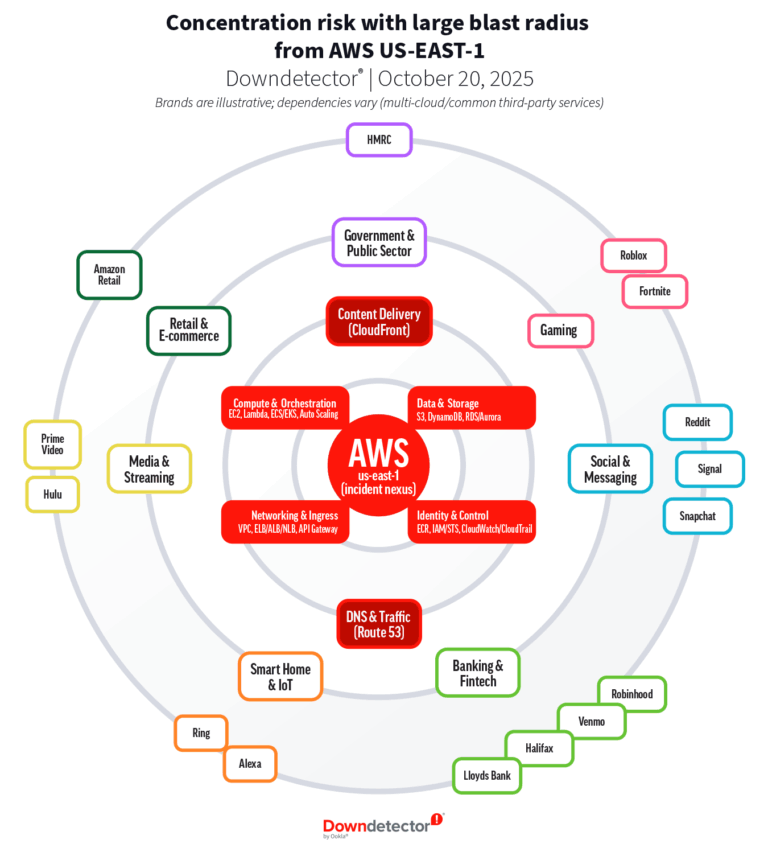
This failure triggered problems across other major AWS services, disrupting operations in Amazon’s largest cloud region—hosted in data centers in Northern Virginia in the United States, but serving customers around the world. The outage impacted thousands of widely used websites and apps; the recovery of all AWS services took more than 15 hours.
These online events translated into real-world consequences. For instance, with the learning management system Canvas inaccessible, multiple University of Pennsylvania lecturers were forced to reschedule exams. One student shared their frustration with the Daily Pennsylvanian: “There’s people that study for hours on hours, and even though we have additional days to study, it’s just more draining to push back an exam” (Karthik & David, 2025). Similarly, at Indiana University, students with exams scheduled the next day were unable to access study material (Elledge, 2025).
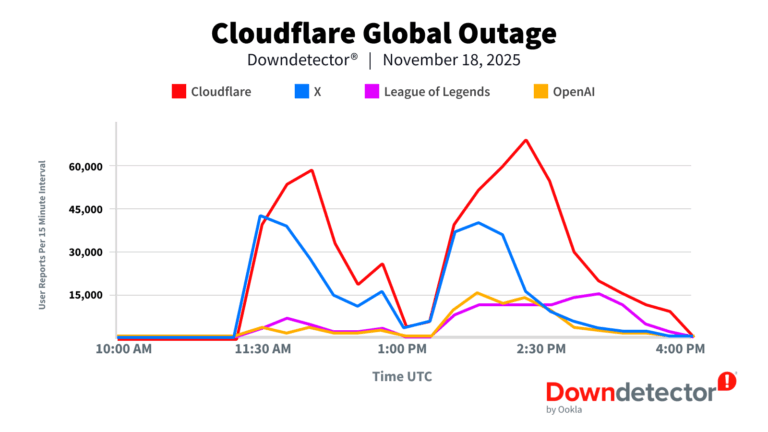
Less than one month later, on November 18, Cloudflare, which manages and secures web traffic for about 20 percent of all websites (W3Techs, 2025), went down.
The Cloudflare outage also began with a simple error: a database permissions change caused the duplication of entries into a configuration file. The file, which now exceeded normal sizing limits, distributed across Cloudflare’s network, causing a software crash (Prince, 2025). The resulting outage impacted one in three of the world’s most popular websites, including X, Spotify, and ChatGPT (Boult, 2025). According to Downdetector (2025), user-reported problems with popular online platforms surpassed 2.1 million that day.
The initial failure of a vendor like Cloudflare or AWS is a trigger. The true scale of the problem comes from the downstream effects. For example, during the AWS outage, the payment platform Venmo couldn’t authorize transactions, which impacted the flow of commerce not only for websites that used AWS, but for any business that relied on Venmo to process payments (Bagchi, 2025).
During both outages, in many libraries, parts of the digital shelf containing licensed databases and collections became inaccessible. In academic libraries, users were unable to access content from vendors like Wiley and ProQuest (ProQuest, n.d.; Wiley, 2025). Compounding the problem, some libraries’ own websites were not fully functioning, even if they were not directly hosted by AWS or Cloudflare. For example, if a library’s chat software came from a vendor using AWS or Cloudflare, that library’s patrons would be unable to access webchat during the outage. With no explanation from those vendors—and websites actively hiding the network of vendors they rely on to offer the end user a seamless experience—users naturally assumed the fault was with the website itself.
These events highlight our dependency on systems vulnerable to single points of failure. Internet infrastructure has become centralized around key platforms, highly concentrating risk in our shared digital supply chain. To many people, these large companies and the services they provide appear robust. The promise of the cloud was that it would deliver seamless and consistent access to information without the need for local storage. But these examples of digital fragility remind us of the importance of local, accessible knowledge systems.
The need for local resilience isn’t limited to technical failure. In an interview with Katina earlier this year, Lynda Kellam, a volunteer with the Data Rescue Project, which archives government data at risk of disappearing, pointed out that a “rapid response approach to saving data” can be required not only in political situations, but also “in response to disasters or other events that damage the infrastructure of a country” (Collister, 2025). True resilience against digital loss—whether due to outage or eradication—requires local control over knowledge systems.
Digital Fragility and Information Equity
It’s easy for those of us with strong digital skills to take for granted that if an outage occurs, we’ll be able to find an alternative way to access information or services. But not everyone can, and challenges with digital skills and access are not evenly distributed. In the US, 41 percent of adults without a high school degree are digitally illiterate compared to 5 percent of those with an associate’s degree or higher (Schwartzbach, 2022). The United States National Skills Coalition has found that approximately 50 percent of Black workers and 57 percent of Hispanic workers lack robust digital skills (Kendall et al., 2025).
Beyond questions of skillset, access remains uneven. In the US, 41 percent of adults with annual household incomes below $30,000 do not have a desktop or laptop computer at home, while these devices are almost ubiquitous in households earning over $100,000 annually (National Skills Coalition, 2024). White Americans are more likely to have stronger digital skills than Black and Hispanic individuals, as well as having higher rates of broadband internet access and computer ownership (McKinsey & Company, 2023).
When a large-scale outage occurs, it disproportionately impacts people who already have limited access to devices or insufficient digital skills. Libraries can both provide digital literacy training to help close this skills gap and offer a physically accessible hub for information access during times of digital fragility. This role relies on libraries’ extant infrastructure and their resilience.
Libraries as Knowledge Infrastructures
Libraries differ from other entities impacted by large-scale outages in their ability to offer alternative solutions. When an e-journal is inaccessible on ProQuest’s website, for example, a librarian can walk a patron over to a physical shelf and point out the same journal in print or guide them to another copy of the article in a digital repository not affected by the outage. In the case where a library does not hold the resource a patron requires, they can guide them to a suitable alternative or endeavour to find another library that does.
All of this is made possible by librarians engaging in responsible data stewardship principles, including practices like the 3-2-1 rule, which dictates that you should maintain three copies of your data, stored on at least two types of media, with one of the copies being stored separately (Digital Preservation Coalition, 2025). Another important initiative is LOCKSS (“Lots of Copies Keep Stuff Safe”), a preservation system that distributes several copies of digital content across independent institutions, rather than trusting a single cloud provider, to ensure online material does not vanish when a website goes down. As the software is open source, any library can use it without having to pay a license fee (LOCKSS, 2025).
Digital repositories can also help ensure files remain accessible over time. Many repositories make research freely available, and their independence means that the knowledge they hold is not lost if a publisher platform shuts down.
By moving beyond the fragility of single-storage methods, librarians are helping preserve knowledge for the long term. The recent outages remind us that cloud-first does not mean cloud-only. Promoting print resources is not anti-digital; it’s a way of ensuring information resilience when digital systems fail.
If libraries are to function as resilient infrastructures during moments of digital failure, preparation is critical. In addition to participating in initiatives like LOCKSS and using tools like digital repositories to keep critical collections accessible without relying on cloud-based services like AWS or Cloudflare, academic and local libraries should make sustained investments in print collections and local servers. Developing a shared map of vendors that depend on single points of failure could also help libraries recognize vulnerabilities and advocate for more resilient infrastructures.
Promoting the Library as Essential Infrastructure
During digital outages, librarians’ expertise in reference and information literacy only increases in value. When a website crashes and the user is left alone with a dark screen, the library offers human support that can transform a vast collection into a navigable resource. Beyond assisting with access to the information itself, the librarian’s connection with the user in that moment is powerful, offering a sense of reassurance and confidence that a screen cannot provide and an explanation a vendor might not be willing to provide.
But this expertise is only effective when people are aware of it.
As a teacher still relatively new to the library sector, I have noticed that while libraries are excellent at promoting collections, workshops, and other internal initiatives, we could be bolder in promoting the library itself as infrastructure essential to today’s civic and academic life.
Librarians are often encouraged to prioritize service over visibility. For instance, the American Library Association’s latest Behavioural Performance Guidelines call for “user-centered service.” Its document on Core Competencies for Librarians describes a primary mission focused on meeting library users’ information needs, assisting with research, and ensuring access to knowledge. When discussing life-long learning, the ALA encourages librarians to “participate in on-going professional development to better serve their communities,” again focusing on the benefit to users rather than the librarian themselves (ALA, 2023). Similarly, the Reference and User Services Association (RUSA)—a division of the ALA—says that librarians should be “aware of the need to stop all other activities when a patron approaches and focus attention on the patron’s needs” (RUSA, 2023). It goes on to say “while not every query will be of interest to the librarian, the librarian should embrace each patron’s informational need and should be committed to providing the most effective assistance” (RUSA, 2023).
The attitude expected of librarians is service-first—continually prioritizing the user’s needs. The value of librarianship, then, lies in what librarians enable their users to achieve rather than what they achieve themselves.
Valuing service over visibility has shaped how libraries are understood—as places that provide resources, rather than systems that sustain and safeguard information access. The result is a kind of limbo where libraries are highly valued in practice, but less recognized in policy and national resilience planning. And when digital systems fail, this invisibility suddenly matters.
In 2024, an independent review of libraries in England found a lack of awareness among the general public of what libraries have to offer, as well as a lack of recognition at government level. The review recommended the appointment of governmental secretary of libraries role to solidify the important role libraries play in society as well as a library laureate—someone with a high profile who can advocate on behalf of libraries and be a presence in the media. The review noted that “libraries are all around us and yet they simply aren’t visible in the way that other institutions are” (Welton, 2024).
Libraries can highlight the efforts that make them resilient infrastructures during moments of digital failure through outreach to patrons: workshops on accessing digital repositories and best practice for storage of data by users, signage highlighting print alternatives to digital resources, orientation sessions centered on continuity of access. During digital outages, collaboration with local community groups, local government agencies, and local media can increase the library’s visibility and relevance. Communities of practice focused on resiliency and visibility can also help libraries develop strategy and engage in knowledge sharing. Librarians should also feel empowered to promote their own expertise and the key role they play when the screen goes dark.
When widespread outages occur, the library’s physical spaces and print collections, coupled with librarians’ knowledge and experience, form a parallel system of access. The recent examples from AWS and Cloudflare do reveal the fragility of centralized cloud dependence, but they also offer an opportunity for libraries to position themselves as essential infrastructure for local communities and academic institutions, as well as to highlight the tools and practices through which librarians continually work to protect against permanent loss of information. By taking these steps, we can ensure that when the digital key doesn’t turn, patrons know the library is still there, holding open another door.
AWS. (2025). Summary of the Amazon DynamoDB service disruption in the Northern Virginia (US-EAST-1) region. Amazon. https://aws.amazon.com/message/101925/
Downdetector [@downdetector]. (2025. November 18). Earlier today, a major Cloudflare outage impacted services across the globe. During this time, Downdetector received over 2.1 million reports [Post]. X. https://x.com/Downdetector/status/1990827635195138364
Marianopolis College Library [@marianopolis_college_library]. (2025, November 18). “Please note: Due to the Cloudflare outage affecting websites across the internet, access is currently down for the ACLS Humanities” [photograph]. Instagram. https://www.instagram.com/p/DRM2-nIgDVZ/
Holly is a teacher from Ireland, currently working within the academic library space in electronic collections. She holds degrees in digital marketing, English and education. With a background in media and a strong commitment to information equity and social justice, she combines her skills in research, communication and pedagogy to support learning and access to knowledge. She is part of her library’s Equality, Diversity and Inclusion Committee, promoting equality in academia. A keen writer, her work has been published in places like the Washington Post, the Los Angeles Times, and the New York Times. Outside of work, she loves traveling with her husband, and in 2025 she has been lucky enough to enjoy a road trip from Texas to Montana, as well as visits to London, Paris, Berlin, and New York.
Thank you for your interest in republishing! Anyone is free to use and reuse the article text and illustrations created by Katina for non-commercial purposes under a CC BY-NC license. Please see our full guidelines for more information. Photographs and illustrations are not included in this license. This HTML is pre-formatted to credit both the author and Katina.
This is a required field
Please enter a valid email address
Approval was a Success
Invalid data
An Error Occurred
Approval was partially successful, following selected items could not be processed due to error