How Should Library Leaders Navigate Restructuring?
Guiding organizations through major transitions is inherently challenging. Adaptive leadership provides a framework to help staff navigate uncertainty, redefine their professional identities, and embrace new ways of working.
Today’s library leaders juggle tight budgets, evolving service models, new technologies, and stakeholder expectations, all while ensuring each initiative aligns with the goals of their parent organizations. In this context, restructuring presents a particular challenge.
I was appointed to a leadership role in local government during a period of corporate change and budget constraint. My mandate was to lead a significant restructuring of the City of Cockburn’s Library, Place and Culture business unit that would realign these services with the City’s strategic priorities and foster a more integrated, responsive organizational culture. Staff, however, had a low level of trust in the leadership, a history of conflict and incivility, and low expectations of the opportunity for service improvements or development.
In this article, I’ll reflect on the leadership challenges inherent in such transitions, drawing on my personal experience across the library sector and applying a theoretical framework to offer practical insights for leaders navigating similar terrain.
The Thought Process Behind the Restructuring
The City of Cockburn restructuring was initiated to better align services with strategic priorities, improve cross-functional collaboration, and respond to evolving community needs. As a newly appointed service manager, I was tasked with leading this change in a way that honored the organization’s existing strengths while creating space for innovation.
Key considerations included:
Strategic alignment: Aligning strategic goals and timelines with the City’s Strategic Community Plan 2025–2035.
Leadership communication: Clarifying for City leaders library-specific roles and functions.
Cultural renewal: Fostering collaboration and a service-orientated mindset.
Operational efficiency: Deploying resources effectively by eliminating the duplication of capabilities across teams within the business unit.
Staff engagement: Building trust through transparency and inclusion.
This process required not only structural changes but a shift in mindset from siloed service delivery to a more holistic approach that recognized the role of public libraries as a “third place,” offering meaning and providing connection through local history and community.
Applying Adaptive Leadership in Practice
Drawing on my experience leading cultural change in the library sector, I applied the adaptive leadership framework developed by Heifetz and Linsky at the Harvard Kennedy School. This model emphasizes the leader’s ability to anticipate challenges, identify root causes, and distinguish between technical and adaptive problems. Technical challenges can be solved with known solutions, while adaptive challenges require cultural shifts, experimentation, and emotional resilience.
Organizational restructurings present both technical and adaptive challenges. While the technical aspects involve redesigning roles and reporting lines, the adaptive work lies in helping staff navigate uncertainty, redefine their professional identities, and embrace new ways of working. Key adaptive leadership strategies include:
Distinguishing adaptive challenges from technical challenges: Recognizing that resistance often stems from identity, values, and relationships—not just logistics.
Regulating distress: Maintaining a productive level of tension without overwhelming staff. This involves regular check-ins, open forums, and visible leadership.
Giving the work back: Encouraging teams to co-create solutions rather than imposing top-down directives.
Protecting voices from below: Creating safe spaces for feedback, especially from those most affected by the changes.
In the restructuring at the City of Cockburn, our goal was to shift our focus to service delivery and community engagement rooted in the library’s function as a third place. To achieve this, we sought to transition from siloed teams to integrated service areas, though I knew that capability, rather than structure, was the more important criterion for success. In order to increase trust among staff and help them meet the challenges of service delivery, we worked to reinforce a culture grounded in the shared values of responsiveness, inclusion, and innovation.
To make decision-making participatory and transparent, I signaled intended changes and consulted with staff on desired outcomes and agreed objectives. I also introduced new workflows and communication channels.
We redefined staff roles to support broader service outcomes and prioritized professional development, striking a balance between using the team members’ existing skills and capabilities and developing skills and capabilities that fit our new strategic direction. Where there were gaps, we invested in training to build capacity for new ways of working. To avoid redundancies and dismissals, we used natural contract endpoints whenever possible.
Throughout this process, I was conscious of the impact on existing staff and the perceptions of both internal and external stakeholders. I calibrated the pace of the restructuring, avoiding dramatic transformation in favor of iterative changes. At the same time, I understood that delays would create uncertainty and insecurity, and once decisions were made, I communicated and executed them as soon as practicable.
By approaching the restructuring in this way, we helped ensure that we didn’t just reshuffle roles, but transformed how the organization thought, behaved, and delivered value.
Leadership Challenges During Organizational Restructuring
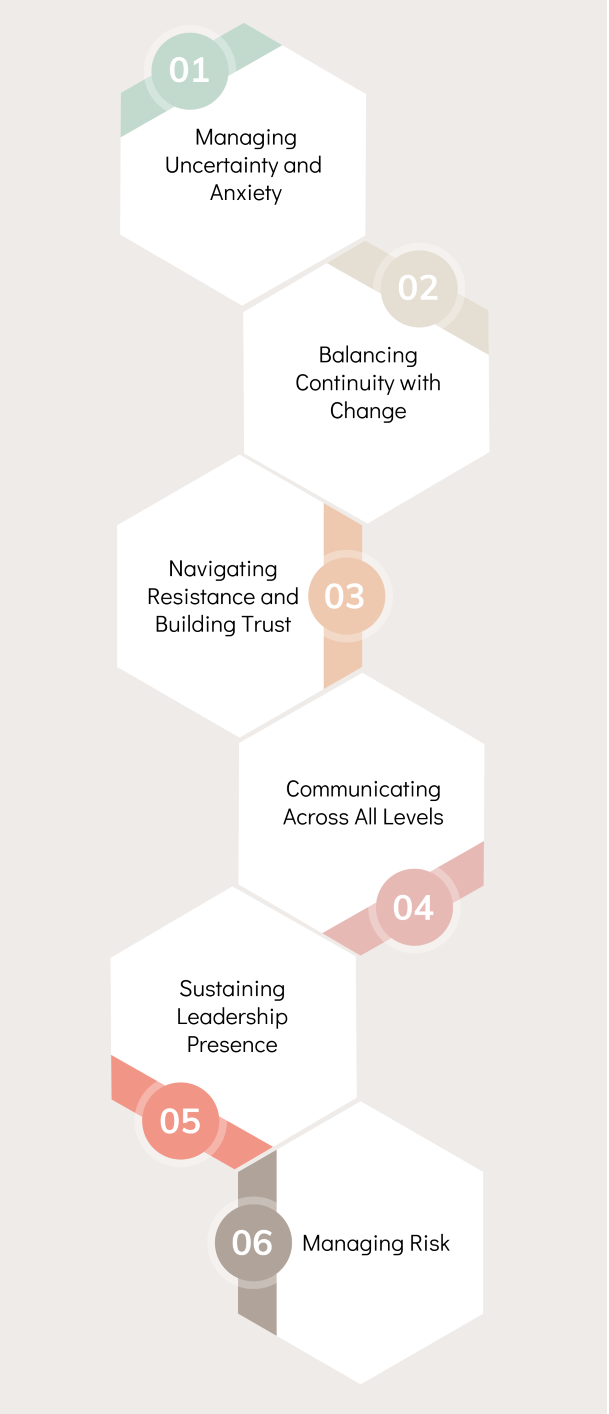
Restructurings are inherently disruptive. Leading through them requires navigating a landscape of emotional, operational, and strategic complexities. In my experience, several key leadership challenges emerge:
Credit: Sae Ra Germaine
Managing uncertainty and anxiety When I worked on the restructuring at Cockburn, staff understandably sought clarity and reassurance. As a leader, I had to balance transparency with the reality that not all answers were immediately available. I started by sharing initial ideas using sketches on whiteboards rather than formal organizational charts, impressing on the staff that these were ideas in development. I also held regular team briefings, even when updates were minimal, and openly acknowledged uncertainty. For staff navigating personal impacts, I provided one-on-one support.
Balancing continuity with change Even as this transformation was underway, we still needed to seamlessly deliver core services. To achieve this, I reviewed community feedback and industry trends to identify and prioritize essential services, delegating operational responsibilities to trusted team leads so I could focus on strategy.
Navigating resistance and building trust Resistance is a natural part of change, often rooted in loss or fear. To navigate this, I took a step-by-step approach, first providing a rationale for changes, then identifying issues to resolve, proposing changes, outlining benefits and obstacles or objections, and considering options and alternatives. I made a point of seeking feedback early, consulting with affected individuals first. I documented their concerns and responded, when possible, in person. I also created forums for open dialogue, allowing staff to voice concerns, and used the feedback I received to refine implementation plans. Finally, I demonstrated follow-through on commitments to build credibility—for example, after informal discussions with staff about the possibility of reorganizing our local history function, I agreed, in response to their concerns, to preserve the existing structure.
Communicating across all levels Effective communication requires listening as much as directing. When I moved into the service manager role at Cockburn, I immediately began to communicate with all staff in the service unit via multiple channels—emails, meetings, staff briefings, and informal conversations. I took care to ensure that my messaging was consistent, empathetic, and aligned with organizational values.
Sustaining leadership presence In times of change, visibility matters. During the restructuring at Cockburn, I made time for informal check-ins and walk-arounds, in addition to attending team meetings to listen and learn. I also shared personal reflections—for example, acknowledging my lack of familiarity with the district, where I had not lived for many years—to model vulnerability and authenticity and to foster connection.
Experimentation and taking smart risks In order to develop and test the steps required to move forward, an adaptive leader encourages creativity and innovation that aligns with the organization’s goals and objectives. At Cockburn Libraries, engaging in experimentation required a willingness to challenge the City’s accepted approach. For example, we argued that the library engagement and library technology functions should be organized outside the branch structure the City had decided on, a risk that allowed us to provide those functions additional strategic support.
Reflections on Outcomes
The restructuring at Cockburn has led to meaningful shifts in how services are delivered and how teams collaborate. While not all of the planned changes have been fully implemented, early outcomes suggest increased flexibility, stronger cross-team relationships, and a clearer alignment of our work with community needs. Staff feedback has been cautiously favorable, with some team members reflecting positively on the increased opportunity for cross-team collaborations and reporting improved morale. Others have expressed appreciation for being consulted and included in communications. This feedback affirms the importance of adaptive leadership and the value of aligning structural change with cultural renewal.
Key Takeaways for Leaders Navigating Restructuring
Lead with purpose: Anchor all communications and decisions in the strategic vision.
Apply adaptive leadership: Accept that not all answers will be known upfront. Create space for learning, experimentation, and shared problem-solving.
Use holistic frameworks: Develop and explain a framework for the restructuring that incorporates your strategic goals, specific obstacles to success, and the larger context in which you’re operating.
Prioritize communication: Be visible, accessible, and authentic. Use multiple channels and tailor messages to different audiences.
Invest in people: Build capacity for change by providing opportunities for staff to ask questions and provide input, offering professional development and coaching, making time for conversations about the impacts of change, and supporting emotional transition. Recognize that emotional resilience is as important as technical skill.
Honor the past while building the future: Celebrate legacy achievements and frame the restructure as an evolution.
Conclusion
Organizational restructuring is more than a technical exercise—it is a deeply human process that tests the resilience, adaptability, and vision of leaders and teams alike. My experience leading Cockburn Libraries through a significant restructuring reinforced the importance of purposeful leadership, empathetic communication, and strategic alignment. Adaptive leadership required me to be both a leader and a supporter, outlining a preferred way of working while empowering staff to shape the pathway.
By applying an adaptive leadership approach, I was able to navigate complexity, support staff through transition, and lay the foundation for a more integrated and responsive service model. The journey was not without its challenges, but it offered valuable lessons in leading with authenticity, listening deeply, and embracing change as an opportunity for renewal. For leaders facing similar transitions, the message is clear: lead with clarity, stay connected to your people, and trust in the process of transformation. Change may be inevitable—but with thoughtful leadership, it can also be empowering.
References
Heifetz, R. A., Linsky, M., & Grashow, A. (2009). The practice of adaptive leadership: Tools and tactics for changing your organization and the world. Harvard Business Press.
10.1146/katina-20260108-1
Janette is an experienced senior executive, values-driven, able to inspire and lead change in the rapidly changing environment of local and community services.
Since the 1990s, she has led and managed multidisciplinary teams to achieve innovation in service delivery across community and academic sectors, including public, state and university libraries, electronic publishing, university consortia, library system vendors, and commercial services companies. With a strong record of relationship building with local governments across state and regional settings, she maintains her enthusiasm for the role of local agencies in the provision of services and the contribution made to the quality of life for individuals and families in local communities.
Thank you for your interest in republishing! Anyone is free to use and reuse the article text and illustrations created by Katina for non-commercial purposes under a CC BY-NC license. Please see our full guidelines for more information. Photographs and illustrations are not included in this license. This HTML is pre-formatted to credit both the author and Katina.
This is a required field
Please enter a valid email address
Approval was a Success
Invalid data
An Error Occurred
Approval was partially successful, following selected items could not be processed due to error




.jpg)