



How Australia Built a Standards-Based National Lending Network
Vendors and open-source products are not substitutes for national infrastructure. But they can be vehicles for realizing it.

Vendors and open-source products are not substitutes for national infrastructure. But they can be vehicles for realizing it.

Interlibrary lending and document delivery have never been neutral technical layers. They are shaped—sometimes constrained—by the platforms libraries choose to implement. Request management software often determines who a library can borrow from and how easily it can do so. In theory, standards-based lending should allow institutions to select any compliant system and connect to the networks they wish to join. In reality, software architecture frequently defines network boundaries.
Over the last 25 years, two broad models have emerged:
These architectural choices have produced distinct global lending structures.
In North America, under the unified model, regional consortia emphasized geographic density, rapid courier delivery, and operational efficiency over cross-platform interoperability. OhioLINK, Prospector (Colorado), Partnership for Academic Library Collaboration and Innovation’s (PALCI) EZBorrow, and Novanet, Council of Atlantic Academic Libraries (CAAL) illustrate this model: tightly coordinated, often vendor-aligned networks optimized for speed and reciprocal borrowing.
By contrast, under the vendor-bridge model, much of continental Europe developed national or federal “backbone” systems grounded in union catalogs and International Organization for Standardization- (ISO-) based messaging. Germany’s Gemeinsamer Bibliotheksverbund Catalogue (GBV), Denmark’s Danskernes Digitale Bibliotek (DDB), and Norway’s Biblioteksentralen reflect coordinated national frameworks designed for interoperability across institutions. In the United Kingdom and Russia, national libraries—the British Library and LIBNET-linked institutions—developed as central document suppliers or lenders of last resort when regional networks could not fill requests.
Governance plays a central role in determining lending structures. North American networks historically separated academic and public libraries, with Canada as a partial exception. European models more often integrated sectors within unified national frameworks.
When a national library convenes and coordinates across sectors, interoperability tends to follow. When it does not, states and regions must rely on vendor platforms to extend beyond local boundaries. That approach is efficient in the short term but does not provide the same level of shared infrastructure as a nationally coordinated system. But while vendors and open-source products are not substitutes for national infrastructure, they can be vehicles for realizing it.
Against this backdrop, the National Library of Australia (NLA) explored a third path: a national network of networks, which includes libraries of all types—academic, public, special, and corporate.
Located in Canberra, the NLA holds more than ten million items and operates Trove, a national discovery and services platform that provides access to approximately 14 billion digital objects, including Australia’s web archive. Trove also functions as a central coordination point for hundreds of partner institutions across the galleries, libraries, archives, and museums (GLAM) sector, providing infrastructure for cataloguing, digitization, the Australian National Bibliographic Database (ANBD), and resource sharing. Since the formation of the ANBD in the 1980s, national resource-sharing in Australia has evolved alongside the development of shared bibliographic infrastructure and identifiers. Early implementations relied on centralized systems, followed by increased system diversity supported by interoperability standards such as Z39.50 and later ISO ILL protocols.
More than two decades after the ANBD was established, Trove and the National Library undertook a comprehensive review of the national resource-sharing landscape in response to the announced end-of-life of VDX—OCLC’s interlibrary loan (ILL) and document request management software. Despite declining overall transaction volumes—accelerated during the COVID-19 pandemic—the review concluded that national-scale resource sharing remained essential, particularly in the context of shrinking local collections and constrained acquisitions budgets.
Although Australia represents a relatively small market within the global library technology ecosystem, its shared infrastructure and cooperative service models, tailored to its unique context, are designed to mitigate geographic challenges and uneven access to local collections. Australian consortia aim to develop larger networks that could scale to countries such as Canada, the United States, or Europe.
Galvanized by the review, the National Library sought to answer the following questions:
Staff from Cooperative Action by Victorian Academic Libraries (CAVAL), a nonprofit library cooperative, partnered with Index Data, a US-based library open-source software development and service provider, to propose Project ReShare as a new national resource sharing infrastructure. (The authors provided subject matter expertise during the implementation of the project.)
The proposed solution was intentionally simple. Local lending networks (Clarivate/Ex Libris’ Rapido for most Australian academic libraries and Project ReShare for Trove member institutions) would fulfill most requests using their own holdings, policies, and workflows. When a library could not supply a requested item within its local network, the request management system would automatically transfer the request to another supplying network using ISO 18626, without requiring staff to re-key or manually resubmit it. The supplying network would communicate the request’s changing statuses back to the requesting library until the request was closed (either by returning the requested book to the supplying library or by notifying the requesting library that no copy was available).
Historically, such transfers required a transferRequest message, forcing the requesting library to close the transaction in their local system, re-submit it to a new system, and then process it in the non-originating system. While some platforms support cross-network movement via add-ons or integrations (such as Atlas’s ILLiad), these approaches required subscriptions to multiple networks and simply moved the request from one network to another. Librarians described this approach as “throwing a request over a wall”: the request was exported from the originating system to a third party, making it someone else’s problem.
The goal was to ensure that, for example, members of CAVAL, primarily academic libraries, didn't have to run Trove software, and that Trove didn't require CAVAL software. The requests would simply move between the two networks seamlessly using the ISO18626 standard.
This type of collaboration between networks would require not just technical innovation, but social coordination. “Social interoperability” refers to the human and organizational relationships that allow technical standards to function effectively in practice. In interlibrary lending, shared expectations, trust between partners (or networks), and a willingness to coordinate across consortia and software limitations determine whether standards-based communication, including messaging protocols such as ISO 18626, can succeed at scale.
Thanks to the National Library’s support of collaboration between potential competitors in the open-source and commercial markets, the project resulted in the creation of a distributed “network of networks” in which peers within one vendor network are “addressable” to nodes in another network, allowing nodes to exchange requests using standards such as ISO18626. But this new model presented a different problem: each network needed to know about the partners in the other network.
In the unified model, the vendor controls the directory. In the vendor-bridge model, requests can be sent at the network’s edges—APIs between installations of software. Some vendor networks can also allow groups to send requests between consortia networks because all of the nodes are running the same software.
The Trove standards-based model, patterned on the internet itself, includes externalized registries or directories that conform their messages to standards, such as ISO15511 or DNS-based SRV records, to expose public service information for lending. Resource-sharing partners, grouped by national libraries, regional consortia, or vendors, can flexibly send requests for physical and print materials to one another, or to affiliated networks, effectively enabling a large vendor network, such as Rapido, to send requests to a ReShare network. In this decentralized model, trust and security—provided through the exchange of signatures and security assertions—are the network's most significant challenges.
The table below describes the strengths and weaknesses of each resource-sharing architecture:
Unified Model | Vendor-Bridge Model | Standards-Based Model | |
Structure |
|
|
|
How fill rates improve |
|
|
|
Advantages |
|
|
|
Risks |
|
|
|
Stressing ISO 18626 compliance as a baseline builds confidence in the system’s reliability and reassures stakeholders of its strategic importance. Theoretically, adopting this standard should enable resource-sharing between interlibrary lending systems. But the implementation of the standard is just as important as the structure of the messages themselves. For example, can a library claim a book as damaged if the request is completed? Currently, the messages exist, but if both systems do not agree that completed requests can be re-opened, this “work” will have to occur outside of the standard (usually via email for ILL practitioners). Service fee payments also fall completely outside of the protocol’s scope.
The use of ISO 18626 between different interlibrary lending systems poses both technical and social challenges, including facilitating vendor cooperation, troubleshooting transactions across each step of a loan or digital transaction, and exposing implementation assumptions between the two platforms. It’s easy when all of the nodes in a given network speak the same dialect, and quite a different challenge when two agree on the language structure but have different implementations/conventions for the same ILL event. Like the difference between “pop,” “soda,” and, as they say in Australia, “soft drink,” we all use different conventions to refer to the same class of objects or operations. For example, in some systems, volumes are delimited by a comma, in others a “|,” or pipe. These disfluencies might not be enough to break the protocol, but they are enough to cause problems or require manual intervention.
Establishing a standards-based model in Australia was expensive on many sides, from development and practitioner testing time to coordinating multiple technical support teams across five different organizations (CAVAL, Trove, Index Data, Project ReShare, and Ex Libris). It was clear that a translator was needed to connect ReShare to Alma/Rapido. This translation requirement led to the project called “CrossLink.”
Started through a grant project sponsored by the Institute of Museums and Library Services and the State University of New York, Geneseo, CrossLink is an open-source system that acts as a translation layer between different implementations of ISO 18626. The software enables any ISO 18626-based resource-sharing systems, regardless of whether they use the same platform, to speak to one another in a point-to-point fashion, as a network, or as a node in another network speaking a different dialect of ISO 18626 (i.e., a proxy).
From a library technology perspective, we typically think of proxy servers as services that enable access to electronic resources from off-campus (e.g., EZProxy or OpenAthens). In this experiment, instead of internet traffic (http/https) from content providers, the proxy service exchanges ISO ILL messages between networks or libraries. The requesting library looks to another system “as if” they are a member of the supplying lending group.
So, for example, from Alma’s perspective, CrossLink presents the Trove network as a single ISO 18626 partner, even though it represents more than 400 individual institutions behind the scenes. From the standpoint of ReShare, CrossLink is a message broker that manages transactions within and outside of its local network.
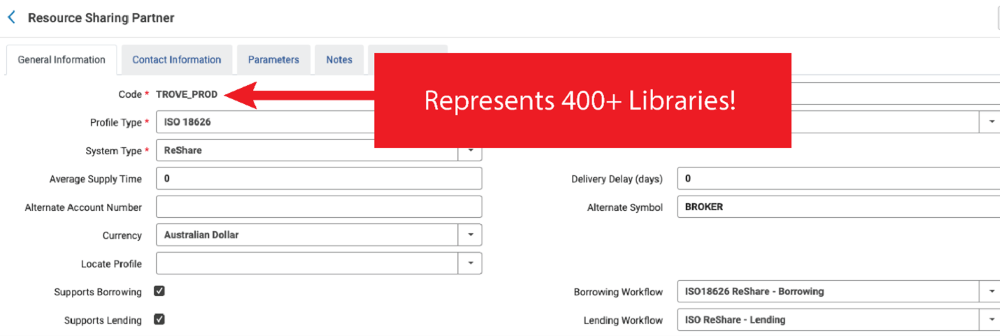
The Trove Partners Resource Sharing system went live on May 12, 2025, with ReShare as its backbone. Seven months after launch, the system has transitioned to business-as-usual operations, with approximately 38,000 requests processed to date. Roughly 25 percent of these transactions (both returnables and non-returnables) involve ISO-compliant external partners.
The current workflow for CAVAL/Trove is shown in Figure 2.
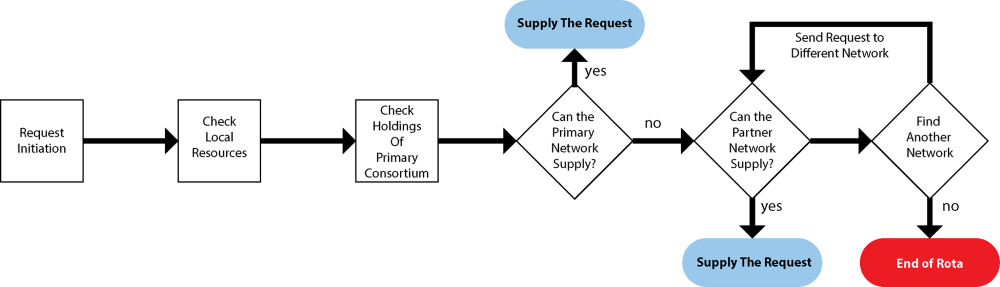
There’s still work to do. Proposed areas of development to further the interoperability between the Ex Libris products and Project Reshare/CrossLink are summarized here; project participants hope these changes will be implemented in future releases of the products.
As operating and collection funds become scarcer, libraries will rely on each other’s holdings to meet their patrons’ needs. In a profession where equitable access is a core value, a requester should be able to access an item via their national library’s bibliographic database within their own system, rather than having to pay for ever more subscriptions to fill patrons’ rare requests. In places like the US where a national library does not exist, consortia will be left to negotiate reciprocal lending relationships on their own—and any messaging/directory system should accommodate both centralized and decentralized lending network models.
As we see it, a network of lending networks requires four components to be fully functional and open:
Outsourcing core lending infrastructure—directory services, discovery, request management, and systems integration—may appear expedient in the short term. But overly restrictive technology and business practices can stifle collective action, and adopting this approach wholesale ultimately weakens the economic and strategic power of a country’s libraries and cultural institutions.
The Trove/CAVAL project, however, shows what organizations and vendors can accomplish together when they align on the goal of standards-based interoperability within a national library framework. We hope other vendors and open-source communities will take on this industry-shaping work.
The authors would like to thank the following people and companies for their continued support and contributions to the Trove/CAVAL project:
Australian Alma/Rapido Community: Jessie Donaghey, Paul Wei. CAVAL: Shaun Brady. Clarivate/Ex Libris: Asaf Kline, Katie Birch, Mike Richens, Oren Farkas, Moshe Schecter, Meghan Wheldon. IDS Network: Mark Sullivan. Index Data: Sebastian Hammer, Jakub Skoczen, Mallory Kasinec, Jason Skomorowski, Kurt Nordstrum, Lynn Bailey. Project ReShare: Jill Morris, Charlie Barlow, Clara Fehrenbach. Trove: Belinda Diehm, Giang Pham, Deanna Cronk. Australian Alma/Rapido Community: Jessie Donaghey, Paul Wei.
We would also like to thank Katie McCaskil from NovaNet (Nova Scotia and Mount Allison Libraries) and Cynthia Holt from CAAL (Council of Atlantic Academic Libraries) in Canada for their October 2025 Conference, The Future of Resource Sharing, which acted as a catalyst for the authors to bring these ideas together into this article.
10.1146/katina-040826-1
Copyright © 2025 by the author(s).
This work is licensed under a Creative Commons Attribution Noncommerical 4.0 International License, which permits use, distribution, and reproduction in any medium for noncommercial purposes, provided the original author and source are credited. See credit lines of images or other third-party material in this article for license information.